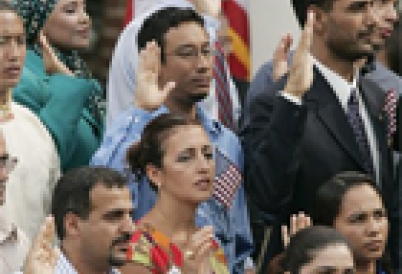
In the absence of federal immigration reform and as immigrants settle in new destinations, U.S. states consider related legislation to an increasing degree. An economic slowdown and anti-immigrant laws affect Latino immigrants, who send fewer remittances home.
The North American Competitiveness Council provided a report on April 22 at the North American Leaders Summit in New Orleans. The report argues that government and business leaders must work harder to broaden public understanding of the benefits that flow from liberalized trade and investment within North America.
While at a New Orleans summit, leaders of Mexico, Canada, and the United States responded to recent criticism of NAFTA by lauding the trade deal. They also touched on immigration and border security.
In an op-ed for the Washington Times, Shankar Singham—a partner with global law firm and COA member Squire Sanders & Dempsey, L.L.P. —warns against anti-free trade rhetoric utilized in current U.S. presidential campaigns. "Those political candidates who have hidden behind trade as the primary reason for economic anxiety are hiding voters from the truth of the new global economy," writes Singham.
In a Christian Science Monitor op-ed, AS/COA's Susan Segal and the Center for Global Development's Nancy Birdsall discuss how the pending U.S.-Colombia Free Trade Agreement could lower incidents of human rights abuses in Colombia.
In an op-ed for El Diario, Christopher Sabatini argues that congressional delay of a vote on the U.S.-Colombia Trade Promotion Agreement could have negative political and economic effects on the entire hemisphere and also threatens security and free trade in Colombia. (en español)
The U.S. House of Representatives stalled the bilateral free-trade deal with Colombia, approving a rule change that waives a requirement to consider the agreement within 90 days. The future of the pact remains uncertain.