With Peru hosting the annual APEC summit in 2008, growing economic ties between Asia and Latin America get another boost. An AS/COA Asia-Latin America update takes a closer look at prospects for the 2008 APEC Leaders Summit, links between Mexico and South Korea, and the Free Trade Area of the Pacific.
January 1 marked an end to all tariffs on agricultural goods—including corn and sugar—traded between the U.S. and Mexico. But NAFTA could hit roadblocks in 2008: Mexican truckers face barriers to accessing U.S. roads and presidential campaigns have taken protectionist tones.
U.S. and Peruvian heads of state met Friday to sign a a bilateral trade deal. But U.S. Congress remains reluctant to move forward on free-trade pacts with Colombia and Panama. At a recent COA event, Colombian Minister Luis Guillermo Plata emphasized that a trade agreement would support stability and prosperity in his country.
Speaking at the James A. Baker Institute for Public Policy, COA Vice President Eric Farnsworth argued that trade and investment expansion serve as "the most effective means we have to support growing democracy in Latin America."
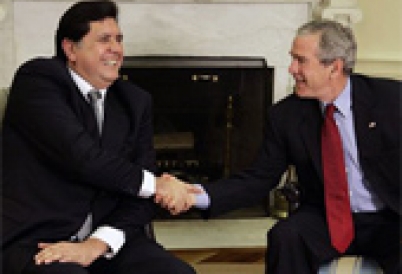
U.S. President George Bush hosted Peruvian President Alan García for the signing of the U.S.-Peru Trade Promotion Agreement on December 14 after the deal won overwhelming approval in the Senate. Bush has called on Congress to now take action on the Panama and Colombia agreements.
On November 30, AS/COA welcomed former Presidents José Sarney and Alejandro Toledo at the annual Latin America Conference. Panels focused on promoting social and economic development in the Americas as well as Venezuela's vote on constitutional reform.
Secretary of Commerce Carlos M. Gutierrez, speaking at the James A. Baker Institute for Public Policy, discussed the importance of trade to the U.S. economy. He also spoke about free trade in the Americas, saying rejection of a free-trade agreement with Colombia "would be not just a step backwards, but one of the biggest foreign policy mistakes of our time in our region."