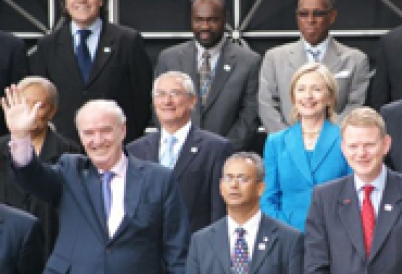
Leaders from the European Union and Latin America gathered in Lima for a biennial summit, focusing on trade, inequality, and climate change as rising food prices threaten to exacerbate poverty.
In an AS/COA Online interview, OAS Secretary General José Miguel Insulza describes the role of the agency in negotiating recent border tensions between Ecuador and Colombia, autonomy and recall votes in Bolivia, and U.S.-Cuba relations. "[T]he OAS has to prove itself as the main forum for political dialogue in the Americas," said Insulza.
Speaking at the 38th Washington Conference on the Americas, IMF Managing Director Dominique Strauss-Kahn called for increased private and public investment and greater productivity as key factors for sustaining recent economic growth. A rebalancing of China’s exchange rate and policies to reduce the growth in food prices will be some of the next challenges facing the region and the world.
As the Western Hemisphere experiences the consequences of rising food prices, experts and leaders seek to identify the crisis' source as well as solutions. A debate over biofuels has emerged with the food price hikes.
The reelection of Prime Minister Jose Luis Rodriguez Zapatero offers both Spain and the United States the chance to mend ties and broaden cooperation in Latin America. Eric Farnsworth and Christian Gomez outline ways the two countries can support Latin America's standing in the global economy and democracy in the region.
Presidents of Colombia, Ecuador, and Venezuela ended their standoff and the FARC appears increasingly weakened. But the contents of an assassinated FARC leader's laptop suggest the group's reach extends well past Colombia's borders.
Spain voted Sunday as immigration and the economy took center stage. With a large South American immigrant population in Spain and Spanish conglomerates' holdings in the Americas, the election results hold implications for Latin America.