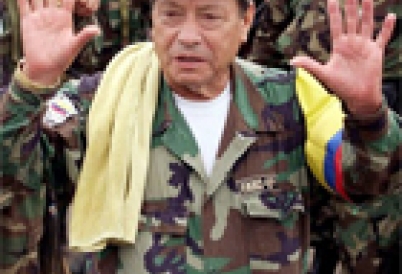
After more than four decades of civil strife in Colombia, the death of the FARC’s founder and commander Manuel Marulanda's serves as the latest setback for an already weakened rebel group.
Colombia
Leaders from the European Union and Latin America gathered in Lima for a biennial summit, focusing on trade, inequality, and climate change as rising food prices threaten to exacerbate poverty.
In an AS/COA Online interview, OAS Secretary General José Miguel Insulza describes the role of the agency in negotiating recent border tensions between Ecuador and Colombia, autonomy and recall votes in Bolivia, and U.S.-Cuba relations. "[T]he OAS has to prove itself as the main forum for political dialogue in the Americas," said Insulza.
“Trade agreements are not gifts of the United States [to another country] but gifts that we give ourselves,” said U.S. Trade Representative Susan Schwab. In a period of economic uncertainty, trade is an important driver of re-energizing economic growth, she emphasized at the 2008 Washington Conference on the Americas.
Latin America is “at a crossroads” marked by the struggle between competing futures, according to Colombian Minister of Defense Juan Manuel Santos. This clash will shape internal and external geo-politics for years to come, forcing the United States to pay close attention to engagement with its friends.
In an op-ed for the Washington Times, Shankar Singham—a partner with global law firm and COA member Squire Sanders & Dempsey, L.L.P. —warns against anti-free trade rhetoric utilized in current U.S. presidential campaigns. "Those political candidates who have hidden behind trade as the primary reason for economic anxiety are hiding voters from the truth of the new global economy," writes Singham.
In a Christian Science Monitor op-ed, AS/COA's Susan Segal and the Center for Global Development's Nancy Birdsall discuss how the pending U.S.-Colombia Free Trade Agreement could lower incidents of human rights abuses in Colombia.