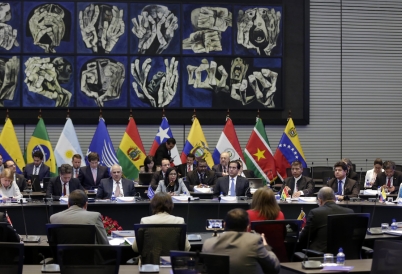
Argentina’s Mar del Plata played host to the twentieth Ibero-American summit, where leaders signed a declaration defending democracy and creating a path to boost access to education.
As world leaders gathered in Cancun for the UN Conference on Climate Change on November 29, Mexico and Brazil, Latin America's major carbon emitters, lead regional efforts to cut greenhouse gasses. Observers, however, question the likelihood of the summit producing any major international agreements.
The dispute over Argentina's decision to grant political amnesty to a Chilean ex-guerilla fighter "will have no lasting impact, though it does reveal growing differences within the region that will continue to spark friction," writes AS/COA's Christopher Sabatini for World Politics Review.
A dispute over a piece of land in the San Juan River delta has ramped up tensions between Costa Rica and Nicaragua. AS/COA Online takes a look at the roots of the Central American row.
Against the backdrop of sustained regional growth, Chile, Colombia, and Peru moved one step closer to an integration of stock markets that could add a new dimension to their strong economic performance.
Caracas and Bogota are taking steps to bury the hatchet in what could lead to economic benefits for both sides.
While Venezuela and Colombia have taken an important step in reestablishing diplomatic ties, a sustained commitment by both countries will be necessary to achieve a new era of bilateral cooperation, writes AS/COA's Jason Marczak in El Diario/La Prensa. (en español)