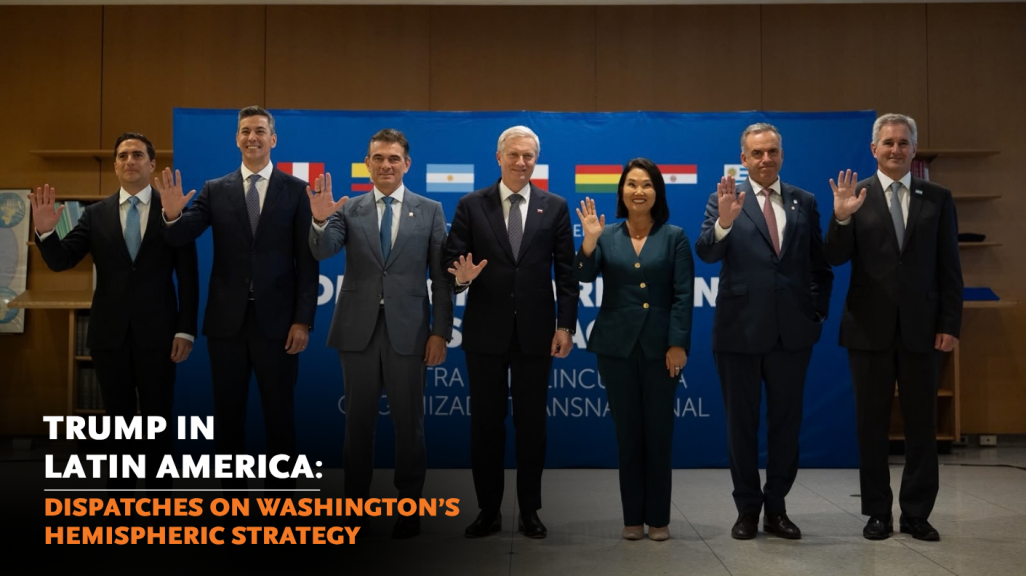
The leaders of the member countries of the Santiago Commitment. (President Kast's X)

The leaders of the member countries of the Santiago Commitment. (President Kast's X)

Trump in Latin America: The U.S. Factor in Brazil’s Vote and a Shield Debate in Chile

By Chase Harrison and Khalea Robertson

Sep 24–Sep 30: Plus, Andean officials get hit with visa bans, Mexican officials get hit with sanctions, and a Southcom general speaks strategy.

Welcome back to our weekly dispatch of stories on the U.S. role in Latin America. Follow us each week and see previous roundups at as-coa.org/dispatches, or sign up to receive them via LinkedIn.

Here’s what to know this week: 

  • Brazil readies for Sunday elections as Lula takes action against U.S. “interference.”
  • U.S. Treasury sanctions Mexicans—government officials included—linked to cartel as Sheinbaum marks two years as president.
  • Shield of the Americas membership sparks debate in Chile.
  • State announced visa restrictions on officials from Bolivia, Colombia, Peru, and Ecuador.
  • Plus: U.S. ban on Canadian goods goes into effect, Southcom general speaks on strategy, and the region braces for a potential diesel crunch.
Sovereignty at issue as Brazil readies for elections

Brazilians go to the polls on Sunday, October 4, for an election in which the issue of sovereignty has featured as a topic amid questions about the Trump administration’s influence. While President Donald Trump did not endorse a candidate, he’s made moves that stir the political pot, such as a July 2025 decision to implement tariffs on Brazil as punishment for the prosecution of ex-President Jair Bolsonaro and, in May, naming several Brazilian crime groups as Foreign Terrorist Organizations. The latter move came shortly after a meeting in the White House with Senator Flávio Bolsonaro, the race’s leading right-wing candidate. At the time, Flávio took credit for the designations.

His opponent in the race, President Luiz Inácio Lula da Silva, has made defense of Brazil’s sovereignty and key point in his campaign. The day after declaring “Brazil is no one’s backyard” in his address to the UN, he filed a court case in Brazil’s top electoral court on September 23 alleging that Flávio pressed the Trump administration for action that would help his campaign. On September 25, Lula’s campaign began airing an advertisement with a voiceover saying: “Flávio Bolsonaro is Trump’s candidate and what Trump wants is to colonize Brazil, take our riches, steal our future and leave us in the dust.” Reuters reports that in a September meeting, Brazilian intelligence officers briefed French and German officials about alleged U.S. and Russian interference in Brazil’s elections. 

A trio of Democratic U.S. senators sent a letter to Secretary of State Marco Rubio on Tuesday warning against U.S. interference and demanding the Trump administration be ready to accept the election’s outcome. 

Brazil has been one of a small number of South American countries not to join Trump’s Shield of the Americas initiative, which launched in March. But Folha de S. Paulo reports that Lula’s administration is considering joining another security initiative called the Santiago Commitment, which Chilean President José Antonio Kast founded in May and includes Argentina, Bolivia, Chile, Ecuador, Peru, Paraguay, and Uruguay. With the goal of combating drug trafficking, presidents and ministers of the group met on the sidelines of last week’s UN General Assembly. They next meet in November in Argentina.

Chile’s divide over Shield membership

Meanwhile, Kast’s decision to sign Chile on to the Shield of the Americas last week has sparked controversy back home. Despite his administration’s repeated affirmation that joining the 15-member regional security-focused coalition does not carry binding legal obligations, pressure has mounted on his government to detail exactly what membership does and could entail. Former Presidents Michelle Bachelet (2006–2010, 2014–2018) and Gabriel Boric (2022–2026) weighed in on September 24 with a joint declaration that expressed concerns about “subordinating foreign relations, security, or defense policy to priorities defined by a foreign power” and called on the government to “reconsider” its involvement. 

U.S. visa restrictions cross the Andes

On September 28, the State Department issued visa bans on more than two dozen officials, most of whom are judges and prosecutors, from Bolivia, Colombia, Ecuador, and Peru. The Department accused those named of “undermin[ing] a democratically elected government through corruption or narcotrafficking activities in our region.” A press release described the visa restrictions, which also include the families of those affected, as part of the Shield of the Americas initiative. All four countries are members.

Twenty Bolivians were among those who either lost their U.S. visa or are now ineligible to receive one. State’s press release singled out Attorney General Roger Mariaca, accusing him of “accepting bribes to facilitate narcotrafficking and helped violent criminals evade justice.” Shortly after the U.S. announcement, the administration of President Rodrigo Paz said it would ask Washington for more information so it could conduct its own investigation. For his part, Mariaca pointed to his office’s investigation into right-wing Argentine political consultant Fernando Cerimedo as a possible reason for his U.S. travel ban. Cerimedo, a former Paz advisor The Economist once dubbed “MAGA’s Man” in Latin America,  is now imprisoned in Bolivia on suspicion of hiring hitmen to murder his pregnant girlfriend. 

As for the other countries involved, the two Colombian nationals named are a senator and a financier connected to leftist ex-President Gustavo Petro’s Historic Pact coalition. In Peru, the visa revocation hit the judge who ruled in January that the country’s port authority had limited supervision powers over the Chinese-financed Chancay megaport, a decision Washington strongly criticized at the time. The State Department did not name the two Ecuadorians who received visa restrictions. 

In other news

Southcom’s all-terrain antidrug approach. “Do I see land strikes as options? Yes. We want all options at the table,” said Southcom Commander General Francis Donovan in a new interview published by The Wall Street Journal. Donovan, who oversees the U.S. military in Central and South America, as well as the Caribbean, detailed the expanded use of high-tech equipment and boots-on-the-ground support for antinarcotic operations in the region.

A brake on Canadian cars, and more. A White House ban on almost $1 billion worth of Canadian goods went into effect on September 29. The ban, announced on September 8, covers motor vehicles, alcohol, and dairy products, goods that were largely already subject to 50-percent tariffs that kicked in last month (see August 26 dispatch). 

"No need” for military in Cuba. A day after a September 25 CBS News report that the U.S. military is sketching plans for a buildup of troops near Cuba in the coming months,Trump downplayed the possibility of military action, telling reporters, “I would say that Cuba and us will make a deal. I don’t think we’ll need the military.” 

On September 29, Treasury tightened restrictions on banking operations involving Cuban nationals and cut back on travel permissions for U.S. citizens to visit Cuba for professional or educational activities.

Latin America braces for diesel crunch. With diesel prices in the United States crossing $6.50 per gallon last week, Trump told reporters on Sunday that he was “seriously considering” a temporary export ban of the fuel. The United States is the source of nearly a quarter of the diesel used by Latin America and the Caribbean, per figures from the Latin American and Caribbean Energy Organization. Top regional markets include Mexico, which relies on U.S. diesel for around 40 percent of its domestic supply, as well as Chile and Peru, where U.S. diesel covers upwards of 60 percent of domestic consumption, driven largely by the mining sector. 

Related

Explore