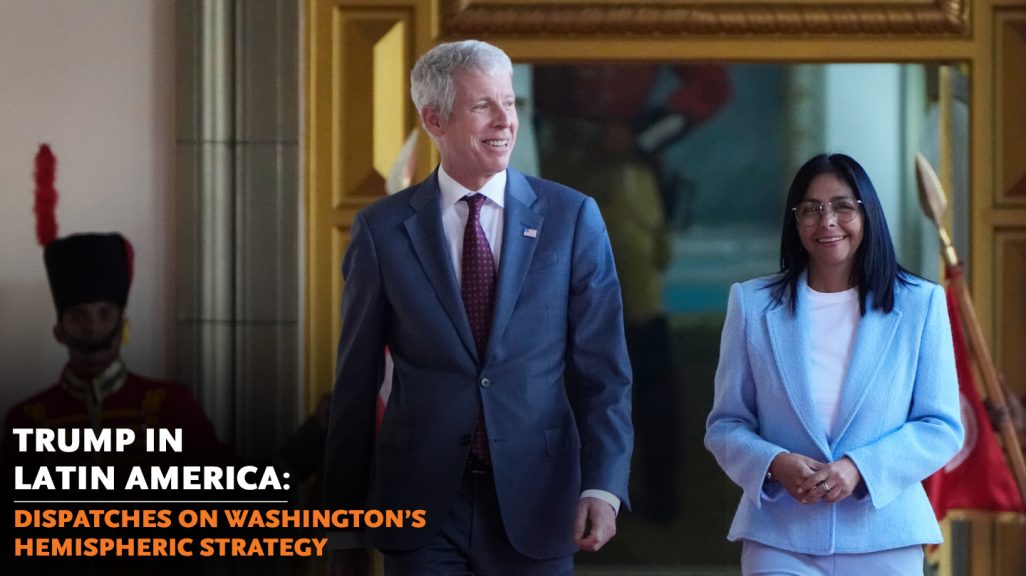
Wright and Delcy

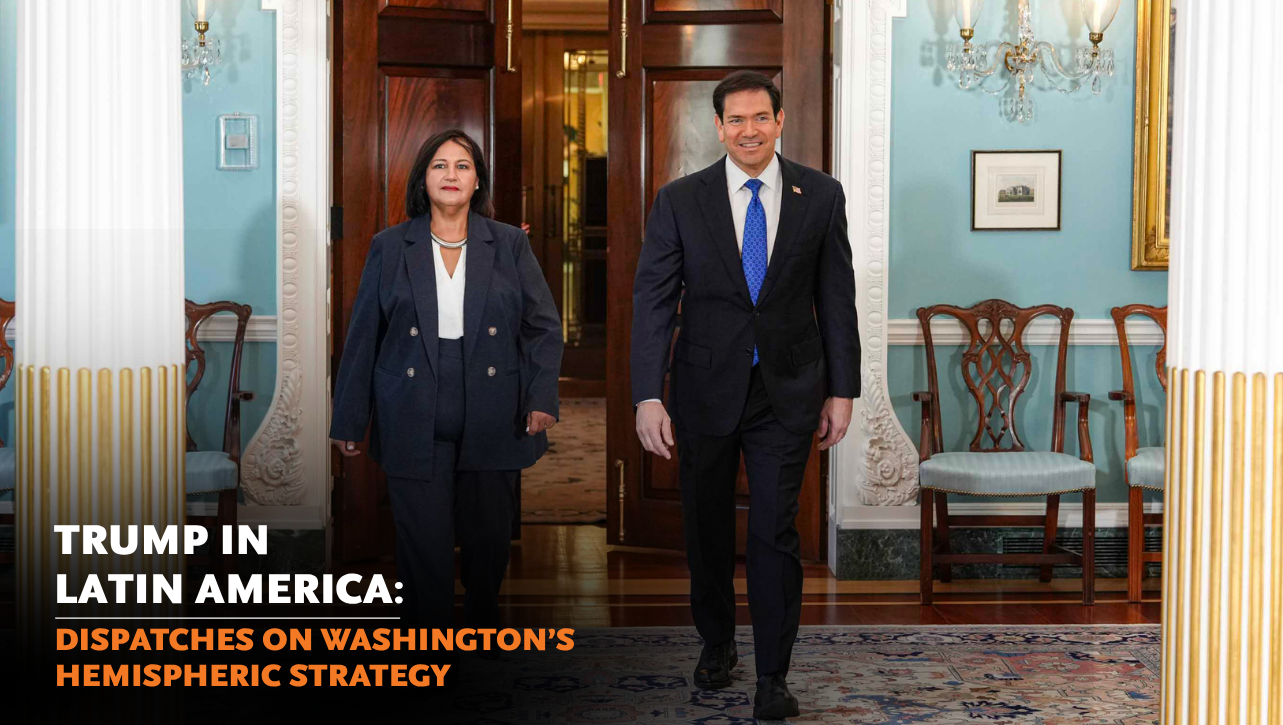
U.S. Energy Secretary Chris Wright and Interim President of Venezuela Delcy Rodríguez. (AP)

Trump in Latin America: Opening Venezuela, Closing Cuba, and Meeting Mexico

By Carin Zissis and Khalea Robertson

Feb 6-12: A Peruvian port comes under the scope and Honduras’ new president visits Mar-a-Lago.

Welcome back to our weekly dispatch of stories on the U.S. role in Latin America. Follow us each week and see previous roundup at as-coa.org/dispatches, or sign up to receive them via LinkedIn

Power play in Caracas

U.S. Energy Secretary Chris Wright arrived in the Venezuelan capital on February 11 with a complex mission: figuring out how to reinvigorate the country’s oil industry. “We’re massively changing the viability of commercial business on the ground in Venezuela, and American interest in it is just overwhelming,” Wright told reporters after meeting with Venezuela’s Interim President Delcy Rodríguez, who also serves as hydrocarbons minister. 

The energy secretary, the first member of Trump’s cabinet to visit Caracas since the U.S. ouster of Nicolás Maduro, is also expected to meet with officials from state oil firm PDVSA, as well as executives from foreign oil companies currently operating in Venezuela. In his three-day visit, he’ll tour major oil fields to scope out the energy infrastructure. 

The White House has begun laying the building blocks for reconstruction. Wright’s arrival in Venezuela came a day after the Treasury Department issued a batch of general licenses effectively loosening restrictions on U.S. involvement in the exploration and production of Venezuelan oil and gas. Just two weeks ago, Venezuela’s chavista-controlled legislature fast-tracked a reform that opened the country’s hydrocarbon sector to private and foreign capital. 

Everyone okay in Chancay?

The U.S. State Department sent a warning after a January 29 Peruvian court ruling that limited a state oversight agency’s control over the Chinese-owned Chancay megaport near Lima. “Let this be a cautionary tale for the region and the world: cheap Chinese money costs sovereignty,” read a February 11 social media post from the U.S. Bureau of Western Hemisphere Affairs. The head of the Peruvian oversight body has said the agency will appeal the ruling

Chancay, one of Latin America’s largest ports, has been viewed as a symbol of Chinese presence in the region. The ruling in Peru happened the same day that Panama’s Supreme Court deemed unconstitutional Chinese holdings in ports at both ends of the Panama Canal, a decision seen as favorable for Washington.

Aid in the time of Cuban blockades

Hours after Cuban President Miguel Díaz-Canel delivered a two-hour-long address on February 5 decrying U.S. actions to choke off the island’s oil supply, the State Department announced $6 million in “direct assistance for the Cuban people” with dry goods, hygiene kits, and other “basic necessities.”

Mexico sent two ships stocked with aid to the island as well. At her February 9 press conference, President Claudia Sheinbaum reiterated her government's search for a diplomatic workaround to deliver fuel to the island without attracting U.S. tariffs. “Mexico sends more than 80 percent of its exports to the United States. President Sheinbaum knows she has to work with the Trump government,” AS/COA Vice President Carin Zissis told Peru’s El Comercio, “But at the same time, Mexico—with a leftist government—has a long history of relations with Cuba.” 

On Sunday, Havana notified airlines that planes will not be able to refuel at nine of the country’s airports for at least a month. In addition to affecting the flow of goods, the cancelations will have an impact on the island’s ailing tourism sector.

Mexico in meeting mode

The three-hour February 11 shutdown of the El Paso airport, located 12 miles from the U.S.-Mexican border, appears to have been sparked by a Customs and Border Protection anti-drone laser rather than a Mexican cartel drone incursion. Still, the confusion came as security features heavily on the bilateral agenda and top Mexican security officials head to Washington. The country’s defense and navy secretaries traveled to the U.S. capital on Wednesday for a multilateral summit of military leadership from across the Western Hemisphere, while Mexican Security Chief Omar García Harfucha close Sheinbaum ally—heads there on February 12 for bilateral meetings

These meetings come on the heels of a visit from a bipartisan U.S. congressional delegation to Mexico over the weekend that was led by Chairman of the Mexico–U.S. Interparliamentary Group Michael McCaul (R-TX) and Ranking Member Henry Cuellar (D-TX). Among other activities, the delegation met with U.S. marines serving in Mexico.

USMCA rumblings. Hours after Bloomberg reported that Trump is questioning whether Washington should quit the North American trade deal signed during his first administration, the U.S. House of Representatives voted to rescind tariffs his administration placed on Canada. The resolution was largely symbolic, but six Republican members of Congress crossed party lines to support it. 

Argentina–U.S. deal draws praise, raises eyebrows

The trade deal Washington signed with Buenos Aires on February 5 will eliminate tariffs on more than 200 U.S. products while opening U.S. market access for the South American country by, among other things, quintupling the quota for Argentine beef. The Trump administration celebrated that such a step could help bring down beef prices in the United States, although U.S. ranchers are less thrilled, reports The New York Times. Reuters also reports that Brazil is reading the fine print to determine if the pact violates Mercosur trade rules

Asfura’s Florida foray

 Less than two weeks after his swearing-in, Honduran President Nasry Asfura flew to Mar-a-Lago for a February 7 chat with Trump, who endorsed Asfura during November’s tense presidential election. Honduras’ new Central Bank President Roberto Lagos has said his country plans to negotiate a trade deal akin to those Argentina, El Salvador, and Guatemala recently inked with Washington. 

Asfura may be back in Florida on March 7. Trump plans to rally regional right-wing allies to align strategies for keeping Beijing’s influence at bay. Other reported invitees: Argentina’s Javier Milei, Bolivia’s Rodrigo Paz, El Salvador’s Nayib Bukele, Ecuador’s Daniel Noboa, and Paraguay’s Santiago Peña

What’s next in Washington?

Trump’s Board of Peace will unite at its first summit on February 19, with Argentina’s Milei and Paraguay’s Peña on the guest list as founding members. El Salvador is also a member of the Board, which requires a $1 billion commitment from each member country, but Bukele’s participation in the summit had not yet been confirmed as of the time of this report. 

Related

Explore