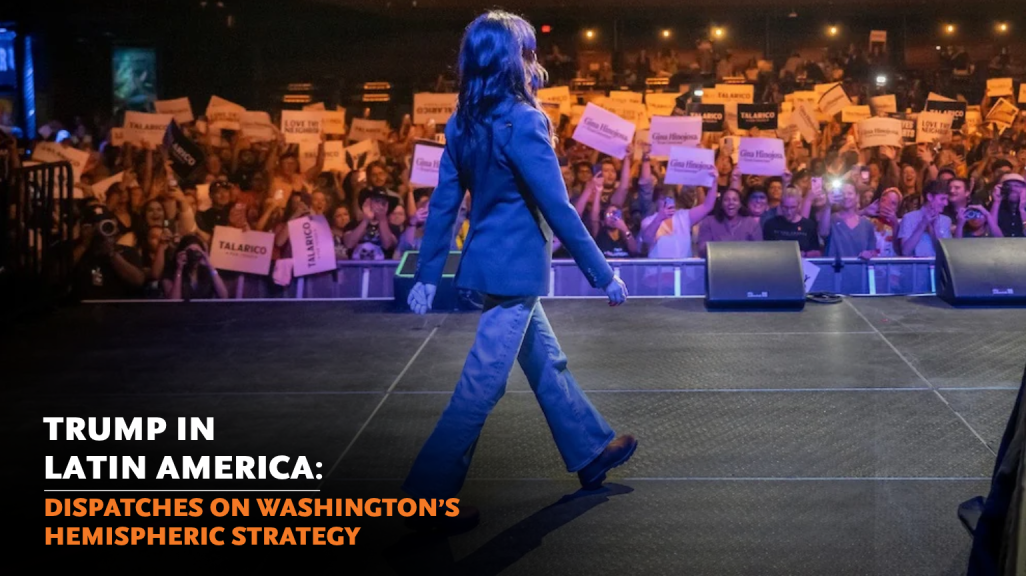
Gina Hinojosa, TX

Democratic Governor-elect of Texas Gina Hinojosa. (Hinojosa's X)

Trump in Latin America: Latinos Swing Democrat in New U.S. Political Landscape

By Carin Zissis and Khalea Robertson

Oct 29–Nov 4: The region looks north to a redrawn political map, Venezuela’s FM makes DC stop, and Trump backs Bukele’s Haiti steps. 

Welcome back to our weekly dispatch of stories on the U.S. role in Latin America. Follow us each week and see previous roundups at as-coa.org/dispatches, or sign up to receive them via LinkedIn.

Here’s what to know this week: 

  • Latinos help propel Democrats to midterm triumph, which may shift U.S.–Latin American relations.
  • Venezuela’s new foreign minister meets Rubio and Bessent in Washington.
  • Trump signs off on Bukele’s deployment to Haiti.
  • Plus: Venezuelan allies, Vance’s Latin American trip, and Canadian trade progress. 
La marea azul

“I’m just asking everybody to pretend I’m on the ballot.” It was a plea that President Donald Trump repeated at rallies for Republicans across the country in the lead up to the November 3 midterms.

Ten years ago, Trump earned a stunning win after running a campaign that kicked off with him describing Mexican immigrants as criminals and rapists. Now, U.S. voters have delivered another surprise victory that saw Democrats ride a blue wave to take the Senate, House, and a majority of gubernatorial seats in an election widely seen as a repudiation of Trump’s second term. And, after a shift right in 2024, the Latino pendulum swung in the opposite direction, playing a crucial role in the outcome.  


Take Texas, a state where Latinos account for a quarter of the electorate and 80 percent of those Hispanic voters identify as Mexican American. Compared with 2024, Hispanic voters shifted toward Democrats by 32 points, per New York Times exit polls, propelling Gina Hinojosa to become the state’s first Latina governor, as well as the first Democrat to hold the role in more than three decades. Overall, young, Mexican-American voters emphatically backed Democrats.   

All told, the Times has the Latino vote shifting 28 points in the Democrats favor since the last election, with 69 percent of the bloc voting blue. Even in Florida, viewed as a Trump base and where Cuban Americans make up the largest portion of the Latino vote, the bloc turned 20 points toward Democrats, leaving Republican incumbents like Representatives Maria Elvira Salazar and Mario Díaz-Balart in uncalled races with razor-thin leads.  

So why did Latinos go blue in such large numbers? AtlasIntel released a poll on election night that shared some clues. For one, the pollster found that most Latinos considered immigration issues, such as deportations, to be the top-of-mind, and some 64 percent said Trump policies “are biased against Latinos” and “target them unfairly.” Moreover, in an election in which affordability weighed heavy on voters’ minds, 7 in 10 Hispanic voters told an AP survey conducted just before the midterms that Trump policies have harmed the U.S. economy. Pew Research found that registered Latino voters were very concerned about the cost of housing, gas, and food.  

If you’ve made it this far, dear reader, you may be pondering the fact that this weekly roundup is supposed to focus on Trump’s policies in Latin America. On that front, Latinos overwhelmingly approved of the January 3 U.S. operation to capture former Venezuelan leader Nicolás Maduro, says AtlasIntel, but it wasn’t a deciding factor in how they cast their ballots.   

Meanwhile, Latin America, the region that became a primary focus area for the White House’s foreign policy, woke up eyeing a new political reality to the north. In neighboring Mexico, the front cover of the daily Reforma declared: “The end of the era of King Trump.”  But even if Mexico has long been viewed as Trump’s proverbial piñata, some Mexican analysts cautioned that a Democratic congress could focus on labor and environmental provisions in the USMCA that may make the negotiating road ahead more complex for Washington’s top trade partner.  

In Colombia, Cambio argues that the government of new President Abelardo de la Espriella put too many eggs in the Trump basket and will now need to reach out to Democrats, many of whom have already voiced opposition to the White House's renewed support for aerial coca fumigation. A Brazilian analysis suggests a Democratic Congress could give Brasília leverage to gain relief on tariffs reaching as high as 37.5 percent on some goods. Fact-checking site Chequeado suggests Democrats could use new legislative powers in oversight of U.S. financial assistance to Argentina, where President Javier Milei is a close Trump ally. Other analysts say the White House’s security strategy in the Americas will face greater scrutiny on matters such as U.S. strikes on alleged drug vessels. 

Tune back in as we keep monitoring what the electoral shift means for Washington’s policy in the Americas.  

Venezuelan FM visits DC

Just three days after his appointment, Venezuela’s Foreign Minister Oliver Blanco flew to Washington to meet with Secretary of State Marco Rubio and Treasury Secretary Scott Bessent on November 2. A State Department readout says the two “discussed progress in the Venezuelan-led reconciliation talks” toward elections and Rubio pressed for the release of remaining political prisoners, of which there are 322, per Foro Penal. With Bessent, Blanco addressed bilateral energy cooperation and Venezuela’s efforts to reenter the global financial system. 

The 35-year-old Blanco, who was once part of the anti-chavista opposition, is the first Venezuelan foreign minister to have a formal meeting with a U.S. secretary of state since 2016. His fast-rising diplomatic career began in February, when interim President Delcy Rodríguez appointed him deputy minister for Europe and North America, and he’s been closely involved in U.S. energy negotiations and coordinating post-earthquake international aid.  

Trump backs Bukele's battle with Haiti's gangs

Trump confirmed on October 31 that he backed Salvadoran President Nayib Bukele’s deployment of 2,000 troops to Haiti to combat the gangs that have fueled the Caribbean country’s prolonged security crisis. “He had a big problem with Haiti. They killed some of his people. And I said, ‘You’re running your country; you have to do what you have to do,'” Trump told reporters.  

El Salvador's deployment does not form part of the U.S.-supported and UN-coordinated Gang Suppression Force (GSF), operating in Haiti since October 2025. Instead, it came in response to the disappearance of four Salvadoran aviation technicians attached to the GSF who went missing after being ambushed by gangs last month. “We will help you take back [your] country from the hands of the traitors,” Bukele said in a November 3 X post written in Haitian Creole.  

In other news

Venezuela's good neighbors? Retired Navy Admiral and former Southcom Commander James Stavridis argues in Bloomberg Línea that the Trump administration should look to Brazil, Colombia, and the Organization of American States as "potential allies" in supporting security and democracy goals in Venezuela..   

The VP’s Argentine and Colombian tour. U.S. Vice President JD Vance will make his first official trip to Latin America this month, visiting Colombia from November 20 to 21 to meet with de la Espriella and then traveling to Argentina to meet with Milei.  

USTR’s Canada angle. Politico reported Tuesday that U.S. Trade Representative Jamieson Greer is pushing to get Washington and Ottawa back to the trade negotiating table, saying he “is eager to lower the temperature between the two countries.” An October poll by Change Research found that 58 percent of U.S. voters say the White House has picked “an unnecessary fight” with Canada. 

Chase Harrison contributed writing and the voter map graphic to this dispatch.

Related

Explore