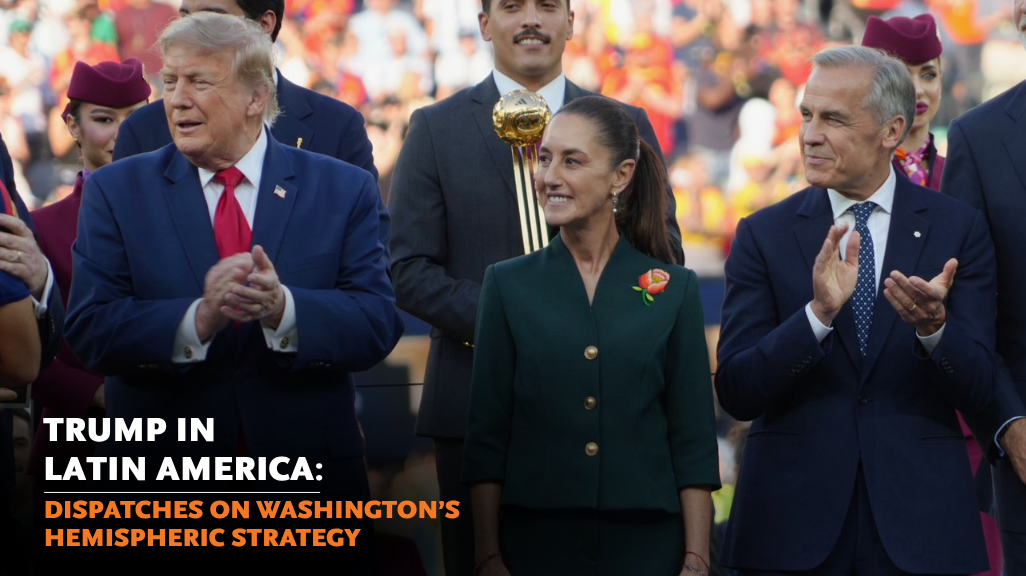
L-R: U.S. President Donald Trump, Mexican President Claudia Sheinbaum, and Canadian Prime Minister Mark Carney. (Sheinbaum's X)

L-R: U.S. President Trump, Mexican President Sheinbaum, and Canadian Prime Minister Carney. (Sheinbaum's X)

Trump in Latin America: Tariffs on Canada, Talks in Mexico, Tensions with Nicaragua

By Carin Zissis , Khalea Robertson and Chase Harrison

July 16–22: State releases a report on Cuban espionage and U.S.–Colombia security ties set to deepen. Plus: Trump’s FTO designations charted.

Welcome back to our weekly dispatch of stories on the U.S. role in Latin America. Follow us each week and see previous roundups at as-coa.org/dispatches, or sign up to receive them via LinkedIn

Here’s what to know this week: 

  • With signs more tariffs are coming, White House slaps duties on Canadian goods as administration officials travel to Mexico City for trade talks.
  • Secretary Rubio responds to Nicaraguan leader Daniel Ortega’s decision to suspend elections.
  • “El Mayo” sentencing and new FTOs named in Mexico, bringing Trump 2.0 designations to 20.
  • A new State Department report deems Cuba the architect of twenty-first century Communism.
  • Venezuela’s Nicolás Maduro appears in court while Delcy Rodríguez gets a pass.
  • Plus: Why U.S. tariffs on Brazil may harm a Trump ally, Washington and Bogotá ready to deepen security ties, and more.
Canada faces tariffs as Mexico hosts trade talks

Sunday marked a moment of North American camaraderie as Canadian Prime Minister Mark Carney and Mexican President Claudia Sheinbaum joined their U.S. counterpart Donald Trump in New Jersey’s MetLife stadium to watch Spain win the final of this trilateral World Cup.

But the warmth on display in the glassed-in VIP suite cooled come Monday, when the White House slapped 50-percent tariffs on more than 550 Canadian products in what the White House called a response to “Canada’s discriminatory treatment” of U.S. alcohol, cars, and dairy. To take this step, the Trump administration reached back to the Great Depression era and invoked Section 338 of the 1930 Tariff Act (infamously referenced in the film Ferris Bueller’s Day Off). Section 338 tariffs have not been implemented previously and legal challenges are expected. 

The duties, slated to go into effect on August 19, would apply to roughly $20 billion worth of products, the value of a little over 5 percent of U.S. imports from Canada last year. While the White House exempted key products such as energy and critical minerals, the tariffs would affect goods covered by the USMCA trade deal. Carney responded Monday night by calling the measures the latest “in a series of unilateral U.S. trade actions” he said are “in direct violation” of the pact.

Could the latest U.S. measure spur Canada and the United States to finally sit down for trade discussions? Ottawa and Washington have yet to hold talks about the USMCA’s current joint review process, even as the Sheinbaum government hosts a U.S. delegation for a third round of negotiations from July 22 to 24 in Mexico City. Topics for these talks, per the Office of the U.S. Trade Representative, include: “steel and aluminum and derivative products, automobiles, economic security, labor, agriculture, and electronic payment services.”

Canadian tariffs and Mexican talks come three weeks after Washington announced it will not renew USMCA long-term, sparking annual reviews of the agreement for the next ten years (See our July 1 edition for more). Sheinbaum told reporters this week that Mexico aims to make future annual review processes speedy, saying: “Our goal is that in this first year of review, we can reach agreements so that in subsequent years, it will just be a checklist, so to speak, a verification that what we agreed to this year is being complied with.” 

USMCA aside, the latest Canada duties may be the harbinger of a larger round of U.S. tariff announcements. After all, the White House already targeted Brazil with new tariffs last week. Now, a series of 10-percent tariffs are set to expire on Friday, and some 60 countries could see them replaced under a June ruling involving Section 301 of the 1974 Trade Act. Hemispheric countries that were part of those 301 investigations include: Argentina, Brazil, Canada, Chile, Colombia, Costa Rica, the Dominican Republic, Ecuador, El Salvador, Guatemala, Guyana, Honduras, Mexico, Nicaragua, Peru, Uruguay, and Venezuela.

Reacting to Managua’s election cancellation

After Nicaraguan leader Daniel Ortega announced Monday that his country would no longer hold elections to avoid the opposition “trapping the government,” Secretary of State Marco Rubio issued a statement calling on “the international community to join forces” against the regime, which is co-led by Ortega and his wife, Rosario Murillo. On social media, the State Department urged “hemispheric partners” to support U.S. efforts “in working to ensure the Nicaraguan people may finally choose a future free from tyranny.”

Writing in Americas Quarterly, AS/COA’s Vice President and former U.S. Ambassador to Nicaragua Kevin K. Sullivan notes: “Western governments have less leverage over Ortega than they used to and have largely resigned themselves to keeping their distance.” But he also notes that the Trump administration has proven in Venezuela and Cuba that it is prepared to take “extraordinary measures,” adding, “Will Ortega’s eschewing of elections finally move Managua off the back burner?” 

New FTO designations amid “El Mayo” sentencing

On July 20, a Brooklyn-based federal court sentenced Sinaloa Cartel leader Ismael “El Mayo” Zambada García to life in prison with no parole. The court also ruled that he should forfeit $15 billion in assets.

Outside the courthouse on Monday, DEA head Terrance Cole celebrated the sentencing, saying: “Whether you’re a drug trafficker or a corrupt government official, DEA is coming for you.” The message resonated in Mexico, given the U.S. indictment of several members of Sheinbaum’s governing party, including a powerful former governor of Sinaloa in April. Thus far, the Mexican government has resisted extraditing the officials.

Zambada and Joaquín “El Chapo” Guzmán cofounded the Sinaloa Cartel, a global criminal group that the U.S. government designated a foreign-terrorist organization (FTO) in 2025. Overall, the second Trump administration has issued a record number of FTO designations and Mexico is the Latin American country that serves as a homebase for the largest portion of them. On July 16, the State Department added the Juárez Cartel and Los Viagras to the list, bringing the total number of Mexican criminal organizations deemed FTOs to eight.

Maduro’s day in court

Zambada isn’t the only one facing a judge this week. The criminal proceedings against Nicolás Maduro resume today, July 22, in a New York Southern District court. It is the third pre-trial hearing in the U.S. government’s case against Maduro, his wife and co-conspirator Cilia Flores, and other close associates for alleged “drug-related terrorism.” Ahead of the hearing, lawyers for Maduro and the U.S. government jointly proposed a June 2027 trial start

And in an ongoing case involving the imprisonment and alleged torture of three U.S. citizens in Venezuela, the Department of Justice (DoJ) on July 20 requested immunity for interim President Delcy Rodríguez as a head of state. A week earlier, on July 14, a Miami-based federal judge did not name Rodríguez among the Venezuelan officials responsible for paying $315 million worth of initial damages to the three men. The omission came on the heels of a July 11 State Department letter to the DoJ noting the U.S. government’s recognition of Rodríguez as head of state and “the significant foreign policy implications” attached to the decision of whether to remove her from the case.

Speaking to the press on July 19, Secretary Rubio confirmed that the U.S. government will “be very engaged in” talks between Venezuela’s interim government and opposition representatives on a political transition. See last week’s dispatch for more on the process that is scheduled to begin on August 1. 

State Report alleges Cuban “subversion campaign”

A new 100-page State Department report calls Cuba the “capital of 21st Century Communism” and argues Havana’s networks have infiltrated “elite academia, major nonprofits and NGOs, and even the Democratic Party itself” in the United States. The report tied the Cuban regime to leftist movements stretching back to the 1960s through more recent protests following the 2020 murder of George Floyd and against ICE. 

The paper comes six months into a U.S. energy blockade on Cuba, which continues experiencing sustained blackouts. The State Department on July 21 announced its first shipment of food and hygiene kits for 700 families in Cuba, to be distributed by a Catholic NGO.

Other news

Brazil’s Pix love: The Trump administration’s latest tariffs on the South American country target, among other things, Brazilian popular digital-payment system Pix, and the U.S. move may inadvertently help President Luiz Inácio Lula da Silva’s upcoming reelection bid, argues The Economist. In Americas Quarterly, AS/COA Vice President Brian Winter delves into why Trump’s tariffs have hurt Lula’s electoral rival, Flávio Bolsonaro.

U.S.-Colombia military ties deepen: On Tuesday, Deputy Assistant Secretary of Defense for Americas Security Affairs Joseph Humire announced that Washington will work with the incoming Colombian government to launch Plan Patriota 2.0 and bring security collaboration “to new levels.” The plan’s name references a bilateral security agreement dating back to the government of President Álvaro Uribe (2002-2010). 

Related

Explore