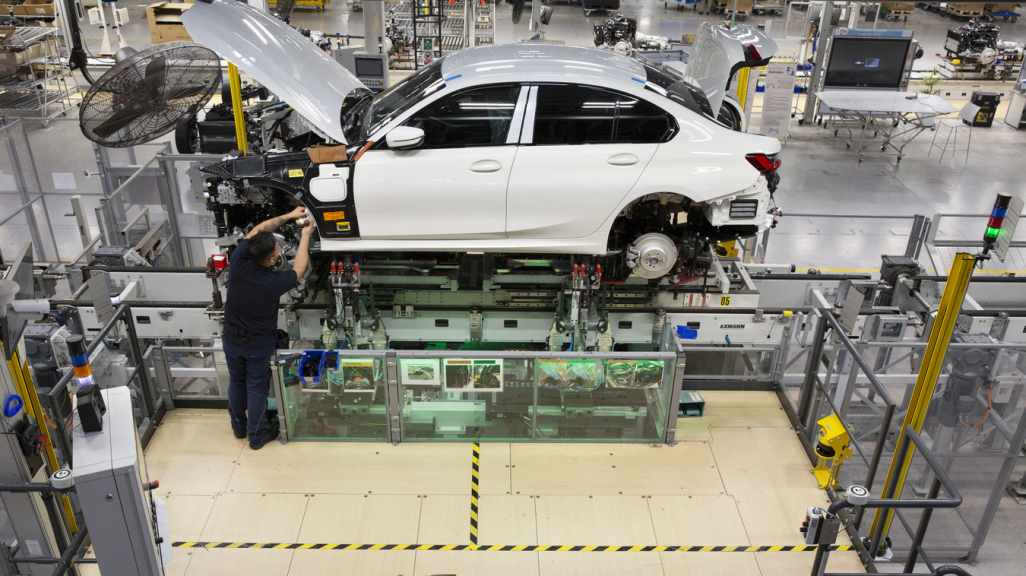
A car factory in Mexico. (AP)

A car factory in Mexico. (AP)


Tracking the U.S.-Mexico Talks in the USMCA Review

By Isabel Teran

Learn about the issues up for discussion in three binational rounds of talks on the North American trade deal.

On May 28, the United States and Mexico launched official negotiations ahead of the mandatory July 2026 U.S.-Mexico-Canada Agreement (USMCA) Joint Review. The review represents a formal opportunity for the three parties to assess the accord’s impact and identify potential updates with the end goal of strengthening North American competitiveness.

While the USMCA is a trilateral deal, Washington is holding bilateral talks with each trade partner, and Canada and the United States have only recently begun preliminary discussions. As such, this tracker focuses on negotiations between the United States and Mexico, which is not only Washington’s top trade partner but also became its top export market late last year. 

The three talks take place between May and July 2026. Check back for updates after each round. 

Trade Advisory Group

COA's Trade Advisory Group comprises member representatives from the Council and invited experts who educate and advocate for open markets and trade facilitation in the Western Hemisphere.

Round One: Automotive Rules of Origin, Steel & Aluminum, Economic Security 
  • Mexico City, May 28-29, 2026

Automotive Rules of Origin

The automotive sector remains one of the most integrated industries in North America, supported by highly interconnected supply chains across Canada, Mexico, and the United States, Mexico, and Canada. In 2025, with the value of Mexican exports to the United States totaling $534.9 billion, Mexico stood out as the largest foreign source of automotive components to the U.S. market, accounting for 42 percent of all U.S. imported auto parts.

Under USMCA, vehicles must contain 75 percent North American content to qualify for duty-free treatment, up from 62.5 percent under NAFTA, USMCA’s predecessor. Washington hopes to up increase the rate for automotive Rules of Origin to 82 percent and introduce a requirement that at least 50 percent of a vehicle’s value be sourced from the United States, per reports on the first round of talks. Moreover, China’s role in North American supply chains has cast a shadow over USMCA’s renewal amid concerns that Beijing's rising investments in Mexican factories amounts to an attempt to sidestep tariffs on U.S.-bound goods. Meanwhile, late last year, Mexico’s Congress approved tariffs as high as 50 percent on some 1,400 products from China and other Asian countries with which it does not have trade deals. The move, designed to protect Mexican domestic industry, could also be seen as appeasing U.S. concerns.

Mexico has resisted proposals to raise automotive content requirements beyond the current 75 percent Regional Value Content threshold, arguing that stricter rules of origin could increase production costs and undermine the competitiveness of North American supply chains. This position reflects the importance of the automotive sector to Mexico’s economy: approximately 79.7 percent of vehicles produced in Mexico were exported in 2025, with more than 80 percent destined for the United States.

Steel and Aluminum

This round of talks took place against the backdrop of U.S. Section 232 tariffs involving 50 percent tariffs on steel and aluminum imports, which Mexico has identified as a key concern in the review process.

Discussions focused on whether the current USMCA requirement that 70 percent of a producer’s steel and aluminum purchases must originate in North America should be strengthened through stricter verification and sourcing rules. U.S. officials argued that stronger requirements would reinforce North American production and limit the use of steel and aluminum originating from non-market USMCA economies.

Economic Security

In the first round, discussions focused on how to reduce North America’s dependence on external suppliers for strategically important industrial inputs. The Office of the U.S. Trade Representative (USTR) indicated that talks focused on supply-chain resilience in sectors including automotive electronics, semiconductors, critical minerals, and other key industrial goods, with the goal of strengthening North American production capacity

Round Two: Agriculture, Level Playing Field, Continued Rules of Origin Discussions
  • Washington, DC, June 16-17, 2026

What to Watch in Round Two

Agriculture

Expected issues include:

  • Market access for agricultural products
  • Sanitary and phytosanitary measures (SPS)
  • Regulatory cooperation and agricultural biotechnology
  • Food security and supply chain resilience

USTR identified agriculture as a priority for the second round, held in Washington round. USTR has stated that the review process will focus on ensuring that USMCA benefits U.S. farmers, while outside analysts have noted that agricultural market access, biotechnology approvals, and Sanitary and Phytosanitary (SPS) measures are likely to feature prominently in the discussion.

Mexico is expected to emphasize preserving access to the U.S. market for agricultural exports and ensuring that new SPS or regulatory requirements do not disrupt highly integrated North American supply chains. Agriculture remains a critical component of the bilateral economic relationship; in 2024, Mexico became the largest market for U.S. agricultural exports with shipments valued at $30.2 billion.

Level Playing Field

As the United States prepares for the 2026 USMCA Joint Review, policymakers have increasingly linked discussions of competitiveness to concerns about non-market practices, industrial subsidies, and state-supported production in strategic sectors. USTR has identified these issues as a priority topic, suggesting discussions will focus on ensuring that North American producers compete under comparable regulatory and market conditions.

Regulatory Cooperation

Potential focus sectors include pharmaceuticals, medical devices, and cosmetics as USTR highlighted regulatory compatibility discussions during the first round.

Round Three: Resolution of Outstanding Issues
  • Mexico City, Week of July 20, 2026

What to Watch in Round Three

The objective will be to reach consensus and follow discussions on automotive rules of origin, steel and aluminum, economic security, agriculture, regulatory cooperation, and level playing field issues.

The third round is expected to focus on narrowing differences and identifying areas where both governments can reach agreement as part of the broader USMCA review process.

Related

Explore