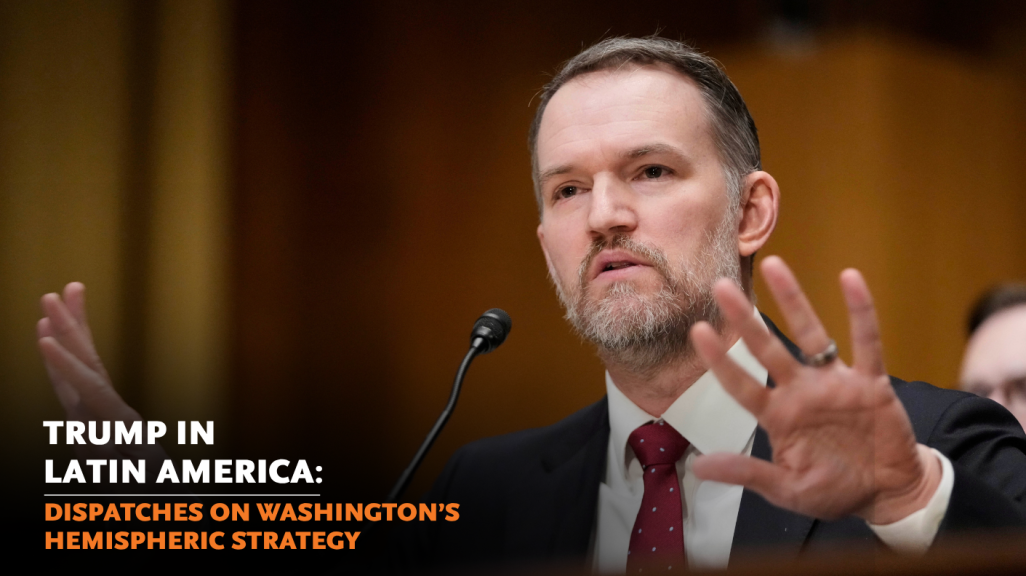
U.S. Trade Representative Jamieson Greer. (AP)

U.S. Trade Representative Jamieson Greer. (AP)

Trump in Latin America: Washington Rejects USMCA Renewal, Responds to Venezuela Quakes

By Carin Zissis

June 25-July 1: Plus, Treasury targets cross-border fuel smuggling and SCOTUS delivers immigration rulings with a regional impact.

Welcome back to our weekly dispatch of stories on the U.S. role in Latin America. Follow us each week and see previous roundups at as-coa.org/dispatches, or sign up to receive them via LinkedIn

Please note: the dispatch will be taking a break on July 8. Catch the next issue on July 15. 

Here’s what to know this week: 

  • As expected, USTR opts not to renew USMCA.
  • Washington responds to Venezuela’s earthquakes.
  • U.S. Treasury targets fuel-smuggling ring with Jalisco Cartel ties.
  • Are high-ranking Mexican officials serving as U.S. informants?
  • Plus: Western Hem staff changes, SCOTUS rulings, and Latin America’s Trump leanings
USTR declines USMCA renewal, sparking annual review process

Washington opted not to renew the U.S.–Mexico–Canada Agreement (USMCA) on Wednesday. In an official statement, U.S. Trade Representative Jamieson Greer said: “The United States will continue to engage with Mexico and Canada to address the Agreement’s shortcomings and our trade deficits with these countries,” adding, “The Agreement remains in force pending resolution of these issues or until the Agreement’s termination.”

What does that mean? Back in 2020, the USMCA went into effect for a 16-year term running until 2036, but with a catch: the three countries agreed to check in every six years in order to decide whether to extend the deal. That sixth birthday arrived on July 1, with Greer telling Bloomberg that the White House is “not prepared to rubber stamp the agreement.” The decision results in an annual review process in which the three countries must opt to extend the deal each year for up to 10 years.

Yes, it’s hard to follow. CSIS Fellow (and former AS/COA podcast guest) Diego Marroquín Bitar authored a handy flow chart for those trying to follow the potential USMCA paths.

USTR’s decision came as little surprise, given Trump’s regular suggestions that he might not extend the deal, even though it was negotiated during his first term as an update to the quarter-century-old North American Free Trade Agreement. But the decision could have major ramifications, given that Mexico and Canada, respectively, are the top two U.S. export markets.

Observers contend annual reviews will only cause investment uncertainty for the economically integrated North American countries. “I don't want to annually review my mortgage or annually review my car or annually review my marriage. Why would you want to do this annually?” said President and CEO of the Business Council of Canada Goldy Hyder in a recent AS/COA Online interview. “It's unpredictable, unstable, uncertain, and it could create the negative consequence of capital chill.”

The Peterson Institute charts the economic risk of the deal’s termination by showing what share of each U.S. state’s exports are destined for Mexico or Canada.

FOX Business reported that an unnamed source indicated the White House will pursue “independent trade deals” with Canada and Mexico. Both Ottawa and Mexico City have voiced objections to separate bilateral deals

A third round of U.S.-Mexico talks related to the USMCA joint review are slated for the week of July 20. Access AS/COA’s tracker of those bilateral negotiations

Watch a COA panel including former USMCA negotiators about the deal's outlook. 
Venezuela: Washington responds to twin earthquakes

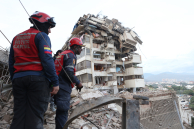
After two devastating earthquakes struck the country on June 24, attention turned to the response of Washington, given the Trump administration’s role in the January capture and removal of Nicolás Maduro and subsequent cooperation with the interim government. As General Francis Donovan, commander of U.S. Southern Command (SOUTHCOM), told Reuters: “January 3rd's not that long ago. And just think about how this relationship has transitioned.” Southcom has deployed 900 personnel to Venezuela to support search-and-rescue missions, in addition to potential support from 800 troops stationed in Caribbean hubs. The U.S. military, which shares daily updates on its logistics coordination, has also dispatched equipment and aircraft, as well as MQ-9 Reaper drones to assess damage. Per the State Department, the United States had committed $300 million in funding for to support the disaster relief efforts.

For an overview of how the United States and Latin American countries have responded, read AS/COA Online coverage

Even as support pours in from across the hemisphere and the world, reports indicate citizen frustration with the interim government for what has been seen as a slow and inadequate response as the official death toll continued climbing, reaching close to 2,000 as of Wednesday morning. 

In Americas Quarterly, Dr. Orlando J. Pérez looks at past quakes in countries such as Mexico, Nicaragua, and Chile, and writes: “How governments respond to disasters of this magnitude shapes political trajectories long after the immediate emergency passes.” The question of how the quakes will affect the government of interim President Delcy Rodríguez is a pointed one as opposition leader María Corina Machado finds her attempts to travel home blocked. Reports suggest Washington does not back her return at the present time. 

Human resources, Western Hem edition

Politico reported that Jeremy Lewin, who oversaw the Trump administration’s overhaul of U.S. foreign aid as acting undersecretary of State for foreign assistance, humanitarian affairs, and religious freedom, is now moving to the White House. He will serve as senior director for Western Hemisphere affairs at the National Security Council and deputy assistant to the president. 

Guatemalan media outlets reported that Cuban-American lawyer Juan José Rodríguez, the Trump administration’s nominee for ambassador to the Central American country, declined the nomination on June 30.

In other headlines

Fuel-smuggling sanctions: On June 30, the U.S. Treasury Department announced sanctions against two Mexicans and nine firms involved in a border-crossing, fuel-smuggling ring with connections to the Jalisco New Generation Cartel

Mexican informants? The New York Times reports that a dozen high-ranking members of Mexico’s governing Morena party have reached out to Washington to provide intelligence on fellow officials, ostensibly “to get ahead of investigations that they fear could soon focus on them.” 

Tilting right: In the wake of right-wing candidates winning presidential elections in Colombia and Peru, various outlets have covered the region’s conservative shift in alliance with Washington on security and immigration policies, including coverage by The Associated Press, Deutsche Welle, The Economist, The Los Angeles Times, The Wall Street Journal, and others.

Learn more about Latin America's 2026 election in our election guide: www.as-coa.org/2026

On July 1, the State Department congratulated Keiko Fujimori for winning the Peruvian presidency following a long wait for results from a June 7 runoff.

SCOTUS’ immigration rulings: A June 25 Supreme Court ruling ended Temporary Protected Status for 330,000 people mostly from Haiti. 

On the other hand, a June 30 Supreme Court ruled against Trump's executive order seeking to limit birthright citizenship. A Duke University study suggests that Latinos would be most affected by birthright citizenship’s end. 

Related

Explore