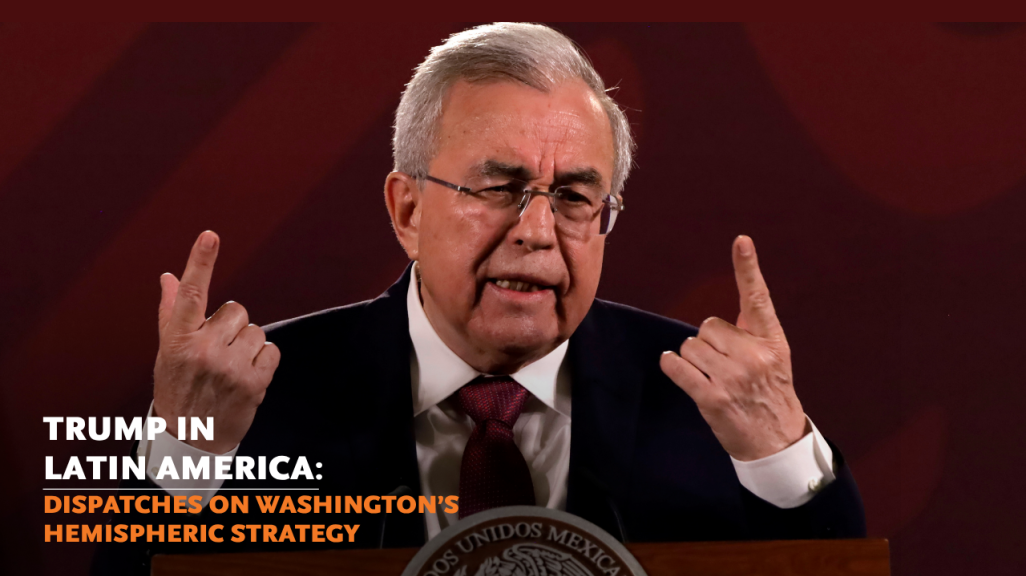
Sinaloa Governor Rubén Rocha Moya. (AP)

Sinaloa Governor Rubén Rocha Moya. (AP)

Trump in Latin America: U.S. Indicts Mexican Governor, Condemns China's Panama Action

By Carin Zissis and Chase Harrison

April 24–30: Plus, carmakers issue a USMCA warning and a U.S. direct flight takes off for Caracas for the first time in seven years.

Welcome back to our weekly dispatch of stories on the U.S. role in Latin America. Follow us each week and see previous roundups at as-coa.org/dispatches, or sign up to receive them via LinkedIn

Here’s what to know this week: 

  • A DOJ indictment against a Mexican governor ratchets up bilateral tensions.
  • Foreign car manufacturers caution that a weakened or defunct USMCA would impact U.S. operations.
  • Washington condemns Beijing for retaliatory actions against Panama over a Canal control dispute.
  • The U.S. Senate rejects a measure requiring congressional approval for military action against Cuba.
U.S.–Mexico tensions soar as DOJ charges Sinaloa governor

Last week, U.S. Ambassador to Mexico Ronald Johnson traveled to Los Mochis, Sinaloa for a groundbreaking ceremony marking the construction of a methanol factory. The event celebrated one of the biggest U.S. investments in Mexico in recent years, but the diplomat also used his stop in Sinaloa state to warn that corruption is the bane of such projects, reported The Los Angeles Times. In his remarks, Johnson added that U.S.–Mexico trade ties require governments to hold corrupt officials accountable, saying: “We may soon see significant action on this front.” 

Sure enough, on April 29, the U.S. Department of Justice unsealed an indictment against Sinaloa Governor Rubén Rocha Moya and nine other former and current Mexican officials  for drug trafficking charges and related weapons offenses. Federal prosecutors in Manhattan allege that the Sinaloa Cartel, a U.S.-designated terrorist organization, was behind the electoral win of Rocha Moya, a member of Mexico’s governing Morena party. The indictment asserts that, in exchange for a victory that involved violent intimidation of rivals, the governor allowed the organized crime group to operate with impunity in the state and to smuggle drugs into the United States.

The move defines a major shift in security relations between the Trump administration and the government of President Claudia Sheinbaum. Bilateral cooperation has deepened since the end of the government of Andrés Manuel López Obrador, Sheinbaum’s mentor and predecessor, but has largely focused on the arrests of kingpins and capos or on drug seizures. However, reports suggest Washington has steadily pressed the Sheinbaum government to root out cartel-related corruption within her party’s ranks. The U.S. case ratchets up that pressure by ensnaring not only a sitting governor, but a national senator and the mayor of Sinaloa’s capital, Culiacán—all from the Morena party.

The timing of the indictment also puts the Sheinbaum government between a rock and a hard place. Just as Mexico enters high-stakes USMCA negotiations with its top trade partner, will she hand over a governor who has long faced corruption rumors and overseen spiraling violence in his state? Or will she risk a rupture with Washington to protect Rocha, a man many argue has the power to unveil a web of corruption that would strike a blow to her party’s legacy?

Not long after the indictment's release, Mexico’s foreign ministry announced that it had received a U.S. extradition request a day earlier, but that it did not include evidence and had been turned over to the attorney general’s office for investigation. That office then announced the extradition request would only be granted in the case of sufficient proof. Sheinbaum, for her part, told reporters at her April 30 morning press conference that her position is one of “truth, justice, and defense of sovereignty” and reiterated the attorney general office’s conditions. 

Bilateral security tensions were already on the rise following the accidental death of two CIA agents in the north Mexican state of Chihuahua, as reported in last week’s dispatch. Sheinbaum said she was unaware of cooperation between the CIA and that state’s officials and suggested such collaboration constituted a violation of Mexico’s sovereignty. White House Press Secretary Karoline Leavitt suggested Sheinbaum should show “some sympathy” for the U.S. deaths. 

Carmakers caution on USMCA accord

With the joint review of the U.S.–Mexico–Canada Agreement on the horizon, foreign automakers have cautioned the White House that ending or weakening the trade pact could threaten their U.S. operations. The Wall Street Journal reports that eight out of 10 cheapest car models in the United States are made by foreign-based companies that rely on parts manufactured in all three countries

Meanwhile, Sheinbaum announced on April 29 that all federal projects in her country must use Mexican steel, given persistent U.S. tariffs on the product from USMCA partners. 

U.S. condemns China for Panama Canal retaliation

Five Western Hemisphere countries joined the United States in signing an April 28 statement that decried a rise in China’s detention and seizure of Panamanian boats. The countries argue Beijing’s actions amount to retaliation for a January decision by Panama’s Supreme Court that invalidated the 1997 concession that allowed CK Hutchison, a Hong Kong-based company, to operate two terminals in the Panama Canal. The court decision was seen as a win for the Trump administration, which sought to reduce China’s influence over the critical waterway. 

Senate rejects Cuba measure

On April 28, the U.S. Senate rejected by a vote of 51 to 47, a resolution that would have required congressional approval for military action against Cuba. Senator Tim Kaine (VA-D), who was one of the Democrats who introduced the resolution in March, argued that Trump’s blockade of the island constituted military action and, therefore, required congressional approval. Senator Rick Scott (FL-R) countered that no troops had been deployed. Kaine has proposed similar resolutions on Venezuela and Iran, though none have passed the Republican-controlled body. 

In other news: Venezuela and Argentina

On April 25, the U.S. government announced it would modify sanctions to allow the Venezuelan government to pay for the legal defense of ousted President Nicolás Maduro in his U.S. court case. In February, Maduro’s lawyer had asked the judge to dismiss the case due to his lack of funding.

For the first time in seven years, a direct commercial flight travels from the United States to Venezuela on Thursday, April 30. The Envoy Air jet is carrying passengers from Miami to Caracas.

A leaked April 24 Pentagon document included language that revealed the United States may be reconsidering its position on the Malvinas/Falkland Islands dispute between Argentina and the United Kingdom, in part to retaliate against London for its position on the Iran War. Days later, the State Department released a statement affirming its neutrality in the Malvinas/Falkland dispute.

Related

Explore