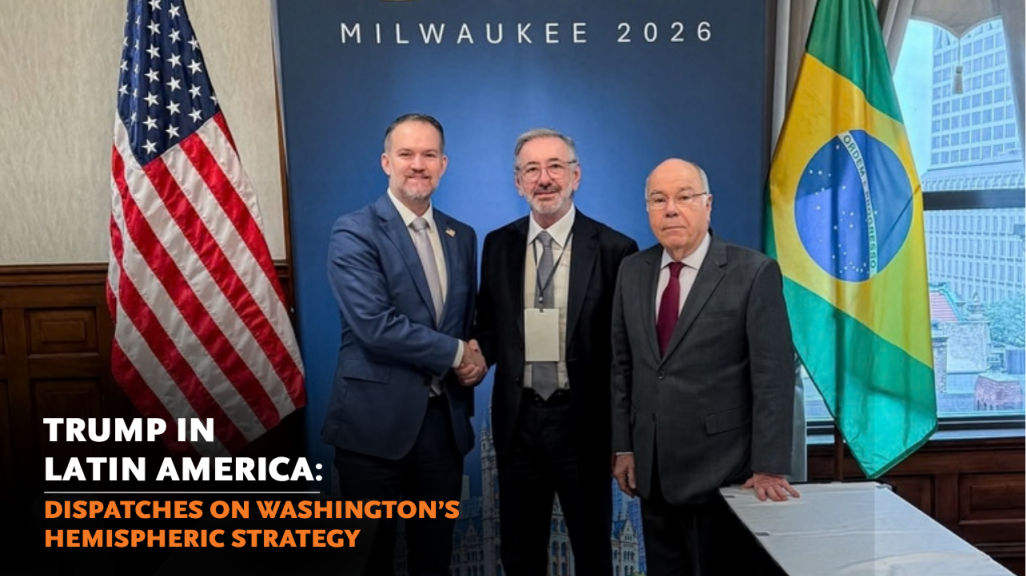
U.S. Trade Rep. Greer, Brazilian Trade Minister Rosa, and Brazilian Foreign Minister Vieira. (Government of Brazil)

U.S. Trade Rep. Greer, Brazilian Trade Minister Rosa, and Brazilian Foreign Minister Vieira. (Government of Brazil)

Trump in Latin America: A Before-and-After in Brazil; Latin America Opines on Washington

By Chase Harrison and Carin Zissis

Oct 1–7: Plus, security cooperation sparks friction in Mexico, reaper drones get a regional redeployment, and soyabeans share a lesson.

Welcome back to our weekly dispatch of stories on the U.S. role in Latin America. Follow us each week and see previous roundups at as-coa.org/dispatches, or sign up to receive them via LinkedIn.

Here’s what to know this week: 

  • At G20, Brazil and U.S. trade officials meet and sketch path forward, even as Brazilians consider booting incumbents.
  • U.S., Mexico dispatch troops to border, despite reports of bilateral security tensions.
  • How are Latin Americans feeling about Trump, Washington, Beijing, and more? The new Latinobarómetro has data.
  • But wait, there’s more: Bolivia arrests attorney general following U.S. visa revocation, a joint statement on Iran, and a lesson on diesel threats.
Brazil, U.S. meet at G20 as Brazilians decide their political future

Milwaukee was the center of the world last week when it played host to a G20 trade ministerial from September 29 to October 1. On the sidelines, U.S. Trade Representative Jamieson Greer met with Brazilian Trade Minister Márcio Elias Rosa and Foreign Minister Mauro Vieira, marking the first in-person meetings for officials from the two countries since Washington revealed new tariffs against Brazil in July.

During the meeting, Rosa and Vieira called for “full tariff reduction,” which would entail the elimination of all three levies on Brazil: those on steel and aluminum, those in response to a Section 301 investigation into efforts to combat forced labor practices, and others related to a 301 investigation into unfair commercial practices. While Greer did not back a reduction, he agreed to submit a trade proposal within several weeks and to join Brazil in a trade working group. Rosa said Brazil will not activate any retaliatory measures under its April 2025 Economic Reciprocity Law if talks proceed in good faith.

The two sides also agreed to include terms on Brazil’s critical minerals and rare earth reserves into a larger bilateral trade framework, echoing comments made by President Luiz Inácio Lula da Silva during his May White House visit, when he spoke to Trump about increasing global participation in Brazil’s mining sector. 

But the entire U.S.-Brazil relationship may soon change, depending on outcome of Brazil’s October elections. The October 4 presidential first round saw Senator Flávio Bolsonaro, who is known for his close ties to the Trump administration, take the top spot in the race. In the past, Bolsonaro has spoken out against some U.S. tariffs on Brazil, arguing in a July letter to Greer that the levies only strengthen Lula’s standing. While Lula has engaged in several spats with Trump over security and trade policy, Bolsonaro, who now is the favorite against the incumbent in the October 25 runoff, is expected to push for a friendlier relationship with Washington.

Trump didn’t make an endorsement before the October 4 first round but called the results "a great victory." Still, major politicians still raised concerns over U.S. involvement in the elections. On October 1, for example, Brazil’s attorney general announced an investigation into a Guardian report that revealed that the State Department had channeled funds to Brazilian civil society groups critical of the judicial system. On Sunday night, the head of Brazil’s electoral tribunal said there was no foreign interference in the election, citing reports from Mercosur Parliament and OAS observers. In its October 6 report, however, the OAS did condemn “international political activism” in the election, without mentioning figures or countries by name. 

Cooperation and contention in U.S.-Mexico security ties

The United States and Mexico deployed hundreds of troops to a section of their shared border between Texas and Tamaulipas after the U.S. Coast Guard said it “encountered gunfire” from the Mexican border on September 26. Mexican President Claudia Sheinbaum said no shots had been detected on the Mexican side but backed collaborative troop deployment.

The move comes amid reports of friction in the Mexican government over U.S.-Mexico security cooperation. The Wall Street Journal’s Santiago Pérez reports that Sheinbaum had expressed frustration with her security and intelligence teams over their collaboration with the U.S. Treasury Department to freeze the bank accounts of former officials linked to her ruling party. Washington sanctioned 21 individuals with alleged ties to the Sinaloa Cartel last week. (See last week’s dispatch for more.) Mexico’s Financial Intelligence Unit took the precautionary step of blocking the accounts of the sanctioned figures but stopped short of connecting them to organized crime.

Sheinbaum also butted heads this week with Mauricio Kuri González, the opposition governor of Querétaro, over his support for U.S. Ambassador to Mexico Ronald Johnson’s involvement in a launch event for a U.S-funded police training academy in his state. This marks the second time the president has cried foul over an opposition-led state’s cooperation with Washington; the presence of U.S. agents in Chihuahua sparked another dispute with that state’s governor in April. (See the April 23 dispatch.)

A lens on Latin America’s opinion of Trump

Latinobarómetro is out with its latest survey of 17 Latin American countries, and founder Marta Lagos writes in El País that, even as the region’s governments sign on to Washingtonian alliances such as the Shield of the Americas, their citizens are looking to new horizons as they become “more independent [and] more modern.” She adds that China is viewed as more influential than the United States in 10 out of 12 surveyed countries that are in the Shield.

The study found that, among survey respondents, Trump notched an evaluation of 4.7 out of 10—lower than Joe Biden’s 5.5 in 2024, but higher than the low of 2.7 that Trump scored during his first term in 2017. Dominicans and Venezuelans scored him highest at 6.2, while Mexicans gave him the lowest rating at 2.8. 

In other news

Visa-less AG detained in Bolivia. On September 30, Bolivian forces arrested 14 people accused of running a criminal organization within the judiciary, including Attorney General Roger Mariaca, who had his U.S. visa revoked for similar allegations two days earlier. The action was celebrated by 15 countries, all in the Shield of the Americas, in an October 1 joint statement. 

Stand against Iran. Washington published another statement this week, an October 5 condemnation of Iranian action and influence in the Western Hemisphere that was co-signed by nine other countries including Canada. Among the actions from Tehran called out in the statement are “lethal plotting, illicit fundraising, political interference and foreign influence activities, and operations meant to bolster terrorist networks.”

Reaper drones get a regional redeployment. Washington is moving MQ-9 reaper drones from Africa to Colombia and Ecuador to target organized crime groups, reports The New York Times. The MQ-9s, frequently used in precision strikes located in complex terrain, are harder to obtain as roughly a quarter of the U.S. fleet have been destroyed in the conflict with Iran. 

Brazil’s soyabean lesson. Trump dialed down threats to impose a diesel export ban after G7 leaders released fuel from emergency stockpiles over the weekend. In the Financial Times, Gillian Tett argues that it’s just as well the ban did not come to fruition, drawing on the example of ex-President Richard Nixon’s 1973 soyabean embargo and writing about how it paved the way for Brazil to dominate the sector’s production. “Just look at that humble soyabean to see what happens when politics ignores the power of unintended consequences,” writes the columnist. 

Related

Explore