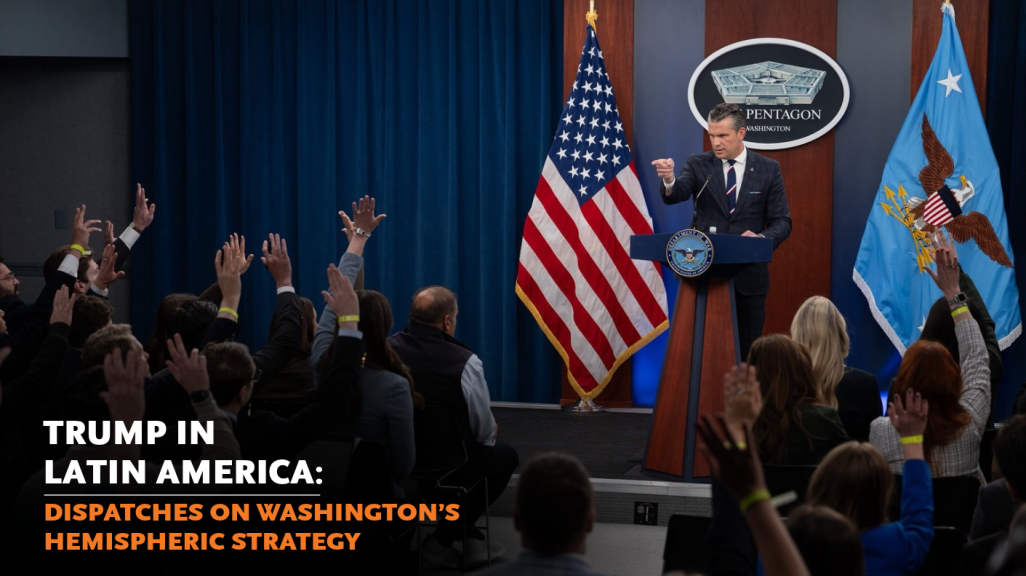
Secretary of War Pete Hegseth at a press conference. (Hegseth's X)

Secretary of War Pete Hegseth at a press conference. (Hegseth's X)

Trump in Latin America: How Will U.S. Policy to the Region Shift?

By Chase Harrison

Nov 5–Nov 11: Plus, Venezuelan energy profits revealed, Bukele rebukes U.S. diplomat, and R2 slain.

Welcome back to our weekly dispatch of stories on the U.S. role in Latin America. Follow us each week and see previous roundups at as-coa.org/dispatches, or sign up to receive them via LinkedIn.

Here’s what to know this week: 

  • How are analysts viewing Washington’s upcoming congressional change? 
  • Report reveals scale of revenue U.S. received from Venezuelan oil profits. 
  • Bukele rebukes claims from U.S. diplomat over Salvadoran operations in Haiti. 
  • Plus: Rubio comments on Venezuelan election schedule, U.S. prosecutors arrest Ecuadorians over cocaine trafficking, and the Mexican government and DEA collaborate in a high-level cartel operation.
Latin Americanists view Trump policy through a post-midterm lens

After a U.S. election where regional issues such as immigration, trade, and hemispheric security were on the forefront of voters’ minds, Latin America faces an evolving political reality in Washington. What are Latin America observers watching as they consider what Democratic control of Congress means for U.S. President Donald Trump’s policy in the region?

Analysts expect increased oversight from Democrats on Trump’s hemispheric actions. In House and Senate Foreign Affairs, Armed Services, and Intelligence Committees, the party may press for investigations and hearings on security and trade policy toward the region, suggests former Colombian diplomat Juan Esteban Orduz in El País. Orlando Pérez of the University of North Texas at Dallas argues in Americas Quarterly that the Democrats will likely scrutinize Trump’s August oil deal with Venezuela, issuing subpoenas and even passing bills that tie energy contracts to specific steps toward free and fair elections in the country. With its power of the purse, Congress can alter budgets around hemispheric initiatives, like the Shield of the Americas or military aid to U.S. partner countries. And, as they did in the current Congress, Democratic legislators can propose resolutions to repeal tariffs or question Trump’s authority to undergo military operations without war powers authorization. Now, they have the numbers to pass such measures.

The Senate also must approve ambassadorial nominees. As of October, 94 of the almost 200 ambassadorial positions are vacant, including in Bolivia, Colombia, Guatemala, Haiti, Paraguay, and Venezuela. Without concessions, new nominees could face hurdles.

Still, Brazilian journalist Sylvia Colombo writes in Folha de S. Paulo that the results don’t necessarily reflect voters’ condemnation of Trump’s Latin America policies. Former Chilean Finance Minister Andrés Velasco warns in The Business Times that Democrats shouldn’t overestimate their mandate. 

Moreover, the Democrat’s newfound power has some limits when it comes to reining in Trump’s foreign policy agenda, AS/COA Director Brian Camblin told Expediente Público. Trump can veto legislation or advance his policies through executive orders. Reuters reported that before the election Trump tasked Stephen Miller and other officials with strategizing on how he could advance his agenda without congressional control. Miller, who was named the new White House chief staff shortly after the midterms, is known as the architect of the administration's mass deportation policy and is a hawk on U.S. military action on drug cartels in Mexico, argues Mexican political scientist and journalist Leo Zuckermann.

Meanwhile, on the same day he faced an impeachment vote, Secretary of War Pete Hegseth delivered a press conference in which he defended the administration’s regional moves, whether it be strikes on alleged drug smuggling boats in the Caribbean, the January 3 operation that removed Venezuela leader Nicólas Maduro, or the Americas Counter Cartel Coalition. 

However, Vice President JD Vance canceled his trip to Argentina, which was scheduled for November. La Nación reports that the decision was due to his party’s electoral defeat. 

In other news:

A windfall from Caracas. The New York Times reporting revealed that the U.S. government received $12 billion in revenue from Venezuelan natural resource exports in the first nine months of the year. A majority of those funds were sent back to the South American country, though the ultimate recipient is not clear. The Washington Post profiles Alejandro Betancourt, the Venezuelan billionaire brokering the U.S.-Venezuela oil deal, as he showcases the operations developing what he calls “America’s Oil.” 

Bukele bites back. Axios reports that Salvadoran President Nayib Bukele refuted U.S. Chargé d’Affaires David Howell’s position that the Central American country’s operations in Haiti did not sufficiently coordinate with the UN-backed Gang Suppression Force and had hit the U.S. embassy building in Port-au-Prince with bullets.

On schedule. Rubio said in a press conference that he expects Venezuela’s new Supreme Court magistrates to be in place by the middle of December, which will then lead to the creation of a new electoral council. The diplomat identified both steps as critical to holding elections next year.

Something fishy. U.S. prosecutors charged five Ecuadorians, including the son of a former president and an ex-legislator, with trafficking cocaine into the United States and Europe in tuna containers, actions that helped turn the South American country into a key transit point of the drug trade. 

R2 detained, too. The Mexican government, in collaboration with the U.S. Drug Enforcement Agency, arrested Rafael Álvarez, known as “R2,” a leader of the New Generation Jalisco Cartel. Meanwhile, The New York Times reports about a former police commander who aided CIA operations in the Mexican state of Chihuahua, spurring tensions between the state and the federal government. 

Related

Explore