U.S.-Mexico trade talks April 2026

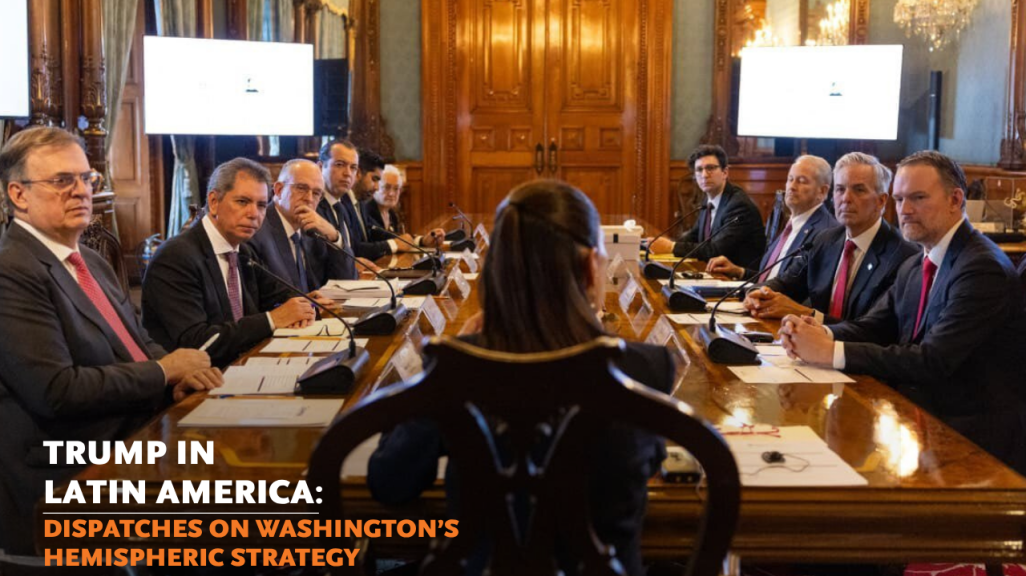
Mexico's President Sheinbaum chairs U.S.-Mexico trade talks. (Government of Mexico)

Trump in Latin America: Greer in Mexico, F-16s in Peru, State Dept in Cuba

By Carin Zissis and Khalea Robertson

 April 17–23: Washington advances with Mexico, spars with Canada over USMCA. Plus, Mexico names a new top envoy to DC.

Welcome back to our weekly dispatch of stories on the U.S. role in Latin America. Follow us each week and see previous roundups at as-coa.org/dispatches, or sign up to receive them via LinkedIn

Here’s what to know this week: 

  • Mexico’s president proposes a new ambassador to the United States.
  • Trump officials move forward with USMCA talks in Mexico, but clash with Canada.
  • Peru’s interim president tries to delay fighter-jet deal, prompting domestic and U.S. backlash
  • Also: CIA in Mexico, Haiti’s PM in DC, State Dept officials in Cuba, and a U.S.-Chile critical minerals deal.  
Mexico’s new man in Washington

On Wednesday, Bloomberg ran a scoop that Mexican President Claudia Sheinbaum was considering proposing Roberto Lazzeri to be her country’s next ambassador to the United States. In her Thursday morning press conference, the president confirmed the news. Lazzeri, who currently heads two Mexican development banks, previously served as the chief of staff to Mexico’s former Finance Secretary Rogelio Ramírez de la O. Should Lazzeri’s nomination be confirmed by the Mexican Senate, he would replace current Ambassador Esteban Moctezuma, who has held the role since 2021.  

The announcement comes amid various cabinet-level changes in Mexico, including the ascension of Roberto Velasco as foreign minister, as we recently covered

USMCA update: Greer visits Mexico, Washington and Ottawa Spar

U.S. Trade Representative Jamieson Greer traveled to Mexico City earlier this week for meetings with Sheinbaum and her government on economic ties. Greer and Mexican Secretary of Economy Marcelo Ebrard announced plans to hold what is described as “the first official bilateral negotiation round” for the USMCA joint review during the week of May 25 in Mexico City.   

Greer also met with Mexican private-sector leaders. At that meeting, he reportedly told them that even successful USMCA talks would not lead to the elimination of all tariffs, suggesting lingering duties on auto, aluminum, and steel tariffs for national security reasons under section 232 of the U.S. Trade Act. (Learn more about U.S. trade policy through a recent Latin America in Focus podcast.) On Wednesday, Ebrard confirmed to journalists that tariffs will remain in place, adding that the best hope is to negotiate reducing them as much as possible during upcoming talks.  

“We should not be nostalgic for an era when there were no tariffs.” —Secretary Ebrard
Meanwhile, at a Toronto conference, Canada’s top official on U.S. trade, Dominic LeBlanc said the Trump administration needs to offer tariff relief on just such sectors as part of USMCA’s extension.  

While U.S. talks with Mexico have advanced, Ottawa and Washington have exchanged trade-related barbs. Last week, U.S. Commerce Secretary Howard Lutnick disparaged Canada’s recent trade diversification policy, describing it as “the worst strategy.” On Sunday, Prime Minister Mark Carney delivered an address in which he said: “Many of our former strengths, based on our close ties to America, have become weaknesses, weaknesses that we must correct.”  Then, during an April 22 congressional testimony on the White House’s trade agenda, Greer commented on Canadian relations. “They’re doubling down on globalization when we’re trying to correct for the problems of globalization,” he told the U.S. House Ways and Means Committee. “So those are two models that don’t fit together very well.” 

On Tuesday, Carney, who recently gained a parliamentary majority, unveiled a 24-person advisory committee focused on U.S. economic ties to prepare for USMCA talks with Washington. The committee, which will meet for the first time on April 27, includes leaders from the banking, rail, energy, auto, and agricultural sectors.  

CIA agent deaths in Mexico spur questions

A Sunday car crash in the northern Mexican state of Chihuahua claimed the lives of two Mexican officials and, reportedly, two CIA agents. The incident has raised eyebrows in Mexico, where U.S. military action is a sensitive issue due to sovereignty concerns.  

In an initial statement, Chihuahua’s attorney general said the deceased officials had been returning from an action to destroy a drug laboratory when their car skidded off the road and crashed into a ravine. U.S. Ambassador to Mexico Ronald Johnson, who previously worked in the CIA, expressed condolences in a social media post identifying the U.S. citizens as embassy personnel.  

However, The Washington Post and other U.S. outlets reported that the two Americans killed worked for the CIA. The Los Angeles Times subsequently reported that four agents in total were involved in the operation and that CIA operatives have worked with Chihuahua authorities at least twice previously this year. 

At her Tuesday press conference, President Sheinbaum warned that a joint operation between Chihuahua authorities and U.S. agents without Mexico’s federal permission amounted to a violation of national law. A day later, Sheinbaum acknowledged that the Mexican military had been involved in the operations to destroy the drug lab but was not aware of the presence of U.S. agents.  

Amid contradictory reports, the Mexico Political Economist covers the long and “surprisingly cozy” relationship between the CIA and Mexican authorities. 

Confusion over Peru’s purchase of U.S. F-16s

Hours before it was slated to take place, Peru’s interim President José María Balcázar canceled an April 17 deal-signing ceremony for the purchase of F-16 fighter jets from the United States. In an apparent response on social media, U.S. Ambassador to Peru Bernie Navarro warned that “if you deal with the U.S. in bad faith,” the Trump administration “will use every available tool” to protect U.S. interests. Balcázar defended his decision by saying that whichever government ends up being elected to assume office in July should be the one to give final approval to the deal, which involves $3.5 billion for 24 combat planes.  

Five days later, however, Peru’s economy and finance ministry informed that an initial payment of $462 million had been dispensed “in fulfilment of valid contractual obligations assumed by the Peruvian state.” Also on April 22, Ambassador Navarro asserted that the F-16s will arrive in Peru and released a statement detailing U.S. involvement in facilitating the deal.  

Balcázar’s action sparked a mini exodus from his cabinet. On Wednesday, both Defense Minister Carlos Díaz and Foreign Minister Hugo de Zela resigned. In statements that generated confusion, de Zela said that the Defense Ministry signed contracts on Monday, while Díaz said Bálcazar had signed a decree approving the purchase in February. The interim president denied any involvement in the deal. 

In other news: Chile, Cuba, Haiti

On Monday, the United States and Chile signed memoranda of understanding to boost investment in critical minerals and promote security cooperation. The agreements come roughly a month after U.S. Deputy Secretary of State Christopher Landau met with Chile’s freshly inaugurated President José Antonio Kast to establish dialogue on critical minerals and rare earths. Chile is the world’s largest copper producer and the second-largest producer of lithium. This week, Greer called on U.S. allies to pay more for critical minerals from key partners to offset Chinese influence.

In related news, Kast has designated business leader Andrés Ergas to be Chile's next envoy to Washington. 

Axios reported on Friday that a State Department delegation visited Havana the previous week in what is thought to be the first U.S. government landing in Cuba since President Barack Obama’s 2016 trip. While pushing for economic and political reforms, U.S. officials also expressed a preference for avoiding a humanitarian disaster on the island and offered to set up Starlink internet connection free of cost, reports The New York Times

Haitian Prime Minister Alix Didier Fils-Aimé visited Secretary of State Marco Rubio in Washington on April 21 to discuss U.S. support for Caribbean country’s efforts to control security woes ahead of elections slated for August. The first foreign troops of a U.S.-backed, U.N.-approved Gang Suppression Force arrived in Haiti at the start of April.  The Miami Herald also reported that the U.S. embassy in Port-au-Prince helped coordinate a diplomatic rapprochement between Haiti and the Dominican Republic. Santo Domingo recently agreed to partially reopen the airspace across their shared border for the first time since March 2024. 

Related

Explore