Andy Lopez Beltran

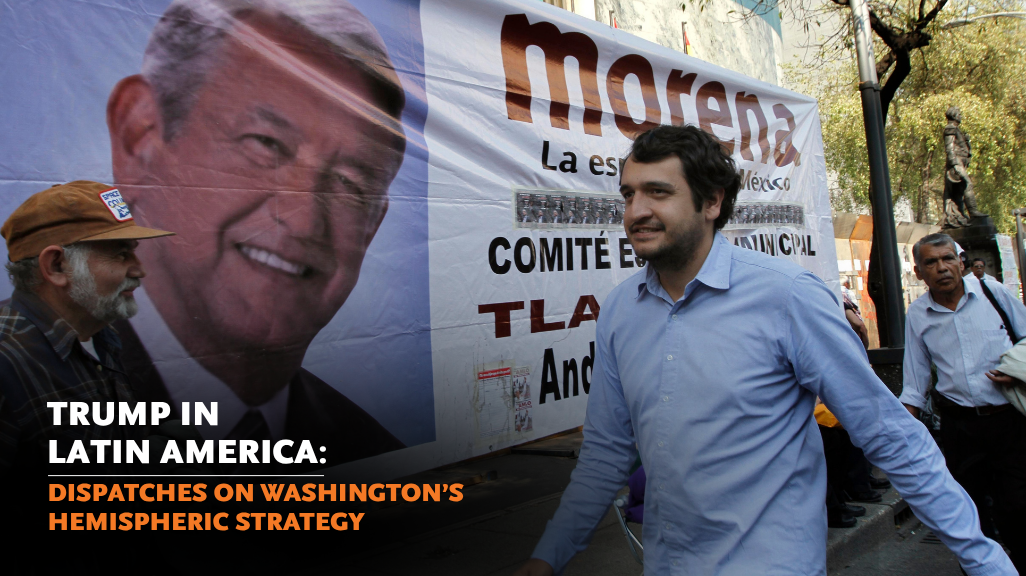
Andrés López Beltrán, son of ex-President López Obrador, walks in front of a banner of his father in 2013. (AP)

Trump in Latin America: Visa Revocation Roils Mexico, Canada Gets Tariff Reprieve

By Carin Zissis

Aug 13–19: Plus, the White House targets Chinese tariff evasion in the Americas, Colombia seeks trade relief, and Venezuela's opposition leader lobbies DC.

Welcome back to our weekly dispatch of stories on the U.S. role in Latin America. Follow us each week and see previous roundups at as-coa.org/dispatches, or sign up to receive them via LinkedIn.

Here’s what to know this week: 

  • Amid a firestorm over the revocation of a prominent Mexican’s visa, Trump officials trumpet bilateral cooperation.
  • Negotiations delay U.S. tariffs on Canadian goods for three days and potentially revive a pipeline deal.
  • White House accuses 40 countries, many in the Americas, of helping China dodge import levies.
  • Colombia’s De la Espriella seeks U.S. tariff reprieve to aid earthquake recovery.
  • Plus: Hemispheric diplomatic changes; María Corina Machado lobbies Washington for involvement in Venezuela talks; DHS deports Mexican nationals to third countries.
In Mexico, fallout from a U.S. visa revocation

On August 13, Andrés Manuel López Beltrán, son of former Mexican President Andrés Manuel López Obrador (2018–2024), publicly posted a strongly worded missive addressed to U.S. President Donald Trump in which he protests the revocation of his U.S. visa. López Beltrán, often referred to as “Andy,” described the move as “politically motivated” before calling for the dismissal of Secretary of State Marco Rubio and Deputy Secretary of State Christopher Landau for their “authoritarian, divisive ambitions.”

López Beltrán is an influential figure in Morena, the governing party founded by his father, serving as its secretary until May 2026. On Monday, party leaders urged the Mexican public to “close ranks” behind President Claudia Sheinbaum in defense of the country’s sovereignty. Mexico’s opposition, meanwhile, called for López Beltrán to be investigated. Mexican investigative journalists report that López Beltrán has been linked to a fuel-smuggling scheme known as huachicol fiscal, but the country’s attorney general has denied the existence of a related open case against him.

At the time of this report, the U.S. government had not given a reason for the visa revocation. While the letter has sparked divisive debate in Mexico, U.S. officials have sought to emphasize cooperation. On Saturday, Landau, who previously served as U.S. ambassador to Mexico, posted on X about the two countries’ “enduring and symbiotic relationship” and warned against allowing “the occasional flareup of political drama to distract us from this fundamental point.” 

And, at an international security conference cohosted this week by the DEA in Argentina, the U.S. agency's head, Terry Cole, made a point of praising Mexican Security Secretary Omar García Harfuch as a “trusted partner” and “good friend of the United States.” (For more on García Harfuch’s background and longstanding political alliance with Sheinbaum, read an Americas Quarterly article by your humble author.) 

Still, Washington's revocations of politicians’ visas have been closely watched in Mexico as a sign that the United States is closing in on corrupt officials.

Mexico is not alone in that regard. An August 16 New York Times article explores how the Trump administration has used the threat of visa removals as a tool in the Americas to punish “adversarial” positions and reward allies.

A Canadian reprieve

Washington and Ottawa worked right up until a midnight deadline to delay the imposition of U.S. tariffs of 50 percent set to go into effect on $20 billion worth of Canadian goods on August 19. (See July 22 dispatch for more.) Late Tuesday evening, Trump heralded a three-day grace period to finalize a deal, saying that the talks could lead to the resuscitation of the Keystone XL oil pipeline project. The binational pipeline project came to a standstill in 2021

Trade ties between the two countries have been tense since the beginning of the second Trump administration. While U.S.–Mexico talks related to the 2026 review of the U.S.–Mexico–Canada Agreement (USMCA) have taken place over the summer, official bilateral talks with the United States’ northern neighbor have been halting

White House report faults hemispheric “transshippers”

An August 13 Trump administration report titled The Great Transshipment Scam identifies more than 40 countries globally that it says serve as conduits for Chinese goods flowing into the United States, allowing Beijing to evade tariffs initially set in 2018. The report, presented last week by White House trade advisor Peter Navarro, suggests this maneuver costs the United States as much as $26 billion in lost tax revenue annually, and that goods transshipped through the “top hubs” of Mexico, India, and Vietnam led to $28 billion in revenue losses last year by one estimate. While main U.S. trade partners Canada and Mexico feature prominently, other hemispheric countries are named as well, including Argentina, Brazil, Chile, Colombia, Costa Rica, the Dominican Republic, Panama, and Peru.

Observers say that differentiating between legitimate and fraudulent country-of-origin practices is complex, with The Economist going so far as to call the Trump administration’s claim of a widespread scam “absurd.” However, the White House report says AI advances will allow for new detection methods to protect against “foreign actors participating in the Shadow Transshipment Network.”

For its part, Mexico, is considering imposing anti-dumping measures on certain Chinese goods, reports Bloomberg. In January, the Mexican government implemented tariffs running as high as 50 percent on some 1,500 products from China and other Asian countries.

ADLE’s post-quake relief request

In light of devastation caused by last week’s earthquake in Colombia, President Abelardo de la Espriella said he asked Trump during an August 15 phone call to temporarily suspend or reduce Washington’s tariffs on his country. U.S. tariffs on Colombian goods rose from 10 to 12.5 percent in July, two weeks before de la Espriella took office. The United States is Colombia’s top export market.

In other news

Staff changes: De la Espriella announced Monday that Maria Consuelo Araújo will represent his government as its next ambassador to the United States. Araújo previously served as foreign affairs minister during the presidency of Álvaro Uribe (2002–2010). 

In Ecuador, President Daniel Noboa inked an August 14 decree that makes business leader Luis Bakker Villacreses his country’s new ambassador in Washington. 

Meanwhile in Washington, Juan Pablo Segura was sworn in as assistant secretary of state for Western Hemisphere affairs on August 14. The former Virginia state commerce secretary replaces Michael Kozak in that role

MCM’s lobbying hire: Responsible Statecraft reports that Venezuela’s exiled opposition leader María Corina Machado has hired DC-based Republican lobbyists in the hopes of making inroads with the Trump administration as her country’s democratic future gets negotiated. (See July 29 dispatch for more.) 

Deportation displacement: CBS News reports on anonymous U.S. Department of Homeland Security officials who say the U.S. government has been deporting Mexican nationals to Honduras and Guatemala rather than their homeland. Mexico’s foreign secretariat condemned the practice with a statement affirming that the country accepts its own deported nationals

Related

Explore