Goldy Hyder, Business Council of Canada

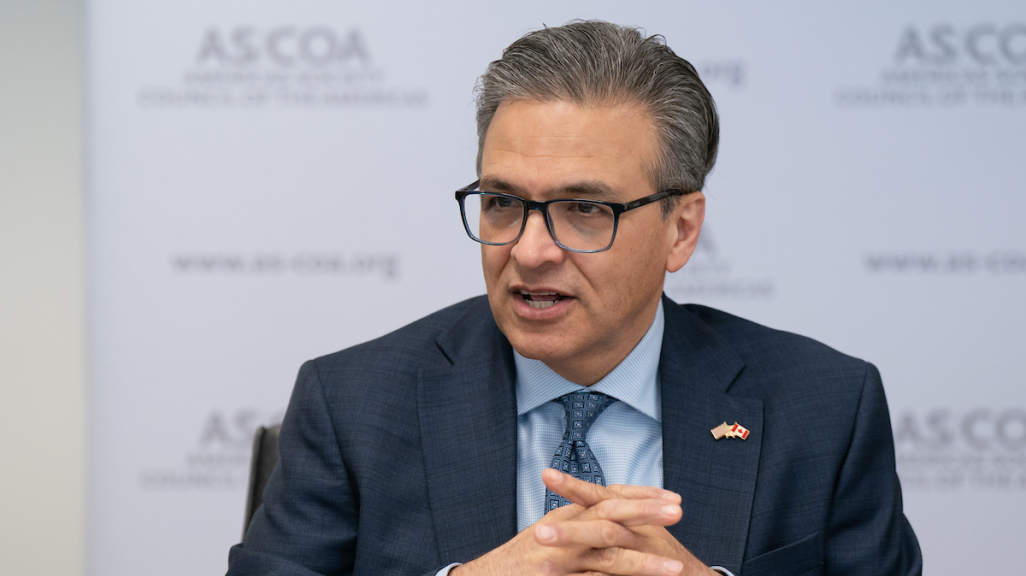
Business Council of Canada President and CEO Goldy Hyder. (Image: Aaron Clamage)

Share

Q&A: BCC's Goldy Hyder Urges Swift USMCA Talks to Avoid "Capital Chill"

By Carin Zissis

The president and CEO of the Business Council of Canada offers his country’s private-sector view on the urgency to renew the North American deal.

A deadline looms over North America. The mandatory joint review of the U.S.-Mexico-Canada Agreement (USMCA) is slated for July 1, even though ongoing negotiations are expected to linger past that date. However, failure to renew the deal this year for another 16 years could push USMCA into a pattern of annual reviews. 

Image
Goldy Hyder

“I don't want to annually review my mortgage or annually review my car or annually review my marriage. Why would you want to do this annually?” asks President and CEO of the Business Council of Canada Goldy Hyder, warning that the default option creates doubt. “It's unpredictable, unstable, uncertain, and it could create the negative consequence of capital chill.” 

Hyder, who joined Council of the Americas in Washington for a May 4 program with our Trade Advisory Group, sat down with AS/COA’s Carin Zissis to share the Canadian private-sector perspective on the urgency for Ottawa and Washington to advance trade talks, the deepening Canada-Mexico ties, and why North America can provide stability in an unpredictable time. Says Hyder: “Let's not get in our own way of what has gotten us to be the successful continent that we are.”

Trade Advisory Group

COA's Trade Advisory Group comprises member representatives from the Council and invited experts who educate and advocate for open markets and trade facilitation in the Western Hemisphere.
Carin Zissis: Across headlines, we see a lot of news about tensions in the U.S.–Canada relationship stemming from Washington's tariffs threats. But behind the news, how does the Canadian private sector view U.S.–Canada relations and, in particular, USMCA talks? 

Goldy Hyder: Let me not dodge the first part of your question, which is the public sentiment aspect. It was not cool to threaten the sovereignty of another country. “We're wanting it to be a fifty-first state,” [U.S. President Donald Trump said.] Funny, not funny? Not funny is the answer, right? That really penetrated the consciousness of Canadians. 

Then came the issue of [Canada] saying, “Wow, we sure are beholden to a single economy. How did that happen?” And it's not President Trump's fault that that happened. We've got to figure out our own economy and how we're going to get access to different markets. 

In an odd way, this has awoken the Canadian consciousness. It's unfortunate it had to happen as a result of what was said, but good things are going to come out of it because a stronger Canada is good for America as well, which is a segue to the second part of your question. 

The Canadian private sector, not surprisingly, looks at the United States of America as a very attractive market in which to invest, deploy capital, create jobs, and expand their supply chains as a long-term play. All of that means we want to see the review and renewal of the USMCA take place, and here we think we share perspectives with our U.S. and Mexican counterparts. All three business communities have said very clearly: We feel that this agreement is working. It's created jobs—over 14 million jobs in United States alone. We believe very strongly that it should remain trilateral because the supply chains have been built trilaterally. 

Secondly, for it to be a true free-trade agreement, it should be tariff exempt on the things that are compliant. If you have a trade agreement and you're complying with a trade agreement, tariffs should not be imposed on those items. 

Lastly, and perhaps more importantly, is timeliness. Sure, the agreement exists until 2036 and we can fall into a scenario of just living off the foundation of, “Well, we have a deal.” But the deal would now be reviewed every year. Why would you create uncertainty when the calling card for capital today is to be a place of predictability, stability, and certainty? 

Zissis: Some have taken the view that Mexico, with its eye on the goal of securing USMCA, has made numerous concessions to Washington, whereas if we look at Canada, the focus has been the opposite.

As we hit this landmark of being just over a year into the government of Canadian Prime Minister Mark Carney, what's your view of Canada's approach?

Hyder: It's possible that both strategies, albeit coming at it from different places, can produce successful outcomes. It's historically been the case that the United States makes side agreements with each country because the issues, again, don't overlap in the same way. It's only natural that if you're going to talk issues that are bothering America about Mexico, then they're going to deal with Mexico directly. With Canada, they have more technical issues, and most of these issues have lingered from previous trade negotiations. So, you have one approach that’s highly engaged, responsive, but it still hasn't produced a deal.

On the other hand, Canada has done a number of things for [the United States]. We did lean in on the digital services tax. We leaned in on the border. We've leaned in on NATO. And we got nothing for those things, right?

I think the Canadian position, which we are certainly aligned with, is let's just get to the table. No more independent side deals, no more concessions, no more giving and taking. Why don't we just go into the room, let trade negotiators do what trade negotiators do, and put it all on the table? Let's talk about what's working, what's not working. Let's talk about how to strengthen it. Let's discuss North American energy security, North American food security, North American supply chain integrity.

"The simple model is you strengthen the whole by strengthening the parts."

Zissis: I want to take advantage of the fact that you were with us today here at the Council to raise something you said: “We have the cash, but we don't have the time.” You were talking both about the short-term question of USMCA, as well as the Carney government’s [longer-term] steps toward trade diversification, right? 

Hyder: I will tell you that as I travel around the world, obviously inside my own country, what I don't hear is that the real issue is capital. There's a lot of money sitting on sidelines because what's missing to deploy that capital is confidence, particularly in democracies now, where we're seeing such wild swings. You can't go on this roller coaster ride if you're deploying capital that belongs to other people, and often, by the way, to pensioners—firemen and women, police forces, teachers, nurses. This is their retirement money that needs to be deployed. 

So you need to have confidence that where it's being deployed has a set of rules, that they're predictable, that there are processes in place. And foundational to deployment of the capital these days is trade agreements. There's 34 chapters in the USMCA that govern a lot of the lives of Americans, Canadians, and Mexicans, including our security, mobility, transportation, and telecommunications. We give you certainty, and it's fair game that you can turn a dollar into two here. The USMCA gives the best chance of doing that. 

We hear America when America says, “We're the number one economy in the world. Trade agreement or no trade agreement, you're going to come here anyways.” Okay, but it can't be America first and America only. The deployment of capital abroad is particularly interested in saying, if I invest in America or Canada or Mexico, I get access to all three, right? Let's not get in our own way of what has gotten us to be the successful continent that we are.

Zissis: You recently were part of the Canadian delegation that went to Mexico and a Mexican delegation is about to go to Canada. Over time, we’ve heard this is a relationship that needs to deepen because North America is about these three countries, but the focus is often the country in the middle, right? How can we finally ramp up the Canadian-Mexican relationship? 

Hyder: I've often said that Trump has managed to do things that no one had managed to do before. Canadians are more united than they've ever been, and we're getting serious about diversification, which is not a response to Donald Trump, but he's allowed it to get further down the field faster. We've been trying to do this for decades because it makes sense to have more than one customer. 

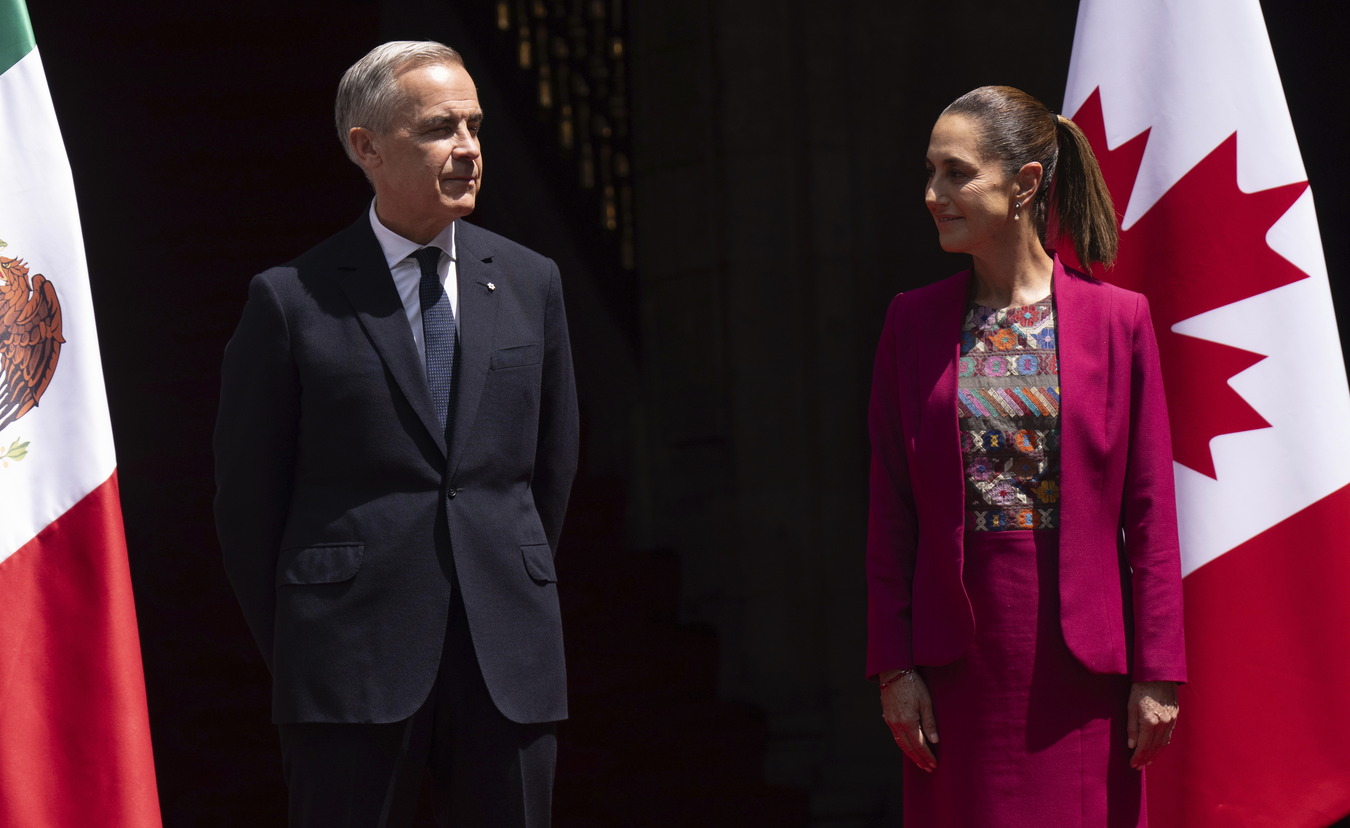
So, of course, we should be selling our goods to different parts of the world, but there's this country called Mexico with which we share a continent and two trade agreements. We're both in the [Comprehensive and Progressive Agreement for Trans-Pacific Partnership], as well as the USMCA. And one of the gifts of this moment is the deepening of relationships between Canada and Mexico from a business perspective, from a political perspective, and, even more broadly, from a citizen perspective. 

We’re hoping that that's not a temporary phenomenon that lasts for this period, and then we go back to regularly scheduled programming. Instead, we see a genuine relationship between Prime Minister Carney and President Sheinbaum and a keen interest to deepen those ties. We’ve said to Canadians and our government back home, diversification should begin at home. The simple model is you strengthen the whole by strengthening the parts.

Zissis: You're coming to Washington often to spread a message about the importance of North America. While you've been here, what's been the mood in terms of what's going to happen next with trade talks? And what's your biggest concern as we're heading down to the wire on USMCA? 

Hyder: Great question. Look, first of all, when we come down here, what we focus on is process. That doesn't make headlines. It's boring. But the process has been an anchor and our friend throughout this exercise. The work of the U.S. trade representative is where we've been doing most of our engagement because at the end of the day, others are going to be at the table to help bring about, we hope, a positive outcome for review and renewal of the USMCA. The process is working, and we think all indications are that, at some point, this is going to come together.

Our message to Republicans, in particular, has been: You have a president who called this the greatest deal of all time. It was his deal, he rebranded it, he negotiated it. And fine, if you believe the Democrats didn't apply it properly, we're at the table to talk about that. But the Democrats didn't get rid of your deal; that's how good of a deal you negotiated. Let's make sure that the legacy behind this agreement is not lost by allowing this thing to go on much longer.

Then, there’s the deadline of July 1. We acknowledge it's going to be very difficult to get to July 1, but we need to work hard to get it done sooner rather than later because it'll bring about the certainty that will help Americans with their cost-of-living issue.

The anxiety I'm feeling is one of concern that this agreement is valid until 2036 and that while it's nice to get a review and renewal done, political parties may feel like it's not a big deal: We have an agreement and there’s a clause that says, if you don't review and renew it, we will do an annual review.

Well, I don't want to annually review my mortgage or annually review my car or annually review my marriage. Why would you want to do this annually? It's unpredictable, unstable, uncertain, and it could create the negative consequence of capital chill, including in the United States of America, because what you're saying is: Every year, the rules may change. 

Obviously, we don't believe in withdrawal. We don't believe in two bilaterals. What we believe in is that sensible people can get into a room and hash this out. So get into that room, hash it out, produce a trilateral, timely, tariff-exempt agreement that allows for the review and renewal of the USMCA to take place.

This interview has been edited for length and clarity. 

Related

Explore