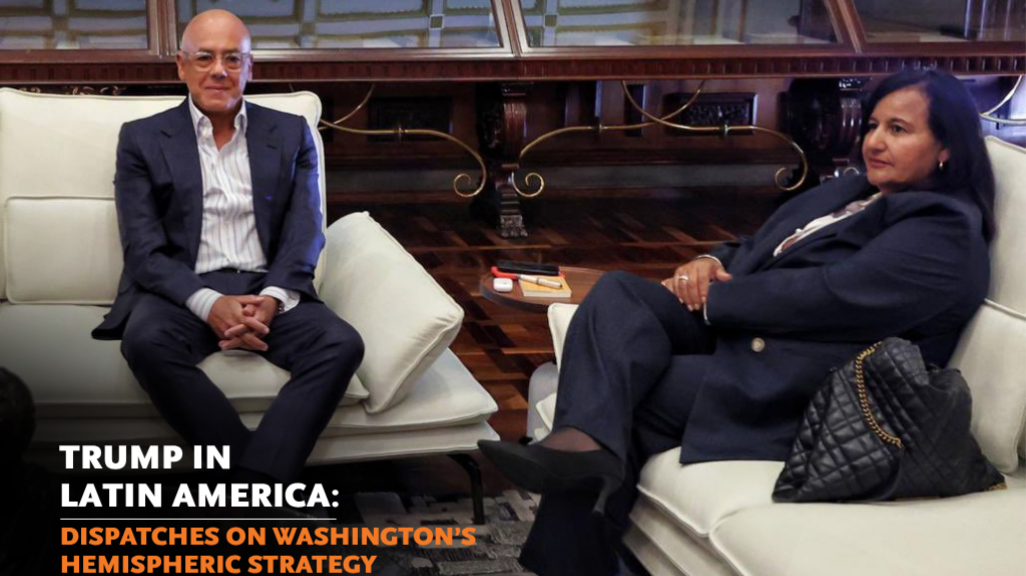
Rodriguez and Figuera

L-R: Venezuela's Jorge Rodríguez and Dinorah Figuera. (Rodríguez's X account)

Trump in Latin America: Venezuelan Democracy Negotiations; Greer's USMCA Aims

By Chase Harrison and Khalea Robertson

July 23–29: Plus, Brazil denies visas to U.S. officials, USTR unveils 301 tariffs, and State sanctions Cuban medical missions.

Welcome back to our weekly dispatch of stories on the U.S. role in Latin America. Follow us each week and see previous roundups at as-coa.org/dispatches, or sign up to receive them via LinkedIn

Here’s what to know this week: 

  • Venezuela set to start U.S.-supervised talks on democratic transition.
  • The third round of U.S.-Mexico USMCA negotiations conclude.
  • Brazil denies visas to U.S. diplomats looking to investigate the electoral system.
  • U.S. 301 tariffs are announced on 60 countries, including 19 in the Americas.
  • New sanctions on Cuba hit its medical missions.
  • Plus: Landau at Fujimori’s inauguration in Peru, a bipartisan visit to Haiti, and sanctions on a Mexican cartel.
Venezuela readies to talk democracy, makes U.S.-backed exit from ICC

Venezuelan government and opposition representatives are in Madrid ahead of U.S.-backed talks set to begin on August 1 that are focused on restoring the country’s democratic institutions. Jorge Rodríguez, president of the current chavista-controlled National Assembly and brother of Venezuela’s interim President Delcy Rodríguez, will represent the government. Representing the opposition is Dinorah Figuera, the previously exiled president of the National Assembly elected in 2015, the year of the last vote recognized as legitimate by many in the international community. (See July 15 dispatch.)

María Corina Machado, who has been Venezuela’s most prominent opposition figure in recent years, confirmed through an open letter on July 26 that she will not be taking part. Machado said neither she nor Edmundo González, widely considered the winner of the 2024 presidential election, would be “an obstacle” to the talks, but called on “those behind it to inform the country of its goals, methods, and timeline.” The U.S. government has expressed support for Figuera’s participation in these negotiations, seemingly sidelining Machado, whom it has also dissuaded from returning to Venezuela

Spanish news outlet ABC identified Florida lawyer Mauricio Claver-Carone as Secretary of State Marco Rubio’s delegate to the talks. Claver-Carone served as Western Hemisphere director at the National Security Council during the first Trump administration and briefly held the title of U.S. special envoy to Latin America at the start of the second but stepped down in May 2025, making his current role in the government unclear

Meanwhile, on July 24, Venezuela became the first country to withdraw from the International Criminal Court (ICC) since the U.S. State Department announced intentions on July 13 to “dismantle the threat posed by the ICC to Americans.” The State Department responded with a congratulatory note welcoming Venezuela’s partnership in the U.S. campaign and highlighting the absence of an ICC ruling stemming from investigations that began in 2018 into former Venezuelan leader Nicolás Maduro, who is now in U.S. custody

Venezuela’s notification to the ICC formalizes a December 2025 National Assembly decision to withdraw from the body in protest of those investigations. At that time, National Assembly President Jorge Rodríguez accused the court of “North American imperialism.”  The United States is not a member of the ICC.

Third round of U.S.–Mexico USMCA negotiations conclude

From July 21 to 23, the third round of U.S.–Mexico bilateral negotiations on the trilateral USMCA trade deal took place in Mexico City and included a meeting on the final day between U.S. Trade Representative Jamieson Greer, Mexican President Claudia Sheinbaum, and Mexican Economy Secretary Marcelo Ebard. Topics covered steel and aluminum, regional supply chains, economic security, and North American manufacturing. Reports indicate that a contentious issue in this round involved the U.S. push for a change to the rules of origin around cars that would require 50 percent of a vehicle’s components to be made in the United States. Mexico argues this would undercut regional integration. A fourth round has been scheduled for September in Washington.

Speaking to the U.S. Senate Finance Committee on the eve of his trip to Mexico, Greer said he is aiming to have “at least some arrangements” with Canada and Mexico for presidential approval by the end of the year, which he said could take the form of interim agreements. Greer’s remarks underscored that negotiations will likely stretch into next year. The trade representative also indicated that non-trade issues would impact talks, saying, "The president is going to have a hard time agreeing to renewal or even revisions if Mexico isn’t playing ball in all areas, and the water treaty is one of them."

Writing in Americas Quarterly, Brenda Estefan noted that this protracted and piecemeal approach is strategic, saying: “Keeping the review open preserves flexibility and allows the United States to connect trade negotiations to an expanding range of concerns.”

While trade negotiations with Mexico continue, U.S.–Canada discussions have yet to officially start. However, Canada's chief trade negotiator and minister for Canada–U.S. trade met with Greer on July 29 while in Washington. 

In a July 28 conversation with Fox News, Trump referred to the USMCA negotiations, saying: “Here's the thing: Mexico and Canada need us. We don't need them. The deal is important for them. It's not important for us."

Section 301 tariffs in the Americas

While in Mexico, Greer announced the imposition of new tariffs on 60 economies worldwide, including 19 in the Americas. The levies stem from U.S. investigations into the use of forced labor to produce goods sold to the United States in violation of Section 301 of the 1974 Trade Act. Countries received either a 10 or 12.5 percent tariff, depending on whether the Office of the USTR determined that efforts have been made to properly enforce bans on forced labor.

Section 301 tariffs immediately replaced global 10 percent tariffs based on Section 122 of the same trade act—dealing with balance-of-payments deficits—that had been in place since February and expired just after midnight on July 24.

One country that has a relative advantage in this latest round of tariffs? Mexico, which faces lower tariffs than competitors, per the Financial Times

Brazil denies U.S. diplomatic visas over electoral system questions

The Brazilian foreign ministry denied visas to two senior U.S. diplomats who were planning to visit Brasília to investigate the country’s electoral system. Brazilian officials, speaking to The Washington Post, said they believed the U.S. officials were seeking to produce a report that could cast doubt on the country’s October 4 electoral process and results. 

This comes amid ongoing bilateral tensions, which flared with the July 15 announcement of new U.S. tariffs on Brazil. On July 26, Brazilian President Luiz Inácio Lula da Silva penned an op-ed in The Washington Post arguing against the logic of the tariffs. “This speaks volumes about the inconsistency between the interests the United States proclaims in its national security strategy and the policies it pursues toward the Western Hemisphere,” he wrote. Brazil's Foreign Ministry submitted a complaint to the World Trade Organization over the levy. 

Sanctions on Cuba’s medical missions

On July 23, the State Department imposed sanctions on 11 more businesses, organizations, and individuals operating in Cuba. The latest sanctions covered entities in the island’s energy and financial sector and ports, as well as Cuba’s international medical missions—a vital foreign currency earner for the country.

Cuba has long faced accusations, including from the UN and the United States, of subjecting the healthcare workers it sends abroad to forced labor conditions. Guatemala, Honduras, and various Caribbean countries to end or reduce Cuban missions earlier this year and late last year. Cuban medical professionals are active in dozens of countries worldwide, including Brazil, Mexico, and Venezuela

Other news

U.S. delegation at Fujimori’s inauguration: Deputy Secretary of State Christopher Landau led the U.S. presence at the July 28 inauguration of Peruvian President Keiko Fujimori. In a meeting the day before, the two discussed trade and security cooperation, among other issues on the bilateral agenda. U.S. Ambassador to Peru Bernie Navarro accompanied Landau, as did officials from the departments of State, Treasury, and Commerce.

Treasury sanctions cartel: The U.S. Treasury department announced on July 23 it was sanctioning 50 Mexican individuals and entities linked to the Jalisco New Generation Cartel, one of 20 Latin American groups named a foreign terrorist organization during Trump’s second term. Among those sanctioned is the man believed to be the new head of the CJNG: the stepson of El Mencho, the group's longtime leader who was killed by the Mexican government in February.

Codel to Haiti: A bipartisan congressional delegation touched down in Haiti on July 27, marking the first visit of its kind in about a decade. The legislators met with the country’s prime minister to get updates on the security crisis. The delegation coincided with the week in which over 300,000 Haitians began losing their U.S. temporary protected status, making them potentially eligible for deportation. 

Related

Explore