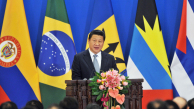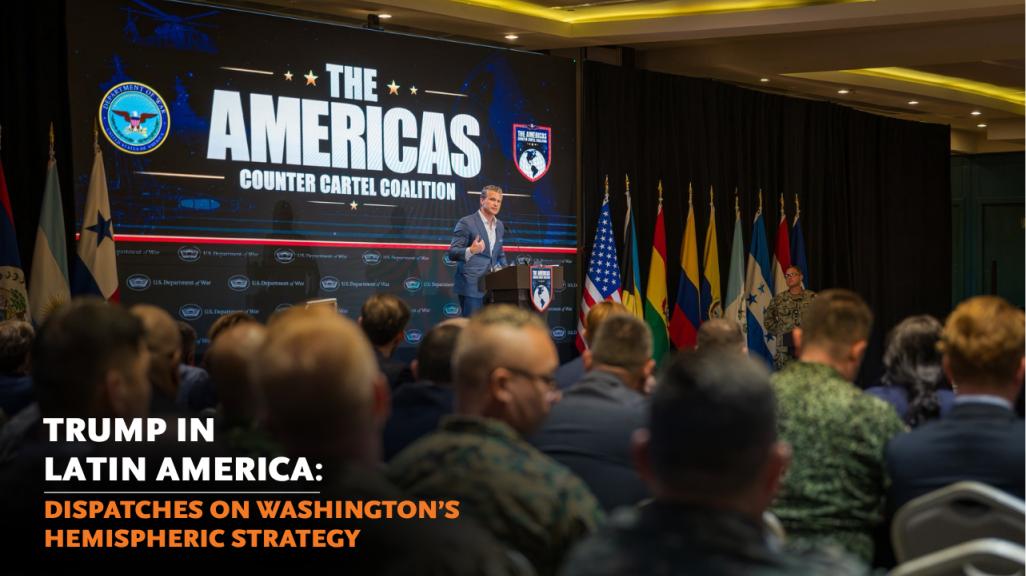
Secretary Hegseth address the A3C. (Hegseth's X)

Secretary Hegseth address the A3C. (Hegseth's X)

Trump in Latin America: U.S. Aids Post-Earthquake Colombia, Hegseth Touts Joint Operations

By Chase Harrison

August 6–13: Plus, a Cuban powerbroker’s mafia ties, a U.S.–China visa standoff in Argentina, and Mexican avocado inspection woes.

Welcome back to our weekly dispatch of stories on the U.S. role in Latin America. Follow us each week and see previous roundups at as-coa.org/dispatches, or sign up to receive them via LinkedIn.

Here’s what to know this week: 

  • Washington pledges quake aid to Colombia days after new president takes office.
  • At Panama summit, Hegseth welcomes Colombia to A3C and touts expanded joint operations.
  • Castro’s grandson named in Cuba mafia indictment as Washington steps up Cuba pressure.
  • Plus: China accuses the United States of threatening Argentine visas, Deputy Secretary of State Christopher Landau visits the Caribbean, Mexican avocados raise U.S. security concerns, and pressure rises on the Jalisco Cartel.
Colombia recovers from earthquake with U.S. aid

After Colombia’s western coast was hit by a 7.4-magnitude earthquake Monday, the State Department announced plans to send $15.5 million in aid and provide an emergency response team. The death toll from the natural disaster stands at over 250 with the largest number of fatalities reported in Cali.

Just three days earlier, the city hosted the inauguration of President Abelardo de la Espriella, who has pledged to take a hardline security approach in a pivot from his predecessor, Gustavo Petro (2022–2026). Closer ties with Washington will be a key aspect of the shift; De la Espriella quickly made good on a promise to have Colombia join the Shield of the Americas, the U.S.-led security cooperation bloc launched in March. 

After the inauguration, then-Acting U.S. Attorney General Todd Blanche, who led the U.S. delegation, described De la Espriella’s oath-taking as “the start of a new friendship and partnership working as a team in the fight against drug trafficking.” Shortly after the inaugural ceremony, the State Department heralded “a new era” in bilateral ties and said it would work with Congress to secure a $1.1 billion security assistance package for Colombia. 

For WLRN, Tim Padgett covers whether the White House’s embrace of de la Espriella, who Trump endorsed, may help win over Florida’s Latino voters in the upcoming U.S. midterm elections in November

In Panama, Hegseth announces Colombia’s A3C entry, extols LAC partners

Secretary of Defense Pete Hegseth was in Panama on August 12 for a two-day summit of the Americas Counter Cartel Coalition (A3C), a U.S.-led regional initiative established in March 2026 in conjunction with the Shield of the Americas. At the summit, Colombia signed on to the A3C, becoming the bloc’s nineteenth member. Hegseth also revealed that de la Espriella had authorized joint counter-terrorism operations with the United States,  a prospect the new president had raised during his campaign. A move allowing foreign troops to operate on Colombian soil would require approval from country’s Senate, reports La Silla Vacía. “Colombia is going to be an incredible partner,” Hegseth said later in a speech at a U.S. military base in Panama’s jungle

Hegseth also praised other countries for partnering on operations, commending Ecuador as the first A3C member to do so, as well as Guatemala and Honduras for “inviting the United States to partake in combined operations against narcoterrorists.”

Hegseth also praised Jamaica for collaborating in the Caribbean, where the United States has carried out deadly attacks on vessels it says are engaged in drug smuggling. Hegseth told the audience that those operations may be investigated by the International Criminal Court (ICC), a body he called on A3C members to reject. The State Department launched a campaign against the ICC last month and Venezuela already withdrew from the agency. (See July 29 dispatch.) 

In his remarks, Hegseth stated: “We follow the Trump corollary to the Monroe Doctrine. We will defend our hemisphere from external threats to national sovereignty, whether from narcoterrorism or foreign malign actors.” A day earlier, the State Department released a video on social media narrated by U.S. Ambassador to Panama Kevin Marino Cabrera describing the Monroe Doctrine as a “framework for regional dominance.” 

In a January 2026 feature for Americas Quarterly, AS/COA’s Brian Winter explored the history of the Monroe Doctrine and its role in the current administration’s policy approach. 

A Cuban powerbroker’s mafia ties

In recent months, Raúl G. Rodríguez Castro, ex-President Raúl Castro’s grandson, has reportedly been a critical figure in talks with the Trump administration during a period in which the State Department has increased targeted sanctions on Havana. Now, The New York Times reports that Rodríguez Castro, whose name has been floated as a potential future leader on the island, may have used his influence to protect a Cuban mafia group engaged in human smuggling and vessel theft. The Cuban government denied Rodríguez Castro’s ties to the mafia and said it had previously warned the United States to take action against the illegal group

Meanwhile, the U.S. pressure campaign on Havana continues. On August 6, Secretary of State Marco Rubio announced new sanctions, this time on five Cuban entities and eight individuals with connections to Cuban government’s military procurement operations. In an interview published by Axios on the same day, Rubio said of the Cuban regime: “Every time they create a new mechanism in which they try to get out of the noose, we just close it off.” 

Last week, Miami Herald and other outlets reported that the CIA had established a task force that seeks to step up pressure for regime change on the island. 

Other headlines

China, U.S. visa standoff in Argentina: On August 6, China’s Embassy in Argentina alleged that the United States threatened to revoke the visas of several Argentine executives operating in the shale oil region of Neuquén over their negotiations with Chinese telecom firm Huawei. The U.S. ambassador to Argentina Peter Lamelas responded to the news on social media by saying, “it is a matter of national security for the United States, Argentina, and energy companies investing in Vaca Muerta and Neuquén.” 

Beijing joins Brazil case: On August 10, Beijing submitted a request to the World Trade Organization to join Brazil’s case against the U.S. imposition of Section 301 tariffs related to forced labor investigations. (See July 29 dispatch.) 

A Caribbean trip: Deputy U.S. Secretary of State Christopher Landau was in Trinidad and Tobago August 9 to 10 to meet with Prime Minister Kamla Persad-Bissessar to discuss energy and security.  Landau then met with Guyanese President Irfaan Ali on August 11 to discuss security and economic cooperation.

Avocad-on and –off: The United States suspended avocado inspection operations in the Mexican state of Michoacán on August 6 over security concerns, temporarily halting imports for the second time since 2022. As Mexican analyst Ramón Peña Franco writes, such a suspension has major economic implications, given that the vast majority of U.S. avocado imports come from Michoacán for an export value of around $3.5 billion in 2024. after the Mexican government dispatched 1,500 troops to the state. 

DOJ ups ante on CJNG: On August 5, the U.S. government announced charges against eight fugitives associated with the New Generation Jalisco Cartel (CJNG), increasing rewards to over $100 million. El País covers Washington’s efforts to battle the cartel

Related

Explore