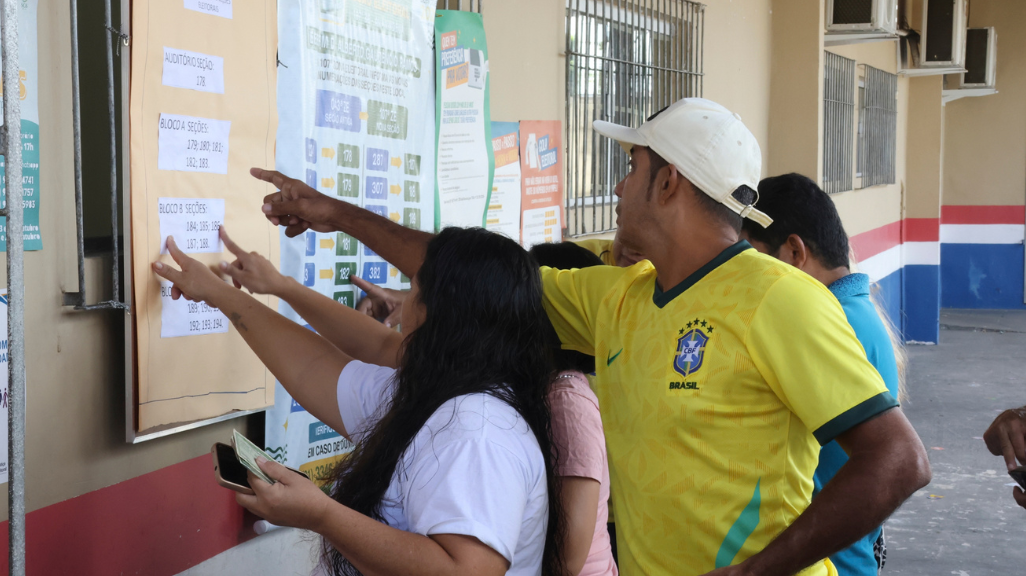
Brazilian voters. (AP)

Brazilian voters. (AP)

Brazil’s Election: Four Points to Understand the First-Round Results

By Luisa Leme and Chase Harrison

With Flávio Bolsonaro pulling ahead in the first round, he and President Luiz Inácio Lula da Silva advance to an October 25 runoff.

It was a big night for the Bolsonaros in Brazil. Just one year after the Supreme Court convicted ex-President Jair Bolsonaro (2019–2023) of a coup plot, his son, Senator Flávio Bolsonaro was the top vote getter in the first round of presidential elections at 47 percent. Not only that, but his Liberal Party (PL) captured the most seats in both chambers of the legislature, with other family members winning seats.

Bolsonaro will face President Luiz Inácio Lula da Silva (2003–2010, 2023–present), who captured just over 45 percent of the vote, in an October 25 runoff. The two will battle for the 8 percent of voters who picked other candidates, as well as the near 6 million Brazilians who cast a null or blank ballot, and the record-breaking 33.5 million who didn’t cast votes at all. 

What are the key takeaways behind the October 4 vote?
1. Bolsonarismo powered the right to a first-round triumph

More than 56 million voters opted for the younger Bolsonaro, marking Lula’s first defeat in a first round since 1998.

Bolsonaro won in 716 municipalities where Lula victored in 2022. All told, Lula earned fewer votes in 25 of 27 states compared with last time, while Bolsonaro flipped cities in key states such as Minas Gerais. Lula won his traditional stronghold, the Northeast region, but not by enough of a margin to make up for his deficit in other regions. 

Sunday’s election was a family affair for the Bolsonaros. Former First Lady Michelle Bolsonaro and Jair’s son, Carlos Bolsonaro, won Senate seats. In the house, another son, Jair Renan Bolsonaro, and brother, Renato Bolsonaro, notched wins. The PL’s strong performance extended to the Chamber of Deputies, where it won 121 of 513 seats. The party also won five governor races, including a surprise triumph in Rio de Janeiro.

2. Other candidates failed to make a dent as abstention hit record levels

The last 48 hours before the election were dominated by speculation over whether one candidate could stave off the runoff by getting 50 percent of the vote. In his final appeal, Bolsonaro asked for voters backing other candidates to rally around an “anti-Lula” vote and seal an early victory. After the results were in, Lula, who had seen his poll numbers rise ahead of the vote, confessed he thought he was headed for a first-round win.

Only about 8 percent of votes went to candidates who were neither Bolsonaro nor Lula. September polling by Quaest suggests that Bolsonaro has an advantage with the voters of the third-, fourth-, and fifth-place candidates, though over a quarter these voters said they intend to nullify their ballots or abstain in a runoff. To win, Lula would need six out of every ten votes that went to losing candidates. 

Overall, the election had an abstention rate of over 21 percent, the highest in Brazil since 1998. Can either candidate mobilize these voters? In 2022, valid votes only increased by 0.3 percent between the first and second rounds. 

3. Senate makeup has implications for the Supreme Court

Brazilians elected two-thirds of the Senate and Bolsonaro’s PL grew its presence in the 81-member assembly from nine to 28 seats, becoming the body’s largest bloc. 

Among its powers, the Senate has the authority to remove Supreme Court justices—a PL campaign promise. After the imprisonment of Jair Bolsonaro, the Court became one of the main enemies of bolsonaristas and other right-wing groups followed, with many Senate candidates running on the same pledge. Starting in February, Brazil’s Senate will have 49 senators in favor of impeachment, just five fewer than than what is needed for a motion to pass. Some Supreme Court justices have been tied to a case involving a major financial scandal known as Banco Master—a case which the Court itself must decide. The Senate would be the only body that could intervene and impeach the potentially implicated justices. 

But the Senate’s shift to the right has implications, given that it had, in the past, been seen as a moderate voice on controversial legislation and also approves Central Bank directors, ambassadors, and heads of other regulatory agencies. 

4. Flávio primes Brazil for closer ties to Washington

The first-round results place Brazil within a region-wide swing to the right. It’s expected that, should he win the runoff, Bolsonaro would seek to have Brazil join the Shield of the Americas, a largely ideologically aligned group of Latin American countries focused on security cooperation.

While U.S. President Donald Trump did not make an endorsement in the race, his influence was felt. Bolsonaro met with him in the White House in May, where he pushed for policies Trump later enacted, such as the U.S. designation of Brazilian crime groups as terrorist organizations. Lula, meanwhile, made sovereignty one of the main areas of his campaign, running ads calling Bolsonaro “Trump’s candidate,” and alerting about the specter of U.S. intervention in Brazil’s democracy. 

Related

Explore