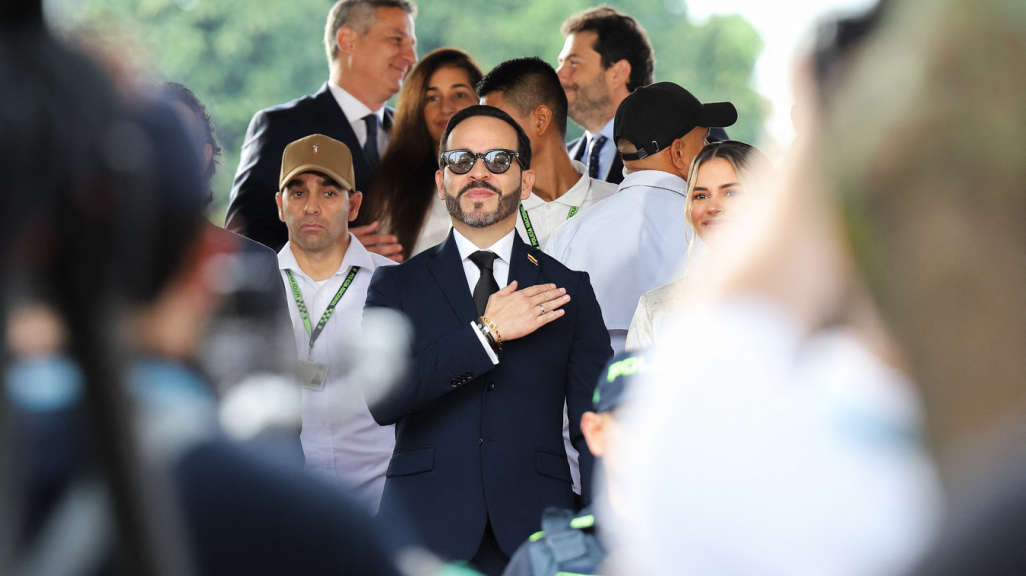
President-elect Abelardo de la Espriella. (AP)

President-elect Abelardo de la Espriella. (AP)

Ahead of Inauguration, Colombia's De La Espriella Sets Agenda 

By Chase Harrison

The president-elect, who takes office August 7, has already unveiled shifts on security strategy, diplomacy, U.S. ties, and an Israeli rapprochement.

On August 7, Abelardo de la Espriella will assume Colombia’s presidency after winning a close June runoff. Ahead of taking office, the right-winger made his agenda known with an emphasis on policies that reverse course from exiting leftist President Gustavo Petro (2022–present).

AS/COA Online compiled a summary of announcements and actions taken by the president-elect ahead of his inauguration.

Decentralization and capital changes

A new inauguration site: De la Espriella will be inaugurated in Cali, a city in Colombia’s southwest, marking the first time a president takes office outside the capital of Bogotá. Originally the president-elect wanted the ceremony to be on a military base in the nearby city of Cauca, in a region strongly affected by the country’s internal conflict, but nearby volcanic activity scuttled that plan. Cali, a traditional stronghold for Petro’s left, was also the site where De la Espriella registered his candidacy.

A second capital: De la Espriella has also proposed plans to turn the presidential palace, El Nariño, into a museum and push Congress to name Barranquilla, a northern city where his family lives, as an alternative capital

A capital manager: The new president has other plans for change in the capital, saying he will appoint a city manager for Bogotá to help advance infrastructure, transit, and security projects. The city’s mayor, Carlos Fernando Galán, a moderate and a prominent political figure, celebrated the decision

Strengthened U.S.–Colombia ties

Joining the Shield: De la Espriella said that on his first day in office Colombia will join Trump’s regional security bloc known as the Shield of the Americas. In another sign of his decentralization push, he proposed that Colombia’s operations as part of this bloc would operate out of Medellín

Senior-level meetings with State: Members of De la Espriella’s cabinet, including Vice President-elect José Manuel Restrepo, visited Washington in mid-July, meeting with figures such as U.S. Secretary of State Marco Rubio to discuss expanding bilateral cooperation. 

New security partnerships: After a July 21 meeting with de la Espriella’s incoming defense minister, U.S. Assistant Secretary of Defense Joseph M. Humire announced that the two countries would collaborate on a security initiative dubbed Plan Patriota 2.0. The name references a security strategy undertaken during the presidency of Álvaro Uribe (2002–2010) in which the Colombian government attempted to wrest territorial control from left-wing guerilla groups like the FARC and the ELN. As that plan develops, De la Espriella has been clear that he will not resume the security policies of Petro that include negotiations, ceasefires, and concessions. In a June 25 speech, he said armed groups will have 100 days into his administration to surrender

Diplomatic shifts

Rapprochement with Israel: De la Espriella plans to restore Colombia’s Israeli diplomatic and economic relations, which Petro severed in 2024 due to that country’s siege of Gaza. De la Espriella also plans to lift visa requirements and move the Colombian embassy from Tel Aviv to Jerusalem, a shift Israel has requested of allies. Guatemala, Honduras, and Paraguay are among the Latin American countries that relocated embassies in recent years. 

Colombia’s incoming Foreign Minister Omar Bula Escobar met with Israeli Foreign Minister Gideon Sa’ar in Washington on July 15. Shortly after, De la Espriella announced he intends to withdraw Colombia’s support of South Africa’s case against Israel in the International Court of Justice in The Hague. 

Eliminating embassies: The president-elect plans to sever relations with the governments of Cuba and Nicaragua, saying, “There will be no ties whatsoever with tyrannies in my government.” He seeks to close 14 embassies, mainly in Europe and Africa. De la Espriella also plans to shutter 15 yet-to-be-identified consulates.

His government pitched a technical audit of embassies and consulates to determine if further consolidation is needed with the goal of redirecting funds toward security and public investment initiatives.

Looking at the legislature

Congressional divides: The new Congress, which was inaugurated July 20, will be fragmented, and the National Salvation Movement, the party under which De la Espriella campaigned, holds just one seat in the Chamber of Representatives and four seats in the Senate. De La Espriella has worked to consolidate his alliance with Uribe’s Democratic Center (CD), the Conservative Party, Radical Change, and We Believe. However, the coalition would still be short of the seats needed to pass legislation.

Leadership differences: De la Espriella’s relationship with the CD came into question after the party failed to support the president-elect's choice for president of the Senate, Alfredo Deluque. Instead, the CD backed one of their own, Honorio Henriquez, who won after picking up votes from Petro’s Historic Pact and several dissenting members of parties aligned with De la Espriella. “I fully respect the autonomy of the Congress of the Republic and the independence of the branches of government,” said De la Espriella of the vote

De la Espriella’s choice for president of the Chamber of Deputies, Nicolás Barguil of the Conservative Party, won with the support of allied parties.

ADLE’s new party: On August 3, Colombia’s National Electoral Council approved the legal status of Defenders of the Homeland, De la Espriella’s party, even though it did not receive enough votes nationwide in the March congressional election to automatically achieve registration. This decision, which was not unanimous, will allow Defenders of the Homeland to receive state funding and endorse candidates in next year’s regional elections

An early congressional victory: Despite questions about the incoming leader’s congressional control, the new legislature did hand him a win when it approved De la Espriella’s request to move the inauguration site to Cali

Related

Explore