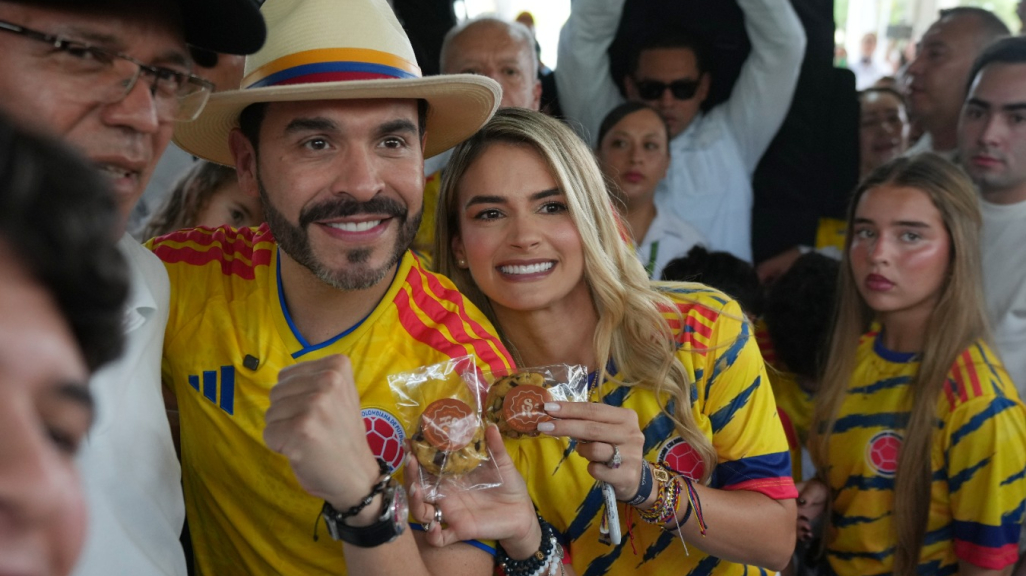
Abelardo de la Espriella and his wife, Ana Lucía Pineda. (AP)

Abelardo de la Espriella and his wife, Ana Lucía Pineda. (AP)

What to Know About Colombia's 2026 Presidential Runoff Results

By Chase Harrison

Far-right lawyer Abelardo de la Espriella is headed for a tight win in a runoff that saw record turnout.

After his strong performance in the first round of Colombia’s presidential race, victory seemed imminent for Abelardo de la Espriella. Sure enough, Sunday’s preliminary results indicate that the far-right lawyer will be the one taking office on August 7. Though his win was not yet official as of the time of publishing, per Colombia’s electoral authority, de la Espriella captured 49.7 percent of the vote to leftist Iván Cepeda’s 48.7 percent, meaning a tighter margin than expected

Outgoing president Gustavo Petro (2022–2026), the first leftist leader in the country’s history, has said he will wait until the count is concluded to recognize a winner. A review of votes began Sunday night and Cepeda has issued challenges to over a quarter of ballot boxes. A recount seems likely.

De la Espriella’s ascent to the presidential palace would represent a repudiation of traditional political actors. Highlighting a rise in insecurity, de la Espriella campaigned on a hardline approach to crime and narcotrafficking. He also has vowed to implement austerity and invest in the hydrocarbon sector. 

What could Sunday’s results mean for de la Espriella’s presidency? Who congratulated him? AS/COA Online covers what you need to know.
A photo finish

The margin between de la Espriella and Cepeda was about one percentage point. Out of the near 26 million valid votes cast, only around 250,000 votes separated the two candidates. That means de la Espriella lost ground against his top rival since the first round, when he secured nearly 675,000 votes more than Cepeda. 

“De La Espriella’s narrow lead does not guarantee a mandate and suggests he will have to tone down his incendiary rhetoric and potentially water down a part of his ambitious agenda to succeed,” Colombian analyst Sergio Guzmán told Americas Quarterly

This was reflected in de la Espriella’s victory speech. Delivered in the coastal city of Barranquilla, home to his campaign headquarters, he vowed to be “president of all Colombians” and that there would be no “winners nor losers.”  He promised to respect the rights and opinions of those who did not vote for him and said, “There will be no retaliation, no persecution, because in a democracy there are no irreconcilable enemies.” This sentiment contrasted with messaging in his campaign, when he promised, at one point, to “disembowel” the left.

Indeed, de la Espriella will need to reach across the aisle, given that his movement lacks a consolidated legislative bloc. His political party, the National Salvation Movement, has just one seat in the Senate and four in the Chamber of Representatives. Several parties with deeper legislative benches in Congress—including the Radical Change, the Democratic Center, the Conservative Party, the Liberal Party, and the Party of the U—endorsed de la Espriella in the runoff, but he did not accept their support, playing up his distaste for traditional parties. The day before the election, he sent a letter to Congress warning legislators not to obstruct his agenda. 

Which leaders congratulated de la Espriella?

Just as swiftly as Colombia’s electoral results came in, so too did congratulations for de la Espriella.

Right-wing Argentine President Javier Milei, who has identified his presidency with a lion, congratulated his ideological ally, who calls himself “The Tiger,” writing on X: “THE LION AND THE TIGER ROAR IN LATIN AMERICA...!!!” 

Other ideologically aligned Latin American leaders who congratulated de la Espriella include Ecuador’s Daniel Noboa, Chile’s José Antonio Kast, Paraguay’s Santiago Peña, Bolivia’s Rodrigo Paz, Panama’s José Raúl Mulino, and the Dominican Republic’s Luis Abinader. Peru’s Keiko Fujimori, whose victory in her country’s runoff is still pending, also sent her support

Latin America’s left-wing presidents, many of whom were ideologically close to Petro, have not issued congratulations as of June 22. In her morning press conference, Mexico’s Claudia Sheinbaum said she would congratulate de la Espriella once results are official. As of time of publishing, Brazil’s Luiz Inácio Lula da Silva had not spoken on the results, though his electoral opponent Flávio Bolsonaro celebrated de la Espriella’s win. 

Uruguay’s Yamandú Orsi and Venezuela’s Delcy Rodríguez have also not spoken on the results. However, Venezuelan opposition leader María Corina Machado congratulated de la Espriella and wrote, “We know that we will have a great ally in the democratic transition of Venezuela and that together, we will achieve the prosperity and security of our people.”

Several senior U.S. officials also sent their regards to de la Espriella, whom President Donald Trump endorsed in both rounds of the election. Secretary of State Marco Rubio, Secretary of the Treasury Scott Bessent, Secretary of Energy Chris Wright, and Deputy Secretary of State Christopher Landau sent messages, with Landau trumpeting, “A new dawn for Colombia!”

Turnout hits record levels

Of the 41.4 million Colombians on the voter rolls, about 26.3 million cast a ballot on Sunday. The turnout of 63.6 percent marked the highest rate of any Colombian runoff.


Just over 98 percent of voters cast a ballot for either de la Espriella or Cepeda. About 1.6 percent cast blank ballots, 0.1 percent cast unmarked ballots, and 0.8 percent—or 220,000—cast null votes.

Geographic breakdown stays constant

In the runoff, both candidates focused on expanding their support in specific geographic regions of the country. De la Espriella, who is from the Caribbean, where he had outperformed previous right-wing candidates in the first round. However, Cepeda expanded his support in all of the Caribbean provinces, which had been beneficiaries of government spending from Petro. Cepeda concentrated campaign efforts not only in the Caribbean but also in Bogotá. There, he expanded his support from 42 percent of votes in the first round to 53 percent in the runoff

In the Atlantic, another region that went for Cepeda, there was an almost 10 percent jump in voter participation between the first and second rounds.

Overall, no province switched from one candidate to the other between the rounds.

Related

Explore