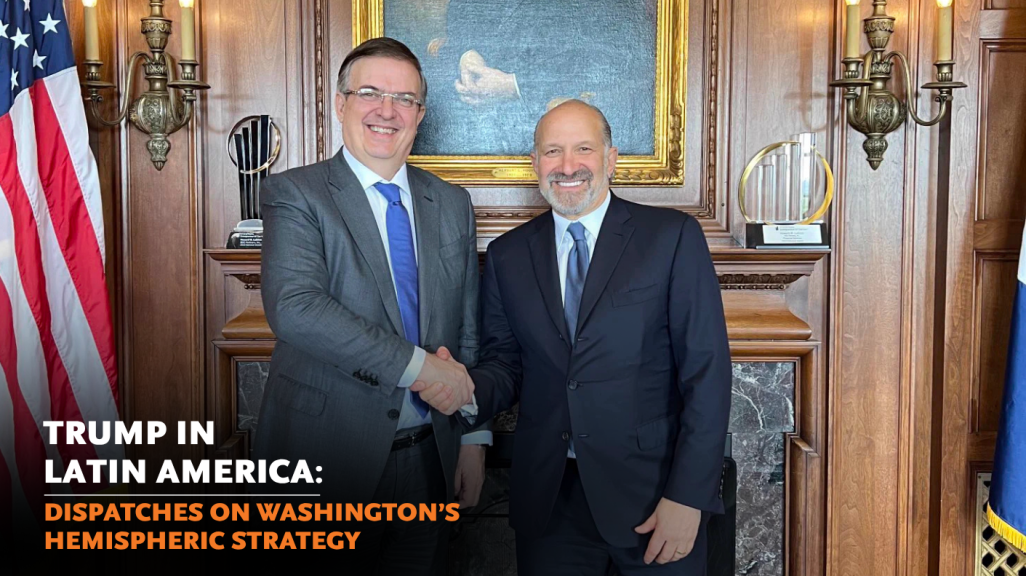
Mexican Economy Minister Marcelo Ebrard and U.S. Secretary of Commerce Howard Lutnick meeting last year. (Ebard's X)

Mexican Economy Minister Marcelo Ebrard and U.S. Secretary of Commerce Howard Lutnick meeting last year. (Ebrard's X)

Trump in Latin America: Trade Paths for Mexico, Diplo Chatter in Chile, Delcy Eyes NYC

By Chase Harrison and Carin Zissis

Sep 11- Sep 16: Plus, doubts on Trump's Falklands/Malvinas position grow, new U.S. tariffs on Canada take effect, and Washington inks a DR rare earths deal

Welcome back to our weekly dispatch of stories on the U.S. role in Latin America. Follow us each week and see previous roundups at as-coa.org/dispatches, or sign up to receive them via LinkedIn.

Here’s what to know this week: 

  • U.S. trade negotiators may come to an agreement with Mexico before midterms. On Canada? Well, it’s complicated.
  • Washington’s man in Chile ruffles feathers amid diplomatic kerfuffle.
  • Venezuelan interim President Delcy Rodríguez weighs a Big Apple visit.
  • Trump continues to toy with Falklands/Malvinas neutrality as Milei sanctions businesses on the islands.
  • Plus: U.S.–Mexico defense ties deepen, a Dominican rare earths deal goes under the microscope, and New York prepares for a very presidential week.
A (Mexican) way forward on USMCA?

If you’re a regular reader of our weekly dispatch, you know we’ve reported that on multiple occasions, President Donald Trump has questioned and even threatened to quit the U.S.–Mexico–Canada Agreement. But Trump sang a different tune in Dublin over the weekend. When asked about the deal’s future at a press conference, he forecast that Washington would not withdraw and would have a “great relationship” with Mexico. The comments came a day after sources told Reuters the two countries hope to reach a bilateral deal before the U.S. midterms, and followed a September 9 virtual meeting between Mexican President Claudia Sheinbaum and U.S. Commerce Secretary Howard Lutnick to evaluate USMCA negotiation progress. Various reports signal that a new round of U.S.–Mexico talks could take place by the end of the month and as soon as next week.

Mexico is seeking tariff reductions affecting steel, aluminum, and the auto sector, while The Wall Street Journal reports that U.S. negotiators want Mexico to limit Chinese inputs into AI hardware destined for export. Mexico has witnessed major growth in its tech manufacturing sector, where foreign direct investment increased 187 percent in the first half of 2026. Chinese investment in Mexican computer and related-equipment manufacturing nearly tripled during that time

On Canada...it’s complicated

When it comes to Ottawa, Trump described relations as “good” during the same press conference before going on to say, “The United States has been ripped off for 50 years by Canada.” The two countries have been rolling out retaliatory tariff measures in recent weeks, with the latest round from the U.S. side taking effect September 15. If no agreement is reached by September 29, Washington will also implement a ban on most Canadian alcoholic beverages and motorcycles, as well as products such as whey and molasses

Canadian Prime Minister Mark Carney, who has been looking to diversify global partnerships as U.S. ties fray, was in France this week, where European Commission President Ursula von der Leyen proposed that his country could become the EU’s first associate member

Trump continues to toy with the Falklands/Malvinas question

Also while in Ireland, Trump said he “probably could settle” the Falklands/Malvinas dispute, adding to prior comments that have called into question whether he intends to maintain Washington's neutral stance when it comes to the territory. Argentine President Javier Milei, who delivered a September 3 national address on the issue, announced this week that he plans to introduce legislation to toughen sanctions against companies operating on the islands. This would build on sanctions announced by his government on September 8 against 60 individuals and entities it believes have been illegally exploring for oil around the Falklands/Malvinas. 

In Chile, chatter over diplomatic differences

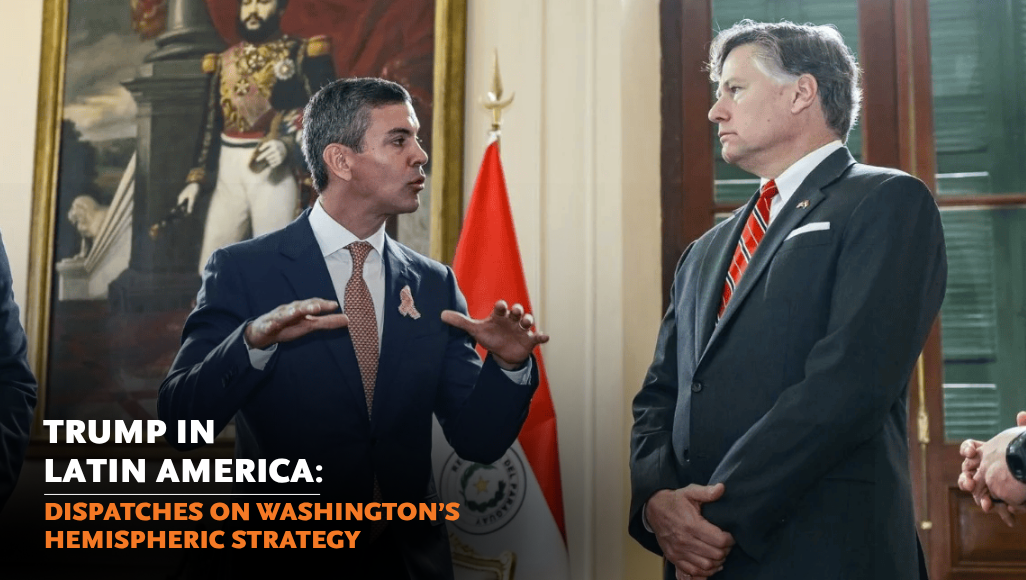
In an interview with La Tercera, U.S. Ambassador to Chile Brandon Judd defended Washington’s decision to include Chile in an investigation of 60 economies that resulted in a 12.5 percent tariff on the country's products for failing to implement regulations barring imports made with forced labor. Judd, a political appointee who previously headed a U.S. border patrol union, also warned that he plans to continue being “a different type of ambassador,” adding that “at times we need to have very, very frank conversations.” 

His comments came after he walked back his claims that U.S. intelligence had indicated left-wing groups were behind Chile’s 2019 social protests. Chilean Foreign Minister Francisco Pérez Mackenna responded to the controversy over the remarks last week by saying: “Ambassadors in general should not opine on the internal politics of the countries where they are based,” and suggested Judd had been advised as such on more than one occasion.

Chile is six months into the government of President José Antonio Kast, whose election is part of the right-wing shift in Latin America that has deepened Trump administration alliances in the region. Still, the Kast government has yet to officially join the Shield of the Americas. In a September 13 interview with El Mercurio, MacKenna was asked whether entrance into the Trump-backed regional security group was tied to reductions of U.S. tariffs. The minister dismissed the idea, saying: “I have not felt U.S. pressure to modify our foreign trade policy.” 

Is Delcy in an Empire State of Mind?

Bloomberg reports that Venezuelan interim President Delcy Rodríguez plans to attend the UN General Assembly in New York next week, which would be the first visit for a head of state from that country since 2018. At the time of this report, both Secretary of State Marco Rubio and Trump have indicated they would meet with her if she makes the trip to New York.

And on September 16, Trump announced he would remove Venezuela from the list of countries Washington believes have failed to demonstrably to combat drug trafficking. The hemispheric countries identified as major drug transit or major drug producers are: The Bahamas, Belize, Bolivia, Colombia, Costa Rica, the Dominican Republic, Ecuador, El Salvador, Guatemala, Haiti, Honduras, Jamaica, Mexico, Nicaragua, Panama, Peru, and Venezuela.

Meanwhile, representatives from Rodríguez’s government are taking meetings on the sidelines of the G20 ministerial on energy in Houston, running from September 14 to 16, after being invited by the United States. Minister of Hydrocarbons Paula Henao's presence marks the first appearance for the country at G20 energy talks.

Should Rodríguez visit the Big Apple, she’ll be in the same city as her predecessor, Nicolás Maduro, who continues to be held in a Brooklyn jail. Meanwhile, Alex Saab, a financier who served in Maduro’s administration and helped the ex-leader evade sanctions, pleaded guilty on September 15 in a Miami court to money laundering. Saab, deported to the United States in May, took a plea deal that will see him cooperating with federal investigations around corruption in Venezuela, suggesting Saab may serve as a witness against Maduro.

In other news

Military money moves. The Associated Press reports that the State Department is shifting $52 million in foreign military financing from Iraq, North Macedonia, Slovakia, and Tunisia to Panama, Ecuador, Colombia, and Peru. The last three countries hosted Secretary of State Marco Rubio last week. 

U.S.-Mexico defense ties deepen. Mexico’s Senate has authorized 139 U.S. military personnel to train in the country at the end of September, marking the fourth such authorization of U.S. troops this year and the first to exceed 100 personnel. The troops will be stationed in Chihuahua, a state that was the site of a row over the presence—and death—of two U.S. CIA officers in April. The Sheinbaum government said the officers were not authorized to be in the country

Wired reports that the two countries are also partnering on a new operation called High Eagle that uses laser-based technology to battle drones linked to organized crime groups

Salvadoran TPS in limbo. Also in immigration news, Temporary Protected Status (TPS) was set to expire for roughly 170,000 Salvadorans in the United States on September 9 but the U.S. Department of Homeland Security has yet to make an announcement of the program’s termination. If no action is taken, TPS protection allowing holders to live and work legally in the Unites States, will be extended for six months. El Salvador’s TPS designation is the last in the hemisphere and one of four remaining overall.

Digging deep on the US-DR rare earths deal. The Latin Times does a deep dive on a September 10 framework deal inked by Washington and Santo Domingo in which the two governments agreed to “jointly flag mining projects of shared interest, open financing channels, shield their respective critical-minerals markets, and knit together a supply chain running from the ground to finished, separated material.” The article notes that the agreement is nonbinding, making it similar to as many as 27 other U.S. cooperation agreements that aim to weaken Chinese control over rare earths. 

The presidents are coming, the presidents are coming! World leaders descend on New York next week for the opening of the UN General Assembly debate. As always, Brazil (in this case Luiz Inácio Lula da Silva) opens the debate, followed by the United States (Trump). Will we see any exchanges between the two hemispheric leaders? Check out the dispatch next week for updates.

And, as Lula competes for reelection in an incredibly tight race, could we be watching his last address at the embattled institution? Follow our Brazil election coverage to learn more about the race. 

Related

Explore