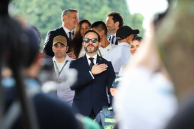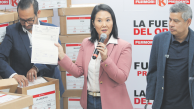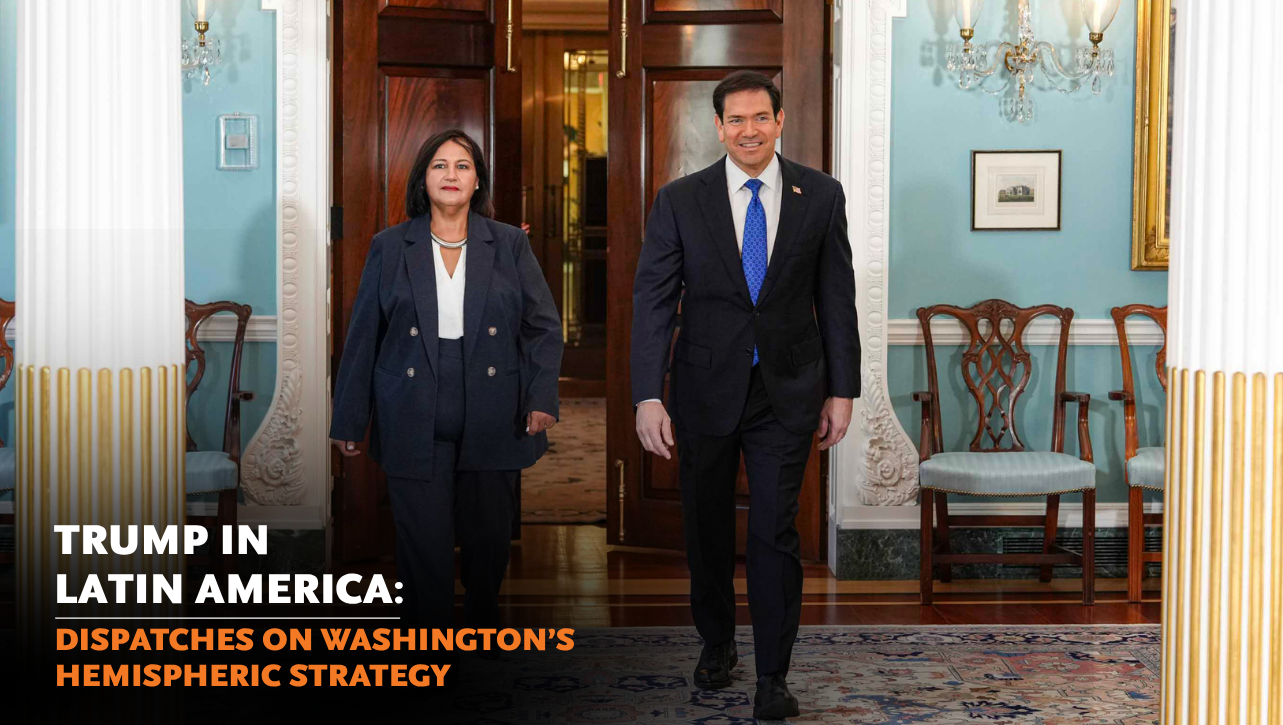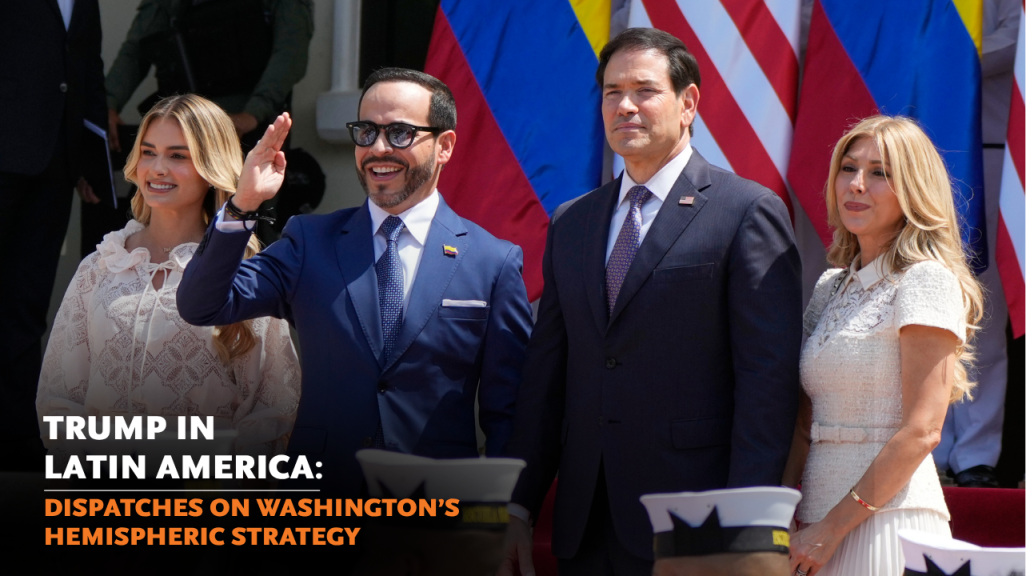
Center: Colombian President Abelardo de la Espriella and U.S. Secretary of State Marco Rubio. (AP)

Center: Colombian President Abelardo de la Espriella and U.S. Secretary of State Marco Rubio. (AP)

Trump in Latin America: Rubio Courts Allies in Colombia, Ecuador, and Peru

By Chase Harrison and Khalea Robertson

Security and China's role are on the secretary's September 8–10 agenda as he meets Presidents Abelardo de la Espriella, Daniel Noboa, and Keiko Fujimori.

Welcome back to our weekly dispatch of stories on the U.S. role in Latin America. Follow us each week and see previous roundups at as-coa.org/dispatches, or sign up to receive them via LinkedIn.

In this edition, we map Secretary of State Marco Rubio’s Andean tour and charts key aspects to U.S. relations with Colombia, Ecuador and Peru. This page will be updated over the course of the secretary’s trip.

Here’s what to know this week: 

  • In Colombia, Rubio and De la Espriella sign mining and nuclear accords, celebrate security partnerships. Plus, Chart: U.S. aid to Colombia
  • Rubio receives national award in Ecuador and announces new FTO designation in security-focused visit. Plus, Timeline: High-level U.S.-Ecuador meetings during Trump 2.0
  • Fujimori government joins the Shield of Americas as Rubio looks to compete with Chinese investment in Peru. Plus, Chart: Peru’s trade with China and the United States
Overview

On his three-country trip to South America from September 8 to 10, Secretary of State Marco Rubio meets with new presidents Abelardo de la Espriella of Colombia and Keiko Fujimori of Peru in his first official visit to both countries. His Andean-nation tour also brings him to Ecuador, where he previously made a state visit in September 2025, to meet with President Daniel Noboa. In all three countries, Rubio’s agenda focuses on security and commercial ties with likeminded heads of state at a time when the Trump administration is pursuing its goal of bolstering its regional counternarcotics approach while pushing back against Chinese economic influence.

In Colombia, Rubio and De la Espriella sign mining, nuclear accords

Rubio began his trip in Colombia, flying on September 8 into Barranquilla, the home of De la Espriella. One month into his term, De la Espriella has worked to improve the U.S.–Colombia relationship after it strained under his predecessor, Gustavo Petro, who clashed with Trump on security policy. The Trump administration has already deemed De la Espriella’s presidency “A New Era in U.S. Colombia Relations” and Rubio’s trip marked the first high-level visit of a foreign dignitary since De la Espriella’s August 8 inauguration. 

During his visit, Rubio and Foreign Minister Omar Bula signed two memorandums focused on mining and nuclear energy and dubbed the Barranquilla Agreements. The mining accord creates a framework for U.S. and Colombian companies to collaborate on the exploration, processing, and sale of critical minerals and rare earths, of which Colombia is believed to have large unexplored deposits. The nuclear agreement focuses on fostering collaboration to advance nuclear energy for civilian use.

Though both Rubio and De la Espriella said that security was the main topic in their private discussions, no new initiatives were announced. However, the two leaders celebrated Colombia’s entry into the regional Shield of the Americas as well as the prospect of the Patriot Plan, a bilateral security project announced in July that seeks to modernize Colombia’s military capabilities and technology.

One wedge in the bilateral relationship, though, has been Washington’s July imposition of 12.5 percent tariffs on Colombian goods. Colombia is one of 60 countries facing tariffs over U.S. charges that the country hasn’t done enough to stop forced labor practices. After Colombia’s August 10 earthquake, De la Espriella asked for the United States to lift the tariffs as the country faced the task of recovery. While on the ground in Barranquilla, Rubio told the outlet RCN, “I believe there have been two rounds of negotiations, they have progressed very well, and I hope that very soon the issue can be resolved through that agreement between the two countries.”

De la Espriella and Rubio are looking to build on a historically strong relationship between Colombia and the United States. Colombia has been the top recipient of U.S. aid in the region for most of the past decade and, on the day of De la Espriella’s inauguration, Washington announced its intention to pass a $1 billion security assistance package, which would be the highest amount of U.S. aid sent to Colombia in two decades.

Security tops U.S. Ecuador agenda as joint operations expand

Rubio received Ecuador’s National Order of Merit shortly after he landed for his second trip to the country as secretary of state on September 9. “When we see threats to security, we have to work. And your president is doing so in an incredible way,” said Rubio during the award ceremony at the Carondelet presidential palace, highlighting the intensifying security alliance between Quito and Washington. In turn, Noboa praised the secretary’s efforts “to improve the lives of people looking for security” across the region.

Speaking at a press conference with Foreign Minister Roberto Kury later that day, Rubio referred to Ecuador as “the most involved and aggressive partner” of the Americas Counter-Cartel Coalition (A3C). Under the A3C framework, Noboa announced in March 2026 that Ecuador would begin joint operations with the United States against narcoterrorism and illegal mining. A military strike that month on what U.S. and Ecuadorian officials contended was a drug trafficking base in a rural town near the Colombian border was among the first-known inland attacks of the Trump administration’s anti-narcotrafficking operations in Latin America. The majority of strikes have targeted boats in the Eastern Pacific Ocean and the Caribbean Sea

The maritime airstrike campaign has evolved since August 28, when Southcom first announced “coordination and collaboration with the Government of Ecuador,” to intercept at least six vessels it said served as refueling stations for alleged drug boats, turning the vessels’ crews over to Ecuadorian authorities before sinking the seacrafts. Southcom linked the vessels to Los Choneros, one of the three Ecuador-based narcotrafficking gangs the White House designates as foreign terrorist organizations. On Wednesday, Rubio announced another group, Los Tiguerones, would be added to the list.

A September 8 op-ed by Rubio, published by outlets in all three countries, emphasized growing investment from U.S. technology firms in Ecuador while warning against Chinese promises “that mask their predatory practices.” In August, Noboa made a weeklong visit to China, where he met with President Xi Jinping and signed seven agreements covering trade, investment, technology, and renewable energy. The Noboa administration also signed a reciprocal trade agreement with the United States in March as Latin American leaders continue to balance relations between Washington and Beijing.


Peru’s Chinese investments under scrutiny as Fujimori deepens DC ties

Fujimori hosts Rubio on September 10, a little over a month after her July 28 inauguration marking the ongoing rise of right-wing presidencies in Latin America. On the campaign trail, Fujimori pledged to strengthen economic ties with Washington and attract U.S. investment

As it stands though, Peru is, after Brazil, the second-largest recipient of Chinese investment in Latin America. Beijing has been Peru’s top trading partner for much of the past 15 years. Writing about Peru ahead of his visit, Rubio mentioned “Chinese Communist Party-backed projects [that] challenge Peru’s legal frameworks” in reference to Peru’s Chancay megaport, which Xi inaugurated in 2024 and has become emblematic of the U.S.–China rivalry in the region. 

On the other hand, like De la Espriella and Noboa, Fujimori has sought to adopt a mano dura approach to security and shown a willingness to work with the White House on these issues. Already, Rubio announced on September 8 that Fujimori’s government will be the latest regional partner to join the Shield of the Americas

Related

Explore