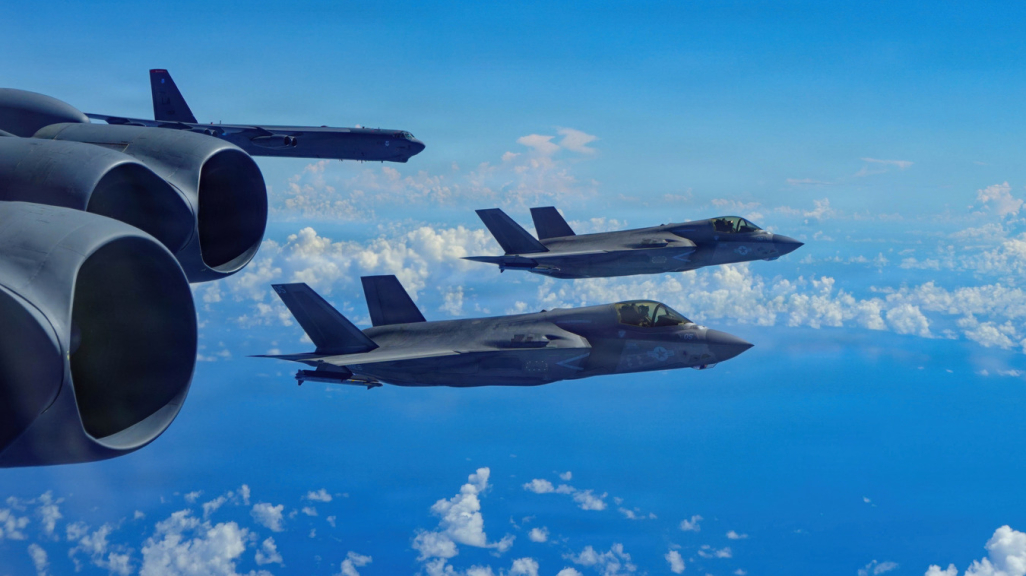
U.S. military aircrafts

U.S. military aircrafts. (AP)

Share

Timeline: U.S. Military Ramp-Up in the Caribbean Culminates in Capture of Maduro 

By Khalea Robertson

The ouster of the Venezuelan strongman came amid an accumulation of military assets in the region and ongoing fatal strikes on alleged drug boats.

This timeline was originally published on October 31, 2025, and has since been updated.

With pillars of smoke still clearing from the explosions that rocked Caracas and surrounding states in the early morning hours of January 3, news broke that U.S. military forces had seized Venezuelan leader Nicolás Maduro and his wife, Cilia Flores, from their fortified residence in the capital. By that evening, Maduro and Flores landed in New York. The operation represents an astonishing peak in tensions in the Caribbean where, since beginning a campaign of lethal strikes on alleged drug vessels in September, the U.S. military has assembled its largest deployment of assets in the Americas in decades.

The administration of President Donald Trump has doubled down on linking the fight against drug trafficking to combating terrorism and accused Maduro of coordinating narcoterrorist actions against the United States. The indictment against Maduro—as well as his son, Flores, and close associates—claims the deposed leader oversaw and participated in a network of corrupt government and military officials that profited from collaboration with drug traffickers shipping cocaine to the United States.

The capture of Maduro has drawn a range of responses internationally. Trump administration allies have expressed support for the action, while other countries and multilateral organizations have criticized the legal grounds behind the operation. Domestically, U.S. lawmakers have raised concerns about the executive branch’s decision to carry out the maneuver without congressional approval or notification.

In mid-October, the U.S. military strikes expanded to include the Eastern Pacific. As of December 31, the reported death tally from the boat strikes is 115 people. The estimated death toll of the Caracas operation is as many as 80 people, including military personnel.

AS/COA Online traces a timeline of the developments. 
August 15: CNN reports that the United States has been increasing its military presence in the Caribbean basin, sending over 4,000 Navy and Marine personnel along with a fleet that includes guided-missile destroyers and submarine assault vessels. Communications from the U.S. Navy and the Department of Defense confirm the deployment of these assets but do not specify the destination.

August 18: In response to the U.S. military buildup, Maduro declares the deployment of 4.5 million militia troops. The militia, formed in 2009 under late President Hugo Chávez, comprises reservists and volunteers that provide reinforcement for the Bolivarian National Armed Forces of Venezuela (FANB). The International Institute for Strategic Studies estimates that there are around 123,000 active troops within the FANB.

September 2: The Trump administration announces its first strike on an alleged narcotrafficking vessel in the Caribbean. Trump says the strike killed 11 people on the boat, which reportedly departed from Venezuela.

Secretary of State and acting National Security Advisor Marco Rubio initially says the boat was likely trafficking drugs to Trinidad or another island in the Eastern Caribbean, but Trump says the suspected narcotics were U.S.-bound and linked to Tren de Aragua, a Venezuelan gang the White House designated as a Foreign Terrorist Organization (FTO) in February.

According to the U.S. Drug Enforcement Agency (DEA), Tren de Aragua is a gang primarily involved in migrant smuggling and extortion with some involvement in street-level drug dealing. The gang is not known to traffic fentanyl, the leading cause of U.S. overdose deaths. Neither the DEA nor the UN Office on Drugs and Crime identify Venezuela as a major cocaine producer. A 2019 DEA study indicates that cocaine transported through Venezuela accounts for around 8 percent of the total trafficked into the United States.

September 8: On a surprise visit to Puerto Rico, Defense Secretary Pete Hegseth tells Navy and Marine personnel deployed on a warship there that they’ve been sent to the “front lines” of an offense against narcotrafficking.

In an interview with CNN that day, Venezuelan Foreign Minister Yván Gil insists that his country wants to avoid conflict with the United States.

September 13: F-35 fighter jets arrive in Puerto Rico, stationed at a naval base that was defunct for more than two decades. 

September 15: Trump says the U.S. military has blown up a second boat in the Caribbean. The White House identifies the three people killed as Venezuelan, but one victim is later confirmed to be a fisherman from Santa Marta, Colombia, drawing condemnation from Colombian President Gustavo Petro.

September 19: On social media, Trump says that a third strike has killed three people. He adds that “intelligence confirmed the vessel was trafficking illicit narcotics.”

October 2: News reports reveal that, in a confidential memo to Congress, Trump declared that the United States is in a “non-international armed conflict” against drug trafficking. The document informs that the president has directed the Defense Department to “use force in self-defense and defense of others against the ongoing attacks by these designated terrorist organizations,” in reference to the Latin American gangs and cartels the Trump White House has classified as FTOs. It also refers to the crews of alleged narcotrafficking vessels as “unlawful combatants.”

October 3: Hegseth announces that a fourth strike in Caribbean waters off Venezuela killed four people but does not specify the nationality or suspected gang affiliation of the deceased. Petro suggests that the victims may have been Colombian citizens, an allegation the U.S. government asks him to retract.

October 6: Reports emerge that Trump ended the diplomatic outreach to the Maduro regime that was led by special envoy Richard Grenell. In February, Grenell negotiated the release of six U.S. detainees in Venezuelan prisons and, per The New York Times, was working to facilitate access to Venezuelan oil for U.S. companies.

October 8: Republicans in the U.S. Senate vote down a resolution seeking to stop strikes on non-military targets in the Caribbean unless authorized by Congress. The 48-51 vote was split mainly along party lines, but Lisa Murkowski (R-AK) and Rand Paul (R-KY) voted with Democrats in support of the bill. John Fetterman (D-PA) was the sole Democrat to vote against the resolution.

October 14: A fifth U.S. military strike kills six people aboard a boat off the coast of Venezuela. Trump again alleges that the victims were drug traffickers connected to a criminal organization designated an FTO, without specifying which group. Two citizens of Trinidad and Tobago are believed to be among those killed as family members of two fishermen raise alarms, but neither U.S. nor Trinidadian authorities confirm the nationalities.

October 15: Trump confirms he authorized the Central Intelligence Agency to conduct covert operations in Venezuela.

October 16: The U.S. military takes into custody two survivors of a sixth strike in the Caribbean, this time on a semi-submersible vessel. Washington later repatriates one to Ecuador and the other to Colombia. Ecuadoran authorities said they found no evidence of a crime and the man was released from custody. Colombian authorities say there is no evidence against their citizen, but add they will investigate the case.

Also on this day, the head of U.S. Southern Command (SOUTHCOM), Admiral Alvin Holsey, announces that he will retire from service in December 2025. The decision comes about a year into what was expected to be at least a three-year posting. Partly in response to Adm. Holsey’s impending retirement, Representative Adam Smith (D-WA), who serves on the U.S. House Armed Services Committee, releases an October 20 statement demanding a congressional hearing on the strikes campaign.

October 17: A seventh strike kills three men the U.S. government accuses of belonging to the National Liberation Army of Colombia (ELN). In a social media post sharing footage of the attack on the alleged drug boat, Hegseth refers to “these cartels” as “the Al Qaeda of the Western Hemisphere.” The United States, then under President Bill Clinton, designated the ELN as a terrorist group in 1997.

Petro refutes the claims of ELN involvement, saying that the vessel was a fishing boat. Trump responds by calling Petro “an illegal drug leader” and threatens to end financial assistance to Colombia and raise tariffs.

October 22: The military campaign against alleged narcotrafficking expands to the Pacific. On the social media platform X, Hegseth shares videos of two separate strikes on boats, with at least one reported to be off the coast of Colombia. The defense secretary says five “narco-terrorists” were killed in the attacks.

Speaking to reporters at the White House the following day, Trump said that while he plans to keep Congress informed about the strikes, he does not plan to request a declaration of war. 

October 24: Hegseth announces the eighth strike of an alleged drug trafficking vessel in Caribbean waters, and tenth overall in the Americas, killing six people. He claims that Tren de Aragua was operating the boat.

That same day, Hegseth orders the deployment of the U.S. Navy’s largest aircraft carrier, the USS Gerald R. Ford, to the Caribbean. The carrier hosts approximately 5,000 troops and over 75 aircrafts with attack, support, and surveillance capabilities. Per The Economist, more than 10 percent of the U.S. Navy’s actively deployed fleet is now in the area covered by SOUTHCOM.

In step with the expansion of U.S. military strikes to the Eastern Pacific—and amid record levels of cocaine production in Colombia—the U.S. Treasury Department places sanctions on Petro, a critic of the strikes.  The notice of the sanctions accuses Petro, who has sought to downplay the spike in production, of contributing to “the international proliferation of illicit drugs” and failing to curb drug cartel operations in Colombia.

October 26: A U.S. destroyer with Marine personnel docks in Trinidad and Tobago, an island nation just seven miles off the coast of Venezuela. The U.S. and Trinidadian governments say it is for a training exercise as part of bilateral military cooperation.

The following night, Maduro suspends all energy agreements with the neighboring country. This announcement implies a break in negotiations on a deal that would have allowed the gas-starved Trinidad and Tobago to extract and refine Venezuelan gas for export. The government of Prime Minister Kamla Persad-Bissessar had convinced the Trump administration earlier in October to reinstate a license from the U.S. government to facilitate the joint operation.

October 27: Secretary Hegseth says three more strikes were carried out on four boats in the Pacific, killing 14 people. He added that Mexican authorities had “assumed responsibility” for locating the sole survivor of the attacks. A day later, Mexican President Claudia Sheinbaum expressed her government’s disagreement with the strikes and said her Foreign Affairs Secretariat will seek a meeting with the U.S. government over the matter.

October 29: Hegseth announces another strike on a vessel in the Eastern Pacific killing four people. He says that the vessel was “known by our intelligence to be involved in illicit narcotics smuggling.”

October 31: While on Air Force One, Trump is asked whether he is considering strikes within Venezuela, to which he responds, “No.” Reuters reports that it remains unclear whether he was referring to immediate strikes or long-term plans.

The Washington Post reports that Venezuelan officials have reached out to China, Iran, and Russia to request military assistance such as radar detection systems and aircraft repairs.

Senate Democrats write to Rubio, Hegseth, and Director of National Intelligence Tulsi Gabbard demanding more information on the strikes, including a legal rationale for the military action. On the same day, the Republican and Democratic heads of the Senate Armed Committee inform that they had also sent joint requests in recent weeks for further details on the operations and have not received a response. 

The Mexican Navy informs that they were unable to locate the presumed survivor of the October 27 attack and called off the search after 96 hours.

November 1: Another strike on a boat in the Caribbean kills three people. In the social media post announcing the attack, Hegseth emphasizes the administration’s claims that all targets were involved in narcotrafficking. 

November 2: In an interview with 60 Minutes, Trump says he doubts the United States will go to war with Venezuela. When asked whether there will be strikes on Venezuelan land, he responds, “I’m not saying it’s true or untrue ... because I don't talk to a reporter about whether or not I'm gonna strike.”

November 4: Hegseth reports on social media a strike on a suspected drug trafficking boat in the Eastern Pacific that kills two people. This brings the total number of announced strikes to 16.

November 6: In a 49–51 vote, Senate Republicans block a war power measure aimed at stopping military action “within or against Venezuela, unless explicitly authorized by a declaration of war” or otherwise approved by Congress. Like a similar vote on October 8, Senators Murkowski (R-AK) and Paul (R-KY) are the only Republicans to vote with the Democrats in support of the resolution.

Later that evening, Hegseth announces on social media another strike on an alleged drug vessel in the Caribbean that kills three people.

November 7: El País, citing Venezuelan and Russian officials, reports that Russia has delivered new assets to reinforce Venezuela’s air defense capabilities in the event of a U.S. attack. This followed a May agreement between the two countries to deepen military and security collaboration. 

November 9: Two more U.S. airstrikes hit two boats in the Eastern Pacific, killing six people. On social media, Hegseth says the alleged narcotrafficking vessels were operated by “designated terrorist organizations.”

November 10: A twentieth U.S. military strike kills four people aboard a boat in the Caribbean Sea, per media reports that emerge days later on November 13 citing an anonymous Pentagon source. Unlike other strikes, Hegseth does not announce it on X.

November 11: The U.S. Navy announces that the USS Gerald R. Ford, the world’s largest aircraft carrier, has arrived in the area covered by SOUTHCOM (see October 24 entry). The carrier is accompanied by two destroyers and a command ship. The Navy’s press release notes, “U.S. military forces are deployed to the Caribbean in support of the U.S. Southern Command mission, Department of War-directed operations, and the president's priorities to disrupt illicit drug trafficking and protect the homeland.”

On the same day, Venezuelan Defense Minister Vladimir Padrino López informs that Maduro has raised the level of military alert across the country. The notice activates all military bases and a mass deployment of air, marine, and terrestrial military assets, as well as “almost 200,000 troops.” The defense minister described it as a new phase of the “Independence Plan 200” that was launched in September 2025 as a response to the increased U.S. military presence in the Caribbean and coordinates actions between Venezuela’s military, police force, and civilian militia troops.

November 15: A strike on a suspected drug boat in the Eastern Pacific kills three people, per a post on SOUTHCOM’s X account.

November 16: The U.S. Navy confirms that the USS Gerald R. Ford has arrived in the Caribbean Sea. In a press release, SOUTHCOM Commander Adm. Alvin Holsey says that U.S. forces “stand ready to combat the transnational threats that seek to destabilize our region.” 

Later that day, Secretary Rubio announces that the State Department will designate the Cartel de los Soles an FTO. An FTO designation makes it illegal for any U.S. person or organization to “knowingly provide ‘material support or resources’ to" the identified criminal group, according to the State Department. The November 16 notice repeats U.S. government claims that Maduro heads what security experts describe as a loose conglomeration of trafficking and corruption networks involving Venezuela’s armed forces.

President Trump, speaking to reporters at a Florida airport that evening, suggests that the designation could allow the United States to target infrastructure inside Venezuela connected to the Maduro regime. However, he added that the U.S. government “may be having some discussions with Maduro, and we’ll see how that turns out.”

The FTO designation became effective on November 24.

November 28: The New York Times reports that Trump and Rubio spoke with Maduro over the phone during the previous week. The U.S. president confirms to reporters on November 30 that there was a conversation but refuses to comment further. Sources cited by The NYT say that a potential meeting between the leaders was discussed.  

November 29: President Trump warns on social media that the airspace above Venezuela should be considered closed. At the same time, a Bloomberg article indicates that there is extensive GPS jamming in Venezuelan airspace, though the source of the disruption is unknown.

November 30: Bipartisan committees in both chambers of the U.S. Congress announce investigations into the U.S. military strikes on boats in the Caribbean Sea and Pacific Ocean, including the possibility of a war crime being committed.   

The announcement followed a November 28 report from The Washington Post that Secretary Hegseth ordered a second strike on the first boat struck in the Caribbean in September to kill two survivors seen clinging to the vessel. In response, Hegseth called the article “fabricated, inflammatory, and derogatory.” President Trump said he believed Hegseth’s denial of issuing an order to “kill everybody” but added, “we’ll look into it.”   

December 4: U.S. Southern Command says on social media that the military killed four men in another strike on a boat in the Eastern Pacific. It again alleges that the target was a narcotrafficking vessel “operated by a Designated Terrorist Organization.”

December 10: The U.S. military seizes an oil tanker off the coast of Venezuela. A video posted by Attorney General Pamela Bondi on social media platform X shows U.S. forces rappelling from a helicopter onto the large crude oil carrier, which was sanctioned by the United States in 2022, per a Bloomberg News report.

Confirming the action to reporters at the White House, President Trump added that “other things are happening” with Venezuela and suggested that the United States would keep the vessel’s oil.

December 15: U.S. Southcom announces on social media airstrikes on three alleged drug vessels in the Eastern Pacific, killing eight people. 

Also on this day, Venezuela accuses neighboring Trinidad and Tobago of aiding the U.S. seizure of a Venezuelan oil tanker and ends all cross-border natural gas cooperation with the twin-island country. The Trinidadian government denies participation in the operation and says that permission granted to the U.S. military to access the country’s airports is meant to help local crimefighting efforts. Venezuela had previously suspended the agreements in October when a U.S. Marine destroyer docked in Trinidad, an island just seven miles off the coast of Venezuela. 

December 16: Trump orders a “total and complete blockade” on sanctioned oil tankers leaving and entering Venezuela. In a post on Truth Social, the president accuses Venezuela of using “oil, land, and other assets that they previously stole” from the United States to finance criminal activities and says he’s designating the Maduro regime an FTO. The Associated Press notes that FTO designations have traditionally been applied to non-state entities, while governments are placed on the “state sponsors of terrorism” list. 

The move would place pressure on Venezuelan oil exports, which had already suffered a blow following the U.S. seizure of an oil tanker on December 10.  

December 17: U.S. Southcom announces a strike on an alleged drug boat in the Eastern Pacific, killing four men aboard the vessel. 

December 18: U.S. Southcom again shares a video of strikes on another two suspected drug trafficking vessels in the Eastern Pacific, which it says killed five men in total.

December 20: The U.S. Coast Guard boards another oil tanker that departed from Venezuela. Though the Department of Homeland Security says the vessel, known as the Centuries, is “suspected of carrying oil subject to U.S. sanctions,” The New York Times reports that it is not among the Treasury Department’s list of sanctioned entities

December 22: A U.S. strike on a suspected drug vessel in the Eastern Pacific kills one person. U.S. Southcom repeats claims that the boat was operated by “Designated Terrorist Organizations.”   

December 26: President Trump mentions in a radio interview a previously unreported strike on “a big facility... where the ships come from” in Venezuela. Three days later, on December 29, CNN confirms that the CIA conducted a drone strike on a port allegedly used by organized crime group Tren de Aragua to store and ship drugs. It is the first known attack on Venezuelan territory. There were no reported casualties.

December 29: U.S. Southcom says a strike on a suspected drug vessel “transiting along known narco-trafficking routes in the Eastern Pacific” has killed two more people.   

December 30: The U.S. military strikes three more alleged narcotrafficking boats “in international waters,” killing three people. An unidentified number of people on two of the boats survived by jumping overboard before their vessels were hit. U.S. Southcom states that the Coast Guard received search-and-rescue instructions.    

December 31: Five more people are killed by U.S. strikes on two boats. U.S. Southcom again does not provide a specific location of the alleged drug trafficking vessels. 

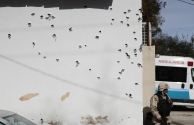
January 3: Starting around 2 a.m. in Caracas, U.S. military carried out what Trump later described as “a large-scale strike against Venezuela and its leader, President Nicolás Maduro.” U.S. strikes hit targets in the capital and surrounding states while soldiers raid Fort Tiuna, the military complex where Maduro and Flores resided. U.S. military and law enforcement seize the couple and they are flown out of Venezuela by 3:30 a.m. to board a naval vessel that takes them to New York. There, they face federal narcotrafficking charges.  

U.S. Joint Chiefs Chairman General Dan Caine later informed that around 200 troops and 150 aircrafts were involved in the operation, which reports say left up to 80 people dead, including civilians and military personnel. The Cuban government says that 32 of its nationals—likely individuals attached to Maduro’s security detail—were among those killed and the Venezuelan Armed Forces say around 24 of its troops died. Trump has said no U.S. personnel were killed in the operation. 

Related

Explore