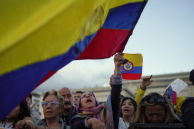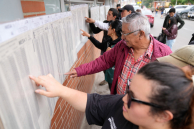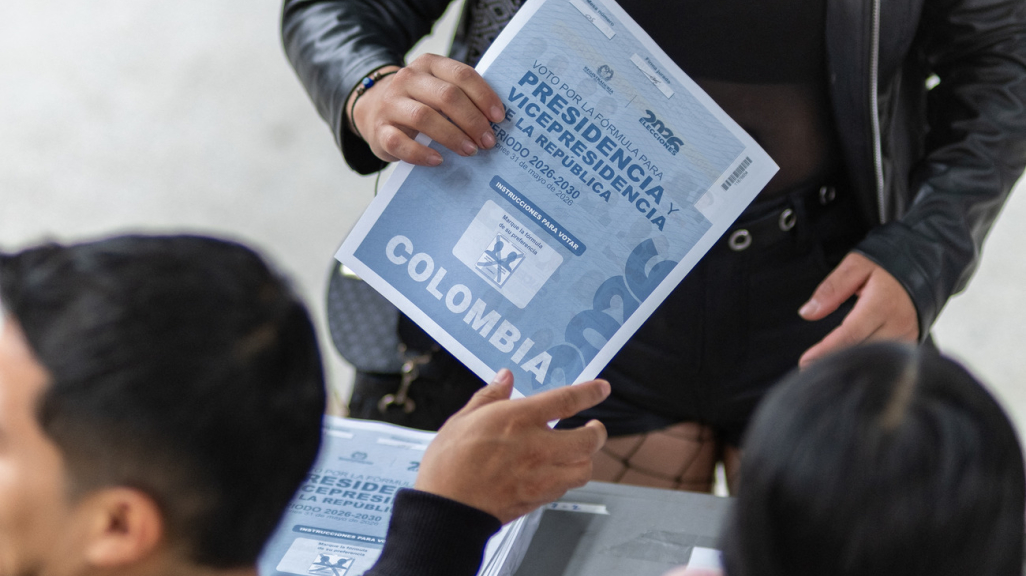
A Colombian votes. (AP)

A Colombian votes. (AP)

Four Takeaways from Colombia's First-Round Vote: De la Espriella, Cepeda Head to Runoff

By Chase Harrison and Carin Zissis

From fraud claims to a deflated centrist vote, find out about the May 31 presidential election ahead of what will be a left-right June 21 showdown.

The tiger roars. On Sunday May 31, Abelardo de la Espriella, the far-right candidate who nicknamed himself after the big cat, took the top spot in Colombia’s first-round presidential election, outperforming polling expectations to garner 43.7 percent of the vote. He will face Iván Cepeda, a leftist who captured 40.9 percent of the vote, in a June 21 runoff.

De la Espriella, a criminal defense lawyer who has never held elected office, ran a campaign centered on his hard-right approach to crime and calls for deregulation and austerity. Savvy on social media, de la Espriella dominated the conservative vote, cutting into the margins of center-right candidate Paloma Valencia. Cepeda, meanwhile, is pitching himself as the second stage of the presidency of incumbent Gustavo Petro.

What were the big surprises of the night? What can be expected in the runoff? AS/COA Online covers the big takeaways from the election day.

Left and far-right candidates prevail with little in the middle

If de la Espriella fared better than expected, then center-right candidate Paloma Valencia was the underachiever of the night, pulling in just 6 percent of the vote. That’s well below the double digits she garnered in pre-election polling. Latin America analyst James Bosworth described what he called “the scale of the collapse” by pointing out that Valencia and her running mate Juan Daniel Oviedo together earned 4.4 million votes in March primaries but a mere 1.6 million on election day.  Meanwhile, centrist candidates Sergio Fajardo and Claudia López—the fourth and fifth-place finishers—won a combined 1.25 million of the 41.4 million ballots cast. 

What de la Espriella had going for him was being a “change” candidate, GDP Consultores’s Juan Manuel Santos Arango told AS/COA Online just ahead of the election. “De la Espriella has something that Cepeda also has, and that it would seem that Valencia lacks, and it's what we would call popular fervor.”

Indeed, de la Espriella, who modeled his campaign in the vein of leaders like El Salvador’s President Nayib Bukele and Argentina’s Javier Milei, describes himself as an outsider, representing a right wing that is “is more concerned with the future than the past.” In doing so, he marked himself apart from Valencia, a disciple of ex-President Álvaro Uribe (2002–2010), an establishment figure.

Still, de la Espriella made a play for moderate voters with his choice of José Manuel Restrepo for vice president. Restrepo served first as trade minister and then finance minister during the administration of center-right President Iván Duque (2018–2022).

Valencia endorsed de la Espriella after acknowledging her electoral loss on Sunday, which could help the right-winger’s growing momentum. But that doesn’t mean this election is a done deal. In Americas Quarterly, Control Risks’ Laura Lizarazo makes the case that many of the voters who cast a ballot for Valencia could well transfer to Cepeda. “Hardline right-wing voters who backed her at the beginning of the presidential race defected to De la Espriella when she chose openly gay centrist technocrat Juan Daniel Oviedo as her vice-presidential nominee,” writes Lizarazo. Unlike Valencia, Oviedo has not yet endorsed a candidate

Observers praise an orderly vote process, despite Petro’s fraud claims

Even as votes were still being tallied on Sunday, Petro cast doubts on results. “The so-called count being transmitted is not legally binding,” he wrote on X. “As president, I do not accept the pre-count results.”  Petro’s claims stem from a long-running dispute he has with the private firm handling electoral logistics in Colombia. The president argued that a change in vote-counting software added 800,000 non-existent voters to the rolls, a figure that narrowly exceeds the difference between first-place de la Espriella and Cepeda. But, as outlet La Silla Vacía’s factchecking division reports, the preliminary count is conducted by poll workers rather than a private company. 

Fraud claims aside, international electoral observers heralded the open, orderly nature of the Colombia’s May 31 electoral process. “The robust nature of the country’s electoral institutions has been confirmed,” rebutted Transparencia Electoral Founder Leandro Querido on X, adding that the president’s criticisms amounted to “an irresponsible narrative of fraud.” And, despite security concerns casting a shadow over election day, the UN reported that no significant human rights violations were documented. 

Observers also congratulated the Colombian voters, who showed up in droves for a record-breaking first-round turnout of 58 percent. 

Regional breakdown follows traditional lines, with some shifts

Sunday’s results echoed the geographic breakdown of previous Colombian elections. Leftist Cepeda, won along the outer edges of the country, including the Pacific and the Atlantic coasts, as well as the capital, Bogotá. De la Espriella won the Andean center of the country, including major cities like Medellín and Bucaramanga. The Amazon and the Orinoco regions split.

Not only does that map reflect previous presidential elections, but it also resembles the vote from the 2016 peace plebiscite. Cepeda, who advocates to continue to negotiate with armed groups, won in conflict-impacted departments, such as Cauca and Nariño. However, de la Espriella, who proposes a militarized assault on such insurgencies, prevailed in departments with active clashes between armed groups, such as Norte de Santander, Caquetá, and Guaviare. 

Still, while regions didn’t flip, both de la Espriella and Cepeda made inroads in less ideologically friendly territories. Cepeda won 120,000 more votes in Antioquia, the second most populated department, than Petro captured in the 2022 first round. De la Espriella won a greater share of voters in the Atlantic and Caribbean coasts than previous right-wing candidates. The conservative candidate is from the Caribbean.

Valencia took third place in every department except Atlántico where Fajardo finished behind Cepeda and de la Espriella.

No matter the winner, Congress will be divided

The makeup of Congress was decided on March 8, alongside the interparty consultation vote, and no party won a majority. As such, the winner of the runoff will face a divided Congress as neither Cepeda nor de la Espriella has sufficient bench to pass reforms outright. Congress may well continue the role it played under Petro, in which it rejected several of his reforms and passed negotiated versions of others. 

But, of the two, Cepeda holds the advantage. His party, the governing Historic Pact, has the most seats in both houses of Congress: 25 in the 103-member Senate and 37 in the 161-member Chamber of Representatives. 

De la Espriella’s party, the National Salvation Movement, will have just four seats in the Senate and one seat in the Chamber of Representatives. But, given Valencia’s endorsement of his candidacy, De la Espriella may look to her party, the Democratic Center (CD), for support. The CD will hold 17 Senate seats and have 28 representatives.

Regardless of who wins the second round, the runner up could still have a political presence. The second-place finisher is offered a Senate seat. However, de la Espriella’s wife Lucía Pineda indicated shortly before the election that if her husband loses that they would leave the country. The family has lived in Florence, Italy and Miami, Florida.

Related

Explore