Lula_straw hat

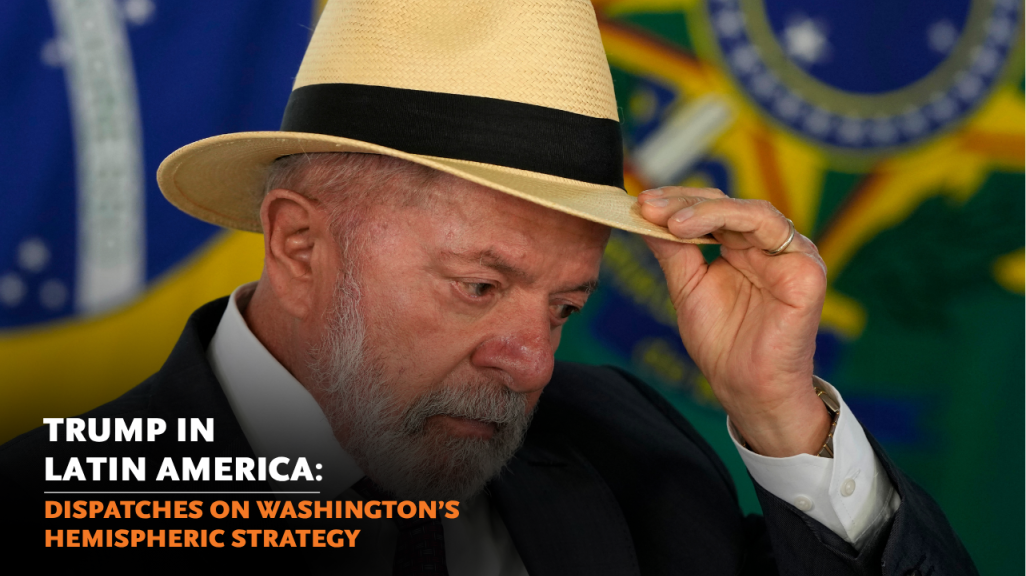
Brazilian President Luiz Inácio Lula da Silva. (AP)

Trump in Latin America: U.S.-Brazil Diplo Rift Deepens; Venezuelan Vote Anticipation Grows

By Khalea Robertson

Jul 30–Aug 5: Plus, more U.S. spies in Cuba, a nuclear deal with Paraguay, and Rubio’s outreach to two new presidents. 

Welcome back to our weekly dispatch of stories on the U.S. role in Latin America. Follow us each week and see previous roundups at as-coa.org/dispatches, or sign up to receive them via LinkedIn

Here’s what to know this week: 

  • Washington and Brasília’s visa tit-for-tat escalates.
  • The U.S. Senate weighs in on new talks for Venezuela’s democratic transition.
  • Southcom launches a new task force to battle regional drug trafficking.
  • Paraguay signs a nuclear cooperation deal.
  • Plus: Reports of increased U.S. intelligence in Cuba; Mexico’s role in the U.S. data center boom; and Rubio’s contact with Paraguay’s Peña, Peru’s Fujimori, and Colombia’s de la Espriella. 
State Department revokes Brazilian ambassador’s visa

The State Department revoked the visa of the Brazilian Ambassador to the U.S. Maria Luiza Ribeiro Viotti, per multiple August 4 news reports involving an interview with a State Department official. The official indicated Viotti’s visa would be restored after the Brazilian government approves the Trump administration’s choice of U.S. ambassador, Florida state legislator Daniel Perez. President Donald Trump nominated Perez for the position on June 1, but his administration neglected to seek Brasília’s approval beforehand, a diplomatic misstep that reportedly irked President Luiz Inácio Lula da Silva’s government.  

A statement from Lula's office called the U.S. visa denial “part of a deliberate escalation of hostile measures against Brazil driven by ideological motives.” The two governments have been embroiled in months of ongoing trade and political disagreements and follows Brazil’s denial of diplomatic visas for officials it says sought to influence the country’s October 4 electoral outcome. (See last week’s dispatch).    

A call before the talks on Venezuela’s democracy

A highly anticipated meeting between Venezuelan government and opposition leaders on August 1 turned out to be a phone call. In social media statements released that day, National Assembly President Jorge Rodríguez, representing the interim government led by his sister, Delcy Rodríguez, and ex-legislator Dinorah Figuera, representing the opposition-majority National Assembly elected in 2015, announced that in-person talks would begin in Caracas this week with a focus on three topics: the response to the June 24 earthquakes, strengthening democracy, and political rights and guarantees.  

Figuera’s statement described the phone call as “the start of a dialogue process for Venezuela’s democratic transition” and thanked the United States and Secretary of State Marco Rubio for their “accompaniment in the transition.” Rodríguez’s statement did not mention a democratic transition or the U.S. government. The State Department issued an August 3 statement acknowledging the talks as a step in “the three phase plan the United States supports to bring about stabilization, economic recovery and political reconciliation and a transition to democratic elections.” Meanwhile, on August 4, Senators Ted Cruz (R-TX) and Jeanne Shaheen (D-NH) introduced a bipartisan resolution urging “immediate steps to restore democratic governance” in Venezuela with U.S. support. They emphasized that this should entail the free participation of all political actors including opposition leader María Corina Machado

In other U.S.–Venezuela news, Reuters reported on August 2 that former government official Mauricio Claver-Carone said he had stepped down from his unofficial role as Rubio’s intermediary with the Venezuelan government. He told the news agency: “I’m retired on Venezuela.”

On July 29, a high-level U.S. delegation that included acting Under Secretary of State for Foreign Assistance, Humanitarian Affairs, and Religious Freedom Jeremy Lewin; Assistant Secretary of State for Economic, Energy, and Business Affairs Caleb Orr; and U.S. Chargé d’Affaires in the Caracas Embassy John M. Barrett met with the Rodríguez siblings in the Venezuelan capital. A post from the Venezuelan interim president’s office says the meeting covered earthquake response, security, investment, and bilateral energy cooperation.  

Plus: TIME magazine sat down for an interview with interim leader Rodríguez to cover her government’s relationship with Washington and more. “I’m starting out by acting in good faith and trusting that these relationships can develop in good faith,” she said, highlighting the U.S. role in the return of foreign oil companies and anti-gang operations, among other items on a bilateral agenda sketched out in a January 4 phone call with Trump.

Southcom launches new anti-narcotrafficking task force

U.S. Southern Command (Southcom) on August 4 replaced Joint Task Force (JTF) Southern Spear with the JTF-Western Hemisphere to continue its military offensive against drug trafficking in the Americas. In a press statement, Southcom Commander General Francis L. Donovan said the new task force will work with the 18 member countries of the Americas Counter Cartel Coalition—a U.S.-led regional initiative established in March 2026 in conjunction with the Shield of the Americas—to “apply sustained pressure against the networks that threaten our collective security,” while also being able to respond quickly to humanitarian crises.  


The now-retired JTF-Southern Spear was involved in airstrike campaigns against alleged drug boats in the Caribbean Sea and Pacific Ocean that has killed more than 220 people since September 2025.  

Washington and Asunción go nuclear

On August 4 in Washington, Rubio and Paraguayan Foreign Minister Rubén Ramírez Lezcano signed a memorandum of understanding aimed at bolstering the South American country’s nuclear energy capacity.  Rubio, accompanied by U.S. Deputy Secretary of State Christopher Landau, also met with Paraguayan Vice President Pedro Alliana that day, following Rubio’s August 3 phone call with President Santiago Peña to discuss bilateral cooperation and thank Peña for “his support of Venezuela’s reconstruction and democratic transition.” 

In other news

U.S. ups Cuban intelligence presence? Citing two anonymous sources, an August 4 Politico report found that U.S. intelligence agencies have recently increased the number of spies and other assets in Cuba. Two days earlier, Rubio described the Caribbean country as “an espionage superpower” and “a national security threat” during a Fox News interview in which he reiterated allegations of Havana’s interference in hemispheric politics outlined in a recent State Department report. (See July 22 dispatch).

Rubio’s call for cooperation with Peru’s new president: The U.S. secretary of state made a congratulatory phone call to Peru’s President Keiko Fujimori on July 30, two days after her inauguration. The call followed the July 29 publication of a State Department factsheet that signaled U.S. intentions to work closely with the new administration on combatting transnational crime, facilitating private investment, preparing for El Niño, and boosting cooperation in the space sector.  

ADLE in Cali: But Peru isn’t the only country holding an inauguration. On August 7, Colombia will swear in its new president, right-winger Abelardo de la Espriella. Rubio will lead the U.S. delegation to the event, which will be held in Cali rather than in the capital of Bogotá, of which outgoing leftist President Gustavo Petro was previously mayor.

Mexico feeds U.S. data center thirst: Thanks to the AI boom, computer servers have overtaken autos as Mexico’s top export to the United States. Financial Times covers the impact of the burgeoning sector on the Mexican economy, even as the Trump administration’s decisions on USMCA have cast doubt on the future of North American trade relations.  

Carin Zissis contributed to this weekly roundup.

Related

Explore