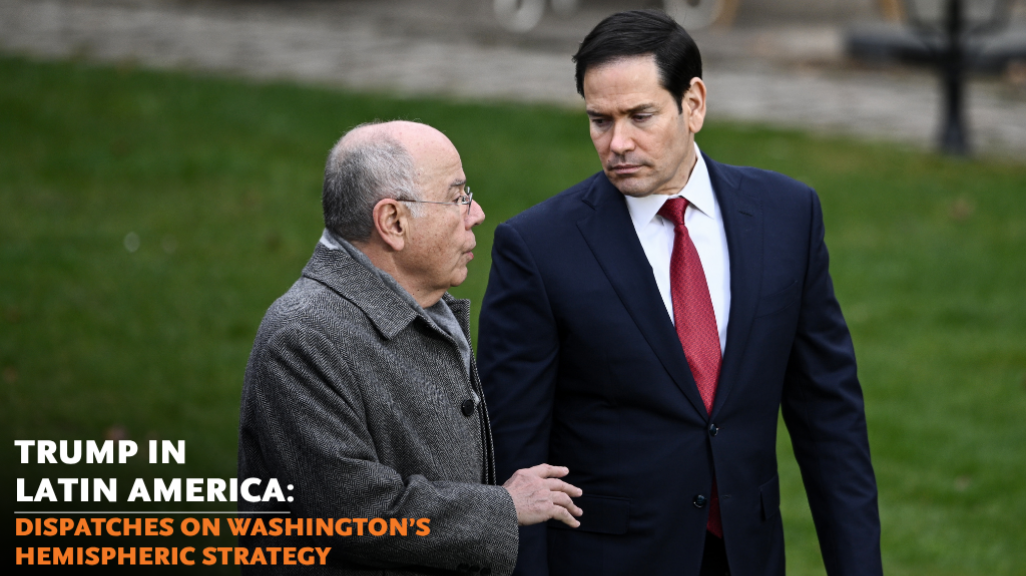
(L-R) Brazilian Foreign Minister Mauro Vieira and U.S. Secretary of State Marco Rubio. (AP)

(L-R) Brazilian Foreign Minister Mauro Vieira and U.S. Secretary of State Marco Rubio. (AP)

Trump in Latin America: FTO Warnings for Brazil and Sanctions Relief for Venezuela's Delcy

By Luisa Leme , Khalea Robertson and Carin Zissis

Mar 27–Apr 2: Plus, a year later, we look at the impact of Liberation Day tariffs on Latin American imports.

Welcome back to our weekly dispatch of stories on the U.S. role in Latin America. Follow us each week and see previous roundups at as-coa.org/dispatches, or sign up to receive them via LinkedIn

Here’s what to know this week: 

  • At the one-year anniversary of Liberation Day tariffs, check in on the state of U.S.trade relations in the hemisphere.
  • Cuba receives its first oil shipment in months, courtesy of Russia.
  • The Brazilian government works to avert FTO designations.
  • The Trump administration lifts sanctions on Venezuela’s Delcy Rodríguez and reopens its embassy in Caracas.
Liberation Day: a year later

It’s been a year since U.S. President Donald Trump announced global reciprocal tariffs on trade partners worldwide. “This is Liberation Day,” he said on April 2, 2025 in a ceremony in the White House Rose Garden. To refresh readers’ memories, most Latin American countries were hit with a baseline 10 percent tariff. Mexico and Canada, Washington’s two biggest trade partners, weren’t part of the announcements; the two countries faced no tariffs for USMCA-compliant goods while non-compliant goods carried a tariff of 25 percent, based on previous announcements made in February 2025.

Nearly a year later on March 31, the Office of the U.S. Trade Representative (USTR) released its annual National Trade Estimate, detailing foreign trade barriers Washington wants removed or reduced and covering more than 60 U.S. trade partners. The report’s forward indicates the administration seeks to reduce such barriers through Agreements on Reciprocal Trade. Since Liberation Day, Washington has signed such deals with Argentina, Guatemala, Ecuador, and El Salvador.

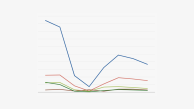
How did Trump’s new trade policy affect imports from Latin America and Canada to the United States? We compare the percentage change for each country from 2024 to 2025. Most Latin American countries saw an increase. But Brazil, which was handed the threat of a 50 percent tariff threat in July, experienced a nearly 6 percent drop. Venezuela, still under the rule of Nicolás Maduro and facing escalating tensions with the Trump administration last year, saw the sharpest decrease.

From Russia, with oil

Despite a U.S. blockade that has been in place since January, a long-awaited shipment of Russian fuel arrived in Cuba this week. A month after its departure, the Anatoli Kolodkin tanker began offloading its 730,000 barrels of crude at the Matanzas oil terminal on Cuba’s west coast Tuesday. But it could take around a month to be processed into gasoline, diesel, and other refined products for domestic use.

White House Press Secretary Karoline Leavitt told reporters Monday that exceptions to the U.S. oil blockade would be considered on a “case-by-case basis for humanitarian reasons.” A day earlier, Trump said, “Cuba’s finished … whether or not they get a boat of oil.”

Another country trying to get a boat of oil to Cuba? Mexico. President Claudia Sheinbaum on Monday said her country was weighing options for restarting oil shipments there, particularly to the private sector

A FTO warning for Brazil

Washington may be on the verge of designating two Brazilian criminal groups, First Capital Command (PCC) and the Red Command, as foreign terrorist organizations (FTOs). Two sons of jailed ex-President of Brazil Jair Bolsonaro lobbied the U.S. government on the issue, per The New York Times. One of them, presidential candidate Flávio Bolsonaro, spoke on the issue at the March 28 Conservative Political Action Conference (CPAC) in Texas, where he accused Brazil’s President Luiz Inácio Lula da Silva of protecting organized crime groups from FTO designation. 

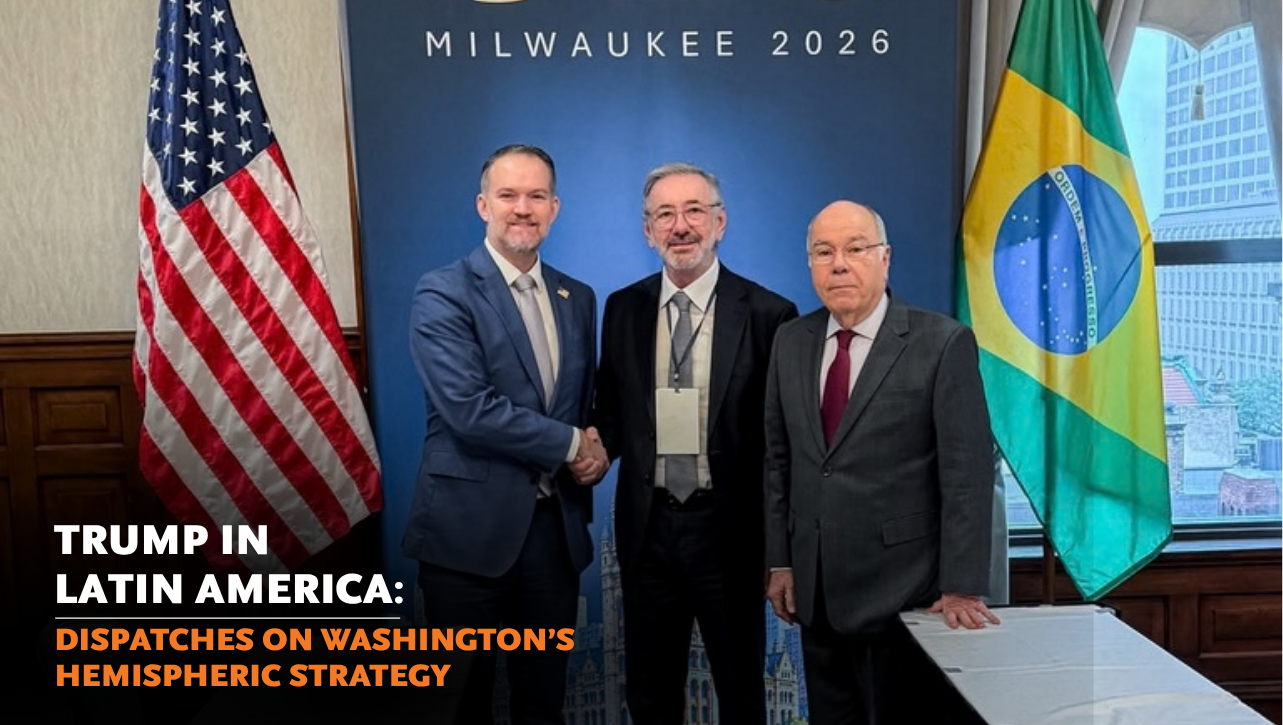
A day earlier, Brazil’s Minister of Foreign Affairs Mauro Vieira met in person with U.S. Secretary of State Marco Rubio on the sidelines of a G7 meeting in France. Vieira followed up on a March 8 call pushing back on the potential FTO designation and reaffirming Brazilian proposals for the two countries to work together against organized crime. The designation could hinder bilateral cooperation efforts and pose risks for businesses operating in Brazil, writes Robert Muggah for Americas Quarterly

Tensions around the issue run high. On March 10, the U.S. Treasury Department sanctioned PCC, putting Diego Macedo Gonçalves do Carmo Gonçalves, a PCC leader, on its Foreign Assets Control list. 

Beyond the critical elections, minerals

The United States secured access to rare earth minerals from Brazil in a half-a-billion-dollar deal with mining company Serra Verde, the country’s only operational rare earths producer. The head of investments at the U.S. International Development Finance Corporation told the Financial Times that the deal “had offtake controls making sure [the metals] were going to the United States and U.S.-aligned parties.”.

Critical minerals were also part of Flávio Bolsonaro’s CPAC speech. The candidate said his country will be the battleground for the future of the region, as “Brazil is America’s solution to break dependence on China for critical minerals, especially rare earth elements.” 

Puertas abiertas in Venezuela

On March 30, the U.S. Embassy opened its doors again in Caracas for the first time in seven years. U.S. Ambassador Laura F. Dogu, who arrived in the capital city in January, said: “We are starting a new chapter in our bilateral relationship" in a video to mark the change. 

In Washington on March 31, Venezuelan opposition leader María Corina Machado met with Rubio. The secretary told Fox News on the same day: "There will have to be free and fair elections in Venezuela. And that point has to ⁠come."

Meanwhile, on April 1, Washington lifted sanctions against Venezuelan interim President Delcy Rodríguez, taking her name off OFAC’s Specially Designated Nationals list. Elliott Abrams, who handled Venezuela policy during the first Trump administration, told Spanish news outlet ABC that Rodríguez is trying to buy time to hold onto power by preserving good bilateral relations until the November U.S. midterm elections and beyond. 

In other news

Sheinbaum told journalists Monday that she would take legal action over the deaths of Mexican citizens held in U.S. immigration detention facilities. Mexican officials have indicated that they will bring complaints to Washington and the Inter-American Commission on Human Rights. Four Mexican citizens have died in just one facility in Los Angeles since last year. 

Last week, we shared news that Colombian President Gustavo Petro had been named in U.S. Department of Justice investigations related to drug trafficking. The New York Times now reports that sources told Petro he does not face criminal charges—for now. “U.S. officials may want to reassure Mr. Petro, political analysts said, because Colombia faces the first round of presidential elections,” per the article.

InsightCrime analyzes what Ecuadorian President Daniel Noboa calls a “new phase” in his government’s battle against organized crime, from the deepening of military ties with Washington to joint EU cooperation aimed at dismantling trans-Atlantic cocaine trafficking. 

An FBI program worked with Peruvian authorities to help in the repatriation of nearly 50 Peruvian cultural artifacts.

Related

Explore