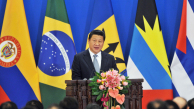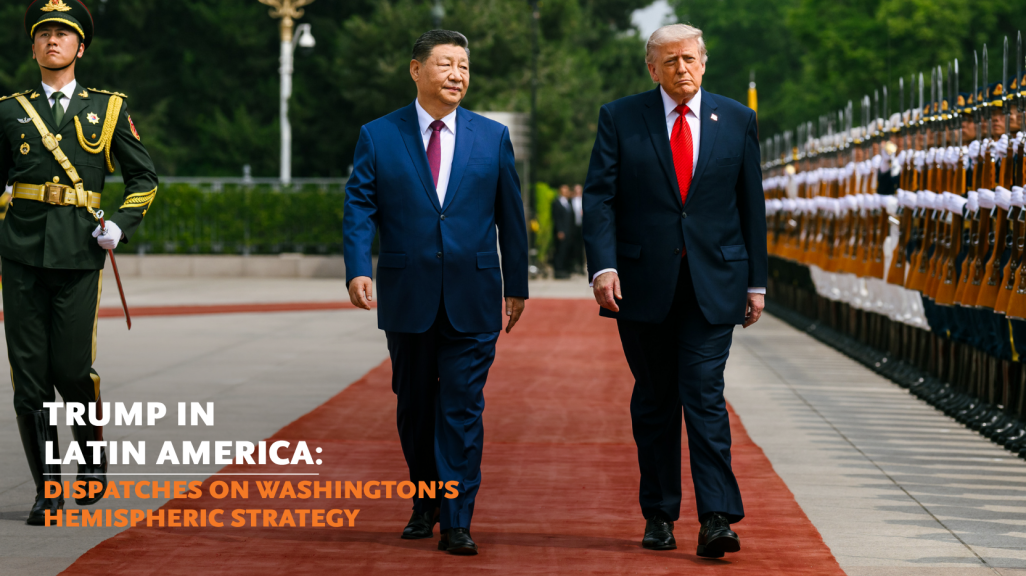
Chinese President Xi and U.S. President Trump. (Photo: White House)

Chinese President Xi and U.S. President Trump. (Photo: White House)

Trump in Latin America: The Hemisphere's Position on the U.S.–China Chessboard

By Carin Zissis

May 8–14: Plus, security tensions continue to test to test U.S.–Mexico ties and Washington offers Havana conditioned aid.

Welcome back to our weekly dispatch of stories on the U.S. role in Latin America. Follow us each week and see previous roundups at as-coa.org/dispatches, or sign up to receive them via LinkedIn

Here’s what to know this week: 

  • Latin America’s position in—and on—the U.S.–China rivalry.
  • From promises of indictments to consular investigations, U.S.–Mexico tensions rise around security and diplomatic relations.
  • The State Department promises $100 million in aid to Cuba, strings attached.
  • What it would mean for governance if Venezuela became the fifty-first U.S. state?
  • And more.
The Latin America factor in the Trump–Xi talks

U.S. President Donald Trump arrived in China on May 13 with a delegation that included not only top cabinet members like Secretaries Marco Rubio and Pete Hegseth, but also roughly a dozen U.S. business heavyweights representing the tech, finance, and aerospace sectors. Aside from Trump’s stated goal to “open up” China so these “brilliant people can work their magic,” trade, Taiwan, and the Iran conflict are expected to top the agenda. 

Still, while his East Asian journey may be the most-anticipated international trip yet of Trump’s second term, the Washington–Beijing rivalry has had major implications for U.S. policy in the Americas. When the White House’s National Security Strategy came out six months ago, the stated U.S. goal of having “a Hemisphere that remains free of hostile foreign incursion or ownership of key assets” was seen as a shot across the bow targeting China’s presence in Latin America

It’s not just the White House and Republicans who are concerned about Beijing’s regional role. Even as Trump’s trip was in the works, U.S. senators on the Foreign Relations Committee introduced an April 30 bipartisan resolution aimed at countering Chinese influence in Latin America and the Caribbean. Though nonbinding, the document raised a litany of concerns, from Beijing’s arms sales in the region, to its efforts to get countries to cut ties with Taiwan, to China surpassing the United States as South America’s top trade partner.

There are some signs Latin American and Caribbean countries are placing limits on China’s regional clout. When it comes to critical infrastructure, late last month, Bolivia, Costa Rica, Guyana, Paraguay, and Trinidad and Tobago joined the United States in criticizing Chinese pressure on Panama following that country’s Supreme Court decision to invalidate a Hong Kong company’s operation of two Panama Canal terminals. On the trade front, Mexico recently applied a 50 percent tariff on Chinese imports in a move seen as protecting its own industries while having the added bonus of appeasing Washington, its top trade partner. Then, there’s outer space; The New York Times covered Washington’s pressure on Argentina and Chile to scuttle Chinese telescope projects

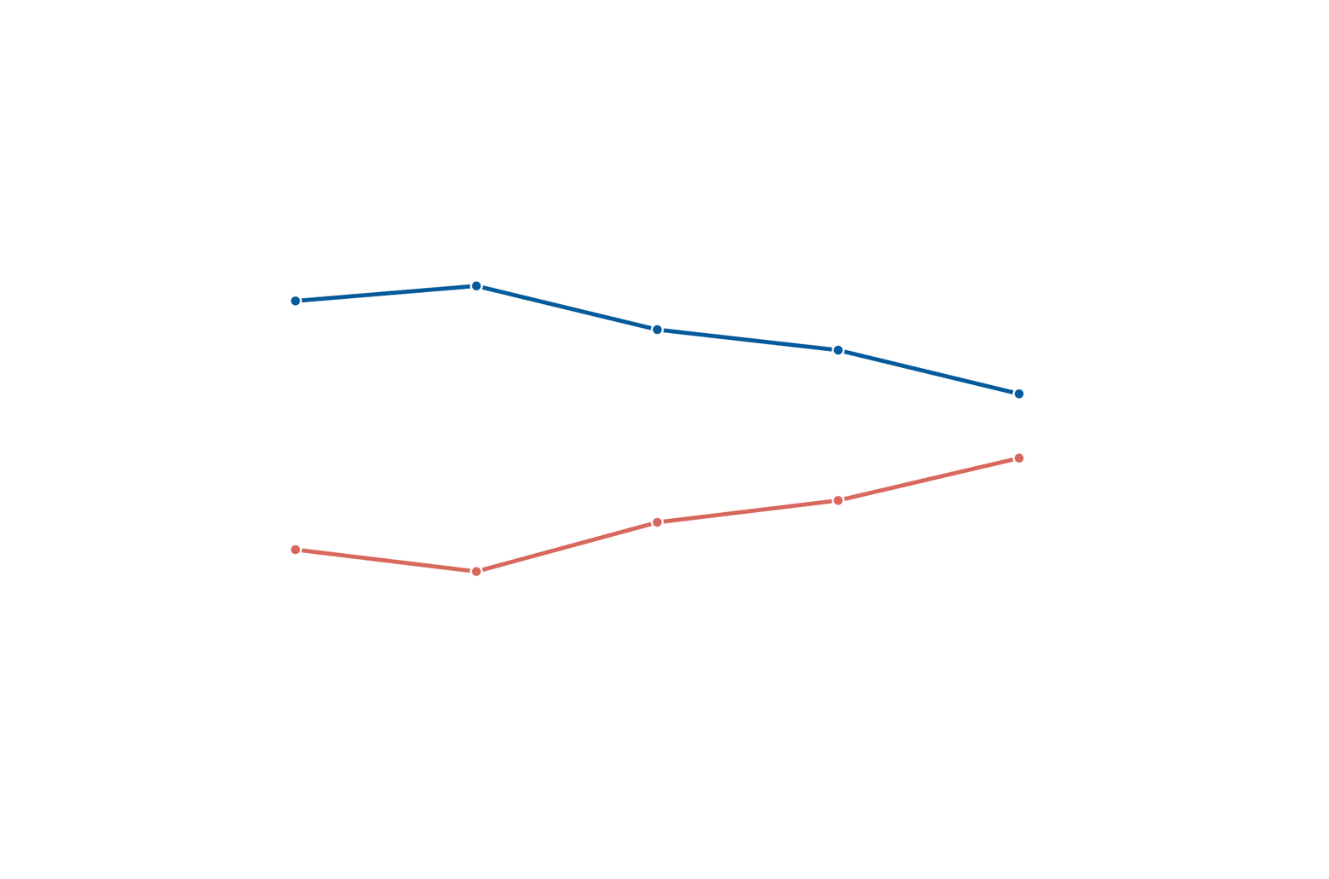
However, a recent poll shows signs the U.S. image has suffered in the region. In April, the German Friedrich-Ebert-Stiftung Foundation released its survey of Latin American countries—Argentina, Bolivia, Brazil, Chile, Colombia, Costa Rica, Guatemala, Mexico, Uruguay, and Venezuela—exploring views on the international order. The study found that, between 2022 and 2026, China was the only major power that saw its reputation improve among these countries. Meanwhile, Venezuela was the one country surveyed that had a net positive view of the global impact of Trump’s policies. When asked to choose between the EU, United States, and China, respondents identified the United States as the best partner for strengthening democracy and battling drug trafficking. They chose China as the best partner on trade and infrastructure and digital technology.


Regardless of shifting attitudes, the United States still outweighs China on economic ties in the region, outranking it as both an export and import market for Latin America and the Caribbean. 

For more on the U.S.–Sino rivalry in the hemisphere, listen to a recent podcast interview with Andrés Bello Foundation’s Parsifal D’Sola Alvarado covering how Latin America is juggling ties with the two big powers in a post-Maduro era. 

Headlines of the week

After Trump shared a map with a U.S. flag in Venezuela and calling it the fifty-first state, the country's interim President Delcy Rodríguez, on the sidelines of a hearing at the International Court of Justice for hearings on a territory dispute with Guyana, said there were no plans for the country to become part of the United States. While describing the idea as “zany,” The New Republic’s Matt Ford looks at the precedents for and implications of such a proposal, including the fact that Venezuela and its 32 million people would become the second-most populous U.S. state and likely get roughly 42 House seats

On May 13, the State Department announced that Washington is prepared to provide Cuba with $100 million in aid if its government agrees to meaningful reforms. Protests flared up in Cuba on Wednesday amid power cuts. The Cuban government says the island has run out of fuel

CNN reported that, in March, the CIA carried out an attack on a car being driven by a cartel operative outside Mexico City. Both the Mexican government and the CIA denied the report, which comes amid tensions over another CIA operation in the northern state of Chihuahua. CNN has stood by the report

In a Tuesday Senate hearing, DEA Administrator Terrance Cole told U.S. lawmakers that the U.S. indictment of Mexican governor Rubén Rocha Moya is "just the start” when it comes to U.S. legal action against Mexican officials. 

CBS broke the news on May 8 that the State Department is reviewing all 53 Mexican consulates with the possibility of future closures. A subsequent report in Mexico’s El Universal suggested at least 20 consulates are being investigated for violating diplomatic treaties by carrying out activities to support Mexico’s governing Morena party, with particular attention on sites in McAllen, Miami, and Sacramento. Mexico is the country with the largest consular network in the United States. 

Under Secretary of State for Economic Affairs Jacob Helberg is in Guyana, Panama, and Costa Rica this week for meetings focused on energy and critical minerals

U.S. deportations to El Salvador doubled in the first quarter of this year compared with the same period in 2025. 

Related

Explore