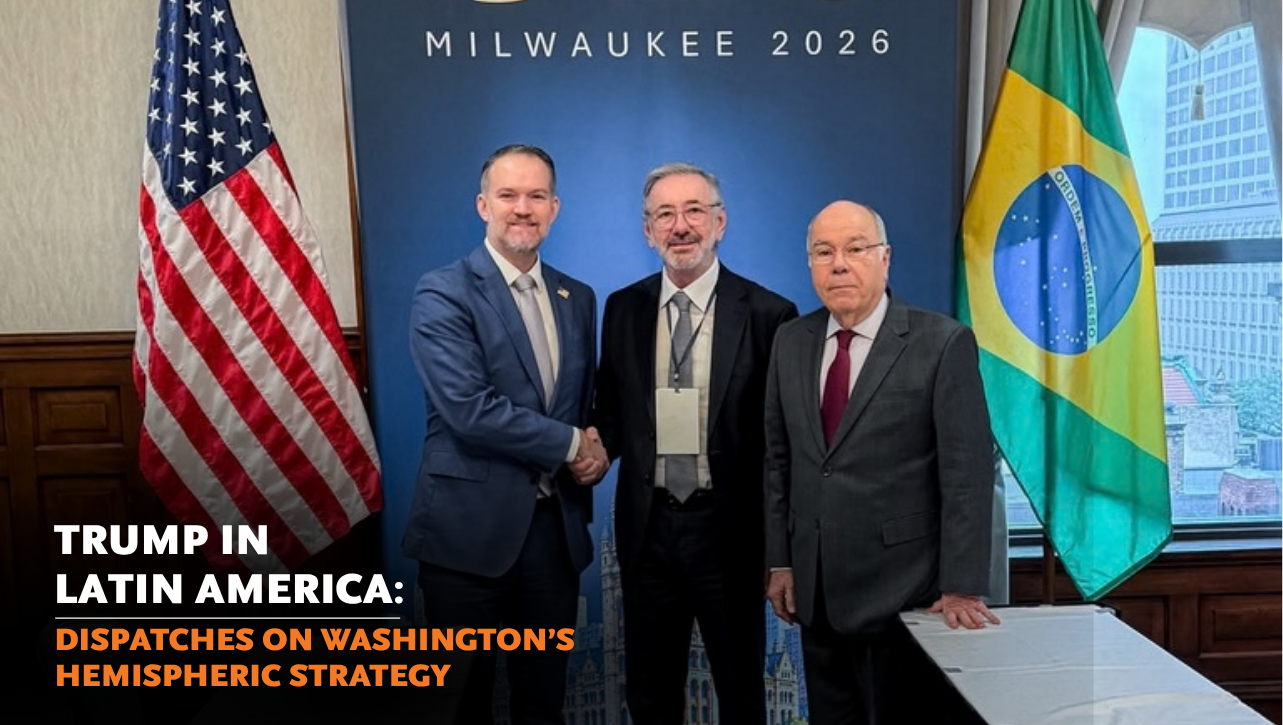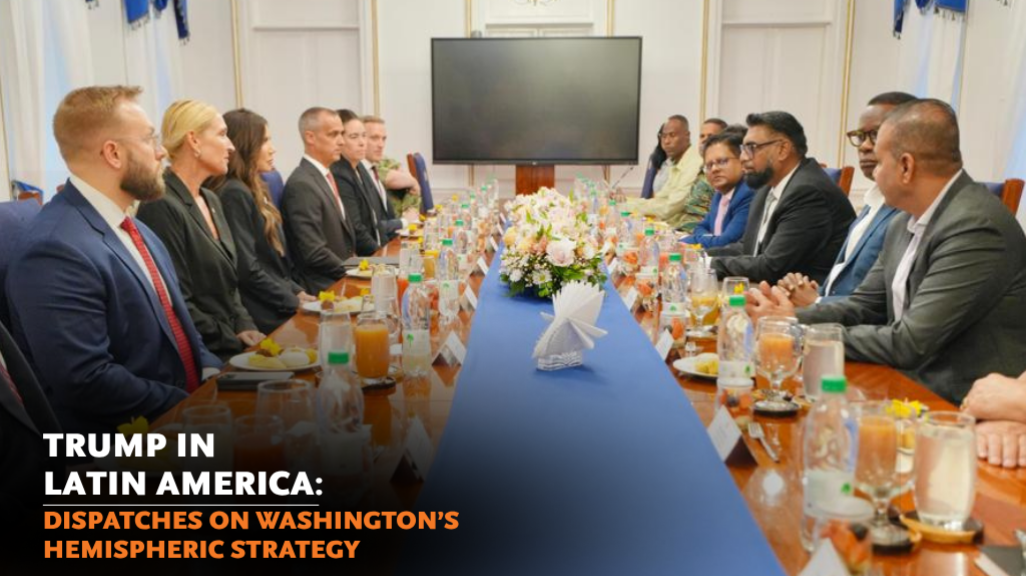
Special Envoy for Shield of the Americas Kristi Noem meets with Guyanese President Irfaan Ali. (Noem's X)

Special Envoy for Shield of the Americas Kristi Noem meets with Guyanese President Irfaan Ali. (Noem's X)

Trump in Latin America: Maduro's Court Battles, Ecuador's Bombed Cattle, Noem's Travel

By Chase Harrison , Khalea Robertson and Carin Zissis

March 20–26: Also, Colombia’s Petro named in DOJ investigations. And what a Dominican space facility tells us about the U.S.-China space race.

Welcome back to our weekly dispatch of stories on the U.S. role in Latin America. Follow us each week and see previous roundups at as-coa.org/dispatches, or sign up to receive them via LinkedIn

Here’s what to know this week: 

  • Special Envoy to Shield of the Americas Kristi Noem tours Latin America.
  • Nicolás Maduro reappears in U.S. court as narco-terrorism trial advances.
  • Revelations arise over U.S.-Ecuadorian counter-narcotic strikes.
  • Sources say Colombian President Gustavo Petro named “priority target” in DOJ narcotrafficking investigations.
  • Amid U.S. energy blockade, CARICOM seeks to send aid to Cuba.
Kristi Noem brings security focus to five countries

Kristi Noem, Trump’s envoy for his U.S.-led Shield of the Americas military coalition, visited five countries in the Western Hemisphere this week, signing security agreements with the presidents of the Dominican Republic, Honduras, Guyana, and Ecuador

In Quito, President Daniel Noboa recognized her with a state honor for her work on the bilateral relationship.  In Costa Rica, Noem signed a migration agreement with President Rodrigo Chaves that will see the Central American country take 25 third-country deportees each week. 

The trip also marked Noem’s last action as U.S. homeland security secretary as on March 24, her successor, Congressman Markwayne Mullin, assumed the cabinet-level position, which oversees border and immigration agencies.

In Ecuador: Drug camp or dairy farm?

As we covered in an earlier dispatch, Quito and Washington announced joint action against alleged drug traffickers in the Andean country in a move that was part of the two countries’ deepening security ties and took place days before Ecuador’s Noboa joined other Latin American presidents to meet with Trump at the Shield of the Americas Summit in Doral, Florida. Now, The New York Times has revealed that its reporters traveled to the area near the Colombian border where operations took place and found that a joint strike destroyed a dairy farm instead of a drug compound.  Residents told UN human rights workers that Ecuadorian soldiers tortured farm workers, in addition to destroying the dairy facility and local residences. 

Is Petro on the DOJ’s radar?

Federal prosecutors have named Colombian President Gustavo Petro in investigations for alleged links to drug trafficking dating back to 2022, per media reports. The Associated Press reports that the DEA has named him a “priority target,” with sources saying he is being probed for ties to Mexico’s Sinaloa cartel.  Petro has denied the allegations. InSight Crime points out that no charges have been formally announced, leaving it unclear why Petro may have been handed a “priority target” label.

The leftist Colombian leader has had a combative relationship with Trump, although tempers cooled after Petro visited him at the White House last month. 

Maduro on trial, Delcy on screen

On March 26, ex-leader of Venezuela Nicolás Maduro makes his second appearance in a New York court as part of pretrial activities. Maduro is being tried for narco-terrorism and trafficking charges under a 2006 counter-terrorism law with limited trial usage and a high burden of proof. Another complication? Several co-defendants in the case are still in Venezuela serving in Delcy Rodriguez’s government. It is still not known who will testify in the trial, but two Venezuelan generals indicted with Maduro in a 2020 case and imprisoned in the United States are rumored to be on the list. 

Meanwhile, Venezuela’s Interim President Rodríguez announced that a group of diplomats will travel to the United States in the coming days to work on reestablishing bilateral ties. This comes as Rodríguez spoke virtually at a Saudi-backed investment forum in Miami on March 25 about opportunities in her country’s oil sector. 

The Maduro trial begins as a separate trial in Miami is underway investigating whether two U.S. politicians lobbied the U.S. government illegally on behalf of the Maduro regime. On March 25, Secretary of State Marco Rubio testified in that trial against a friend who is one of the defendants. As AP reports, this marks the first time a cabinet member has taken the stand in a criminal trial since 1983.

Cuba awaits food and fuel

The Cuban government last week denied a request from the U.S. embassy in Havana to import diesel for its generators amid frequent blackouts on the energy-starved island. The U.S. fuel blockade currently in place on the Caribbean country does, however, exempt Cuba’s limited private sector, which Reuters notes has received rising amounts of fuel over recent months. 

While the wait for at least two shipments of Russian oil continues, (see previous dispatch), CARICOM on Tuesday announced a shipment of humanitarian aid to Cuba via Mexico. The 15-member Caribbean trade bloc said the Mexican government had agreed to ship canned food, solar panels, water tanks, rice, and other basic goods for free to the island, which is not a CARICOM member but has historically held close ties with the group.

In the meantime, Cuban President Miguel Díaz-Canel said on Wednesday that his predecessor, 94-year-old Raúl Castro, is part of negotiations with the Trump administration. Castro headed the Cuban government during its rapprochement with Washington under former President Barack Obama.

In other news

On Tuesday, Venezuelan migrant León Rengel filed a $1.3 million lawsuit against the Trump administration for deporting him to El Salvador’s CECOT megaprison last year. Now back in Venezuela, Rengel is the first of the over 200 migrants deported to CECOT in March 2025 to sue the administration.

Bloomberg covers a Florida-based firm’s plans to build a rocket-launch site in the Dominican Republic to meet rising demand to put satellites into orbit. The project is a sign of how Latin America is becoming the focus of a U.S.-China space race. A February report by a U.S. House committee on Sino-U.S. strategic competition identified roughly a dozen space facilities with China ties in the region, positing that these sites help Beijing to expand its global surveillance. 

Related

Explore