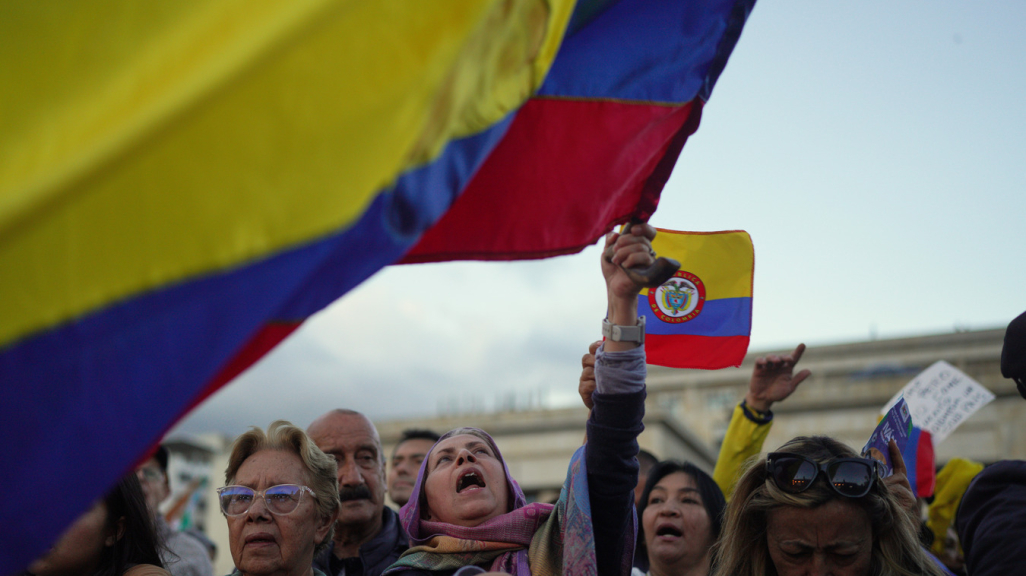
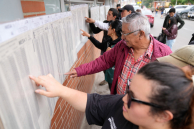
Colombians at a rally. (AP)

Colombians at a rally. (AP)

Share

Q&A with GDP Consultores' Juan Manuel Santos Arango on Dynamics in Colombia's Election 

By Chase Harrison

“De la Espriella has something that Cepeda also has ... popular fervor,” said the Bogotá-based analyst ahead of the May 31 presidential vote.


Colombians vote in the first round of presidential elections on May 31 and polls suggest it comes down to three candidates: Iván Cepeda on the left, Abelardo de la Espriella on the hard right, and Paloma Valencia on the center right. What is the outlook for election day as the clock ticks down?

Image
Juan Manuel Santos Arango

“What we're seeing now is Cepeda with a comfortable majority and de la Espriella having survived Paloma's hurricane in March before she lost momentum,” said Juan Manuel Santos Arango, CEO of GDP Consultores, a Bogota-based consultancy. He forecasts a runoff between Cepeda and de la Espriella.

In this interview with AS/COA Online’s Chase Harrison, Santos covers how Cepeda has maintained his lead, why Valencia is struggling to expand support, and how de la Espriella could scramble traditional regional dynamics.
Chase Harrison: The current frontrunner in the race is Iván Cepeda. What has his strategy been going into the final weeks?

Juan Manuel Santos Arango: Cepeda is employing a very unusual strategy, which is avoiding mistakes rather than making huge displays that will gain attention because he's been leading the polls for the past six months with a very comfortable majority.

He’s carefully choreographed. He tends to read his speeches with minimal improvisation. His campaign activities are planned pretty much to the last detail.

And it also helps that Cepeda represents continuity. So as the government makes popular decisions, including raising the minimum wage and lowering congressperson salaries, it tends to draw support for Cepeda.

Harrison: One candidate who has seen their support stagnate is Paloma Valencia. What’s happening there?

Santos: Valencia is a candidate that really showed up to the race in January when she won the Democratic Center’s nomination. And then I think that her whole strategy was based on winning the primaries in March and getting enough momentum to position herself as Cepeda's rival. Cepeda is perceived as an extreme-left candidate and Abelardo de la Espriella is perceived as extreme right, so she based her strategy on drawing voters that relate more toward the center-right of the political spectrum.

She is a woman. Colombia hasn't had a woman president before. Her vice-presidential candidate, Juan Daniel Oviedo, belongs to the LGBTQ community. So in a sense, it's this formula that has ideals that you would associate with the right, but individual characteristics that you wouldn't associate traditionally with the right. In that strategy, I think that they were focusing on having high participation in large cities.

But that doesn't seem to be working. Valencia had huge momentum in March and then sort of decelerated. She hit de la Espriella, so to speak, but she didn't get a knockout.

What de la Espriella is doing—and I think he's being pretty effective—is drawing more conservative people, more people that would associate themselves to the right, from Valencia’s base. And that's pretty much left her with the center.

So what we're seeing now is Cepeda with a comfortable majority and de la Espriella having survived Paloma's hurricane in March before she lost momentum. What we're expecting right now is that we will have a runoff between Cepeda and de la Espriella.

Harrison: What has helped de la Espriella maintain that momentum?

Santos: De la Espriella has something that Cepeda also has and that it would seem that Valencia lacks and it's what we would call popular fervor. There's excitement about a candidate representing something that is different.

In Colombia, the word “change” is probably the biggest political slogan. If you see how the Petro administration tags itself, it's “the Government of Change.” So I think that there's a sense in Colombian society that the one who proposes the most radical change is probably the one who's going to resonate better with their audiences.

Although Valencia and de la Espriella may have similar right-wing values, de la Espriella represents a huge wave of change. Valencia doesn't. You would associate Valencia with what you would think is the traditional political class in Colombia, whereas de la Espriella is something radically different: a businessman who hasn't been a politician, a lawyer. Emphasizing those traits has been the core of his strategy.

"In Colombia, the word 'change' is probably the biggest political slogan."
Harrison: There's two centrist candidates in the race who have been polling around 5 percent: Sergio Fajardo and Claudia López. Do you anticipate that we might see one of them drop out? Will there be any moves to consolidate support around Valencia?

Santos: Not really. Having Fajardo and López join with Valencia was an effort that former Presidents Álvaro Uribe and César Gaviria advocated for at the end of 2025. There was this push to make a coalition “from Abelardo to Fajardo,” as they said. The point was: how can we make a united front between the right and center to create an opposition against Cepeda?

In the end, it was impossible because people in the center, such as Fajardo and López, did not want to associate themselves with some right-wing views and felt that what de la Espriella or Valencia is advocating for is too harsh on the Petro administration. If it didn't happen about six months ago, the fundamentals for why it didn't occur are still there, you know?

There's also legal and financial issues here. Legally, you can't drop out anymore. That means even if you stopped campaigning and endorsed someone else, your face would still be on the ballot.

Then there's also a financial issue. If you run for president and get over 3 percent of the votes, the state will reimburse some of your campaign expenses. If you get under that threshold, all the money you've invested or your donors have invested in your campaign will have been lost.

Harrison: How is the election is playing out in distinct regions of the country. Are the candidates campaigning differently in various parts of the country?

Santos: It’s fascinating because in the past three presidential elections, voters in what you would call inland Colombia—in Medellin, in Bogota, in Santander—were voting very differently from how people in the Caribbean or in the Pacific voted.

The way it's playing out this year is those regions where there has been a traditional lack of state presence, such as the Pacific and the Caribbean, those are Cepeda territories.

The interior, where you have more industry and a larger state presence, is more likely to vote Valencia or de la Espriella.

But there’s two swing states in play this year: Bogotá and the Caribbean.

Whoever wins Bogotá tends to win nationwide because Bogotá is by far Colombia's most populous region and Cepeda’s force tends to do pretty well there. About three or four months ago, when we had our legislative elections, Cepeda’s party got almost half of all Bogotá's representatives to the House.

And then there's the Caribbean, which I think will be the largest uncertainty in a runoff between Cepeda and de la Espriella. Cepeda tends to do pretty well in the Caribbean, as Petro did pretty well in the Caribbean four years ago. But de la Espriella is from the Caribbean and he is probably the most viable presidential candidate the region has had in at least a decade. President Petro was born in the Caribbean, but he was raised in the interior, whereas de la Espriella was born and raised there.

It's going to be a massive uncertainty how many votes he can gather there. And that could be a gamechanger looking towards the runoff.

This interview has been edited for length and clarity.

Related

Explore