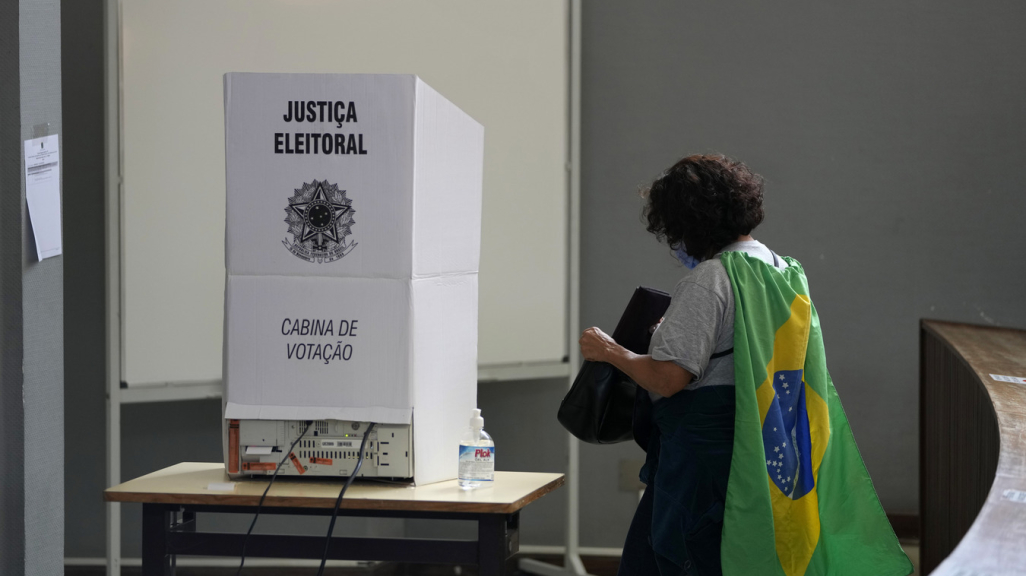
A Brazilian voter. (AP)

A Brazilian voter. (AP)

Brazil's 2026 Elections: Timeline and Fast Facts

By Luisa Leme

A presidential match-up between President Lula and Senator Flávio Bolsonaro will anchor Latin America’s largest electoral process of the year.

Voters in Latin America’s biggest country will cast ballots in an October 4 election that echoes the past with a presidential dispute between two well-known names: Lula and Bolsonaro. This time, 80-year-old President Luiz Inácio Lula da Silva (2003–2011, 2023–present) is seeking reelection for a fourth term in office. His main opponent is Senator Flávio Bolsonaro, 45, the son of former President Jair Bolsonaro (2019–2023), who is serving prison time for a coup attempt.

But the top seat is far from the only one up for grabs in this general election. Brazil’s 159 million voters will get the chance to pick governors, federal legislators, and other seats in an electoral process involving biometric verification and that provides results in a matter of hours.

AS/COA Online covers a timeline and key facts about the competition.
Who will be voting in Brazil’s election?

Voting is open to all Brazilians 16 and older, though it is only compulsory for those between 18 and 70 with a fine for abstention. This year, nearly 159 million people will be eligible to participate. Voters abroad saw a sizable jump, rising 32 percent since 2022 and totaling more than 900,000 people. 

This year’s election also offers new demographic insights; since 2022, Brazil’s Superior Electoral Court (TSE) allows for voters to declare gender and race when registering. This year’s registered voters, compared to the 2024 municipal elections, show the most diverse electorate to date, with 20.5 million self-identifying as black or a person of color and 85 percent more voters self-identifying as Indigenous. 

Turnout in 2022 was 79 percent for the presidential first round, in line with the country’s average. 

The number of eligible voters determines how the TSE calculates campaign spending limits. On July 21, the court ruled to maintain 2022 spending ceilings. Presidential candidates will be able to spend up to $17.2 million in the first round and an additional $8.6 million in the case of a runoff.

What positions are up for grabs?

Brazilians will vote for a president and vice president, 54 out of 81 senators, all 513 members of the Chamber of Deputies, and more than 1,000 seats in state assemblies.  For president and governors, a candidate must win more than 50 percent of the vote in the first round to avoid a runoff. If not, the two leading candidates proceed to a second round. The winners hold office for one four-year term with a possibility of reelection for one consecutive second term. Individuals holding executive posts can run again if they spend at least one full term out of office.

In the Chamber of Deputies, winners receive one of the 513 seats through proportional representation from open party lists in each state. The same process occurs in state assemblies. Deputies serve four-year terms and can be reelected with no term limits.

Each of the 26 states plus the federal district will elect two of their three senators, selected by direct election. They serve eight-year terms and can be reelected with no term limits.

What’s the electoral timeline?

July 20 to August 5: Political parties hold conventions and internal processes to determine candidates for president, vice president, governor, vice governor, senator, and federal and state representative. 

Once parties select their candidates, the choices are registered with the TSE, which vets candidacies for minimum age, party affiliation, and other requirements such as criminal records and financial disclosure. The court determines if the candidacies comply with Brazil’s clean record law and can move forward. 

After July 20, candidates and parties are also allowed to request a right of reply in media outlets and on websites or social media channels in case of defamation or misinformation. 

August 15: All candidates must be registered by this date.

August 16: Political campaigns officially start. Campaigns can advertise on the street and online, but robocalls and bulk text messages without recipient consent are prohibited. 

August 16: The first presidential television debate takes place

August 28 to October 1: Period in which all radio and television channels broadcast an hour of advertisement and political campaign programming each day. Each campaign, party, or coalition receives a set amount of time for programming based on the size of its congressional representation. 

October 4: Election day.

October 9 to 23: Official campaign period for the runoff vote.

October 25: Runoff vote for president and governors.

January 5, 2027: Presidential inauguration in Brasília.

January 6, 2027: Governors take office in all 26 states and the federal district. 

Related

Explore