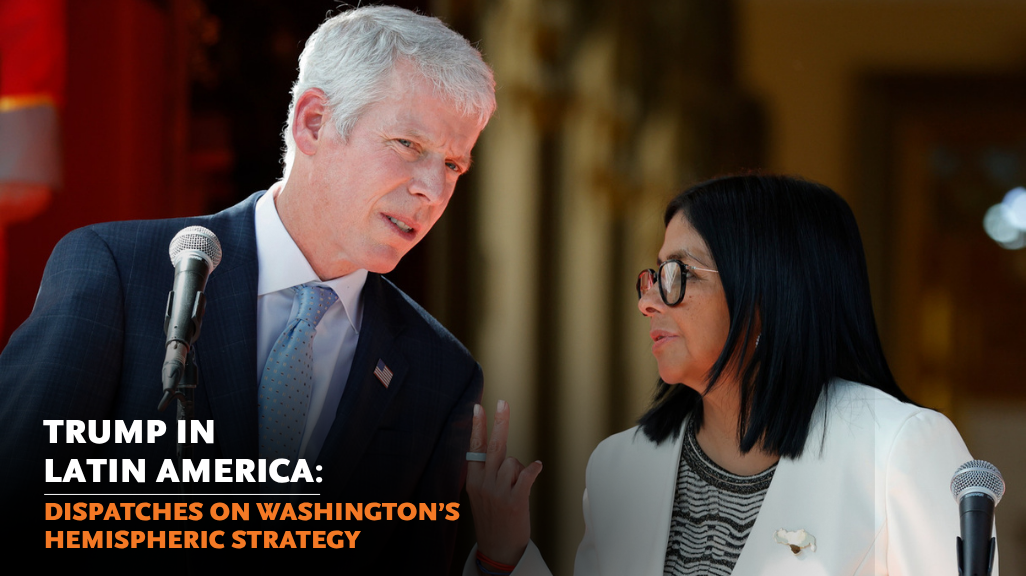
U.S. Energy Secretary Chris Wright and Venezuelan Interim Leader Delcy Rodríguez. (AP)

U.S. Energy Secretary Chris Wright and Venezuelan Interim Leader Delcy Rodríguez. (AP

Trump in Latin America: Venezuela Oil Deal Spurs Questions; U.S.-Brazil Trade Talks Resume

By Carin Zissis , Chase Harrison and Luisa Leme

Aug 27–Sep 2: Plus, U.S. military brass heads to Colombia and Trump signals a shift on Washington’s Falklands position.

Welcome back to our weekly dispatch of stories on the U.S. role in Latin America. Follow us each week and see previous roundups at as-coa.org/dispatches, or sign up to receive them via LinkedIn.

Here’s what to know this week: 

  • Questions surround a Trump administration joint oil venture in Venezuela that gives the United States a stake in about a fifth of the country’s oil reserves.
  • Trade negotiations kick off between U.S. and Brazilian officials over Washington’s July tariff hike on the South American country.
  • The leaders of U.S. Southern Command ramp up bilateral security cooperations with Colombia.
  • Plus, Cuban migration to Brazil swells and Trump ignites Falklands/Malvinas uncertainty
Venezuela: One energy deal, many questions

President Donald Trump took to social media on August 28 to announce that Washington had entered into “THE BIGGEST OIL DEAL IN WORLD HISTORY” by working with “Highly Respected” interim leader of Venezuela Delcy Rodríguez. Later that night, Rodríguez issued her own announcement thanking Trump and Secretary of State Marco Rubio for backing a deal in which the United States becomes a majority owner in a private firm with the right to develop 17 strategic Venezuelan oil fields. An August 31 White House factsheet says the agreement involves a 100-year lease of those oil fields and grants the U.S. Department of War a 35 percent equity stake in North American Blue Energy Partners (NABEP), a private oil firm. Moreover, the State Department gets the exclusive right to purchase 20 percent of oil output at production costs and right-of-first refusal on the remaining production. Reuters reports that some of the oil fields were previously controlled by Chinese and Russian companies

Meanwhile, U.S. Energy Secretary Chris Wright headed to Caracas on Tuesday where he said separate deals inked by U.S. and other international firms this week would help “massively grow available oil production” and cut prices. This marks Wright’s second trip to Caracas since February.

But the U.S. oil deal has sparked a plethora of questions. Below we explore a few of them.

How much oil are we talking about? The deal involves control over 65 billion barrels of oil, or about a fifth of Venezuela’s proven reserves. The White House says this will bolster U.S. current proven reserves of 46 billion barrels to “secure our energy dominance for the next century.” 

Some experts question Caracas’ claim that, at 17 percent of the world’s total, it controls more oil reserves than does Saudi Arabia

What’s the timeline? The deal may be getting unveiled right in time for the U.S. midterms, but observers say getting production on track could take years. Back in the 1990s, Venezuela produced over three million barrels of oil a day but, after years of underinvestment and collapsing infrastructure, that figure stood at just 1.12 million a day as of July, reports The New York Times

What does the deal mean for the future of Venezuelan governance? Given that Washington entered into the deal with an interim leader, the contracts are with her government, notes The Economist, raising concerns about when a democratic transition will be underway. Democrats on the House Foreign Affairs Committee took to X to say that Trump’s “intervention in Venezuela was never about…defending democracy.” A U.S. official told Politico in a briefing that the deal “in no way impedes the democratic transition” but also said, “I’m not going to give you a timeline.” Across polling, opposition leader María Corina Machado outpaces Rodríguez, who holds low levels of approval among Venezuelans. 

Who’s behind NABEP? Washington is entering into a joint venture with Barbados-based oil firm NABEP, Venezuela’s second-largest operator after Chevron.* NABEP’s CEO, Alejandro Betancourt, is a Venezuelan tycoon under investigation for money laundering and tax fraud in both Spain and Switzerland. Financial Times describes him as “a wily operator” while Axios reports that Betancourt has “a long history of supporting U.S. interests,” including Maduro’s removal. As one U.S. official put it: “No Betancourt, no energy-security deal.” 

*Disclosure: Chevron is a corporate member of the Council of the Americas.

Brazil and United States warm up for the negotiating table

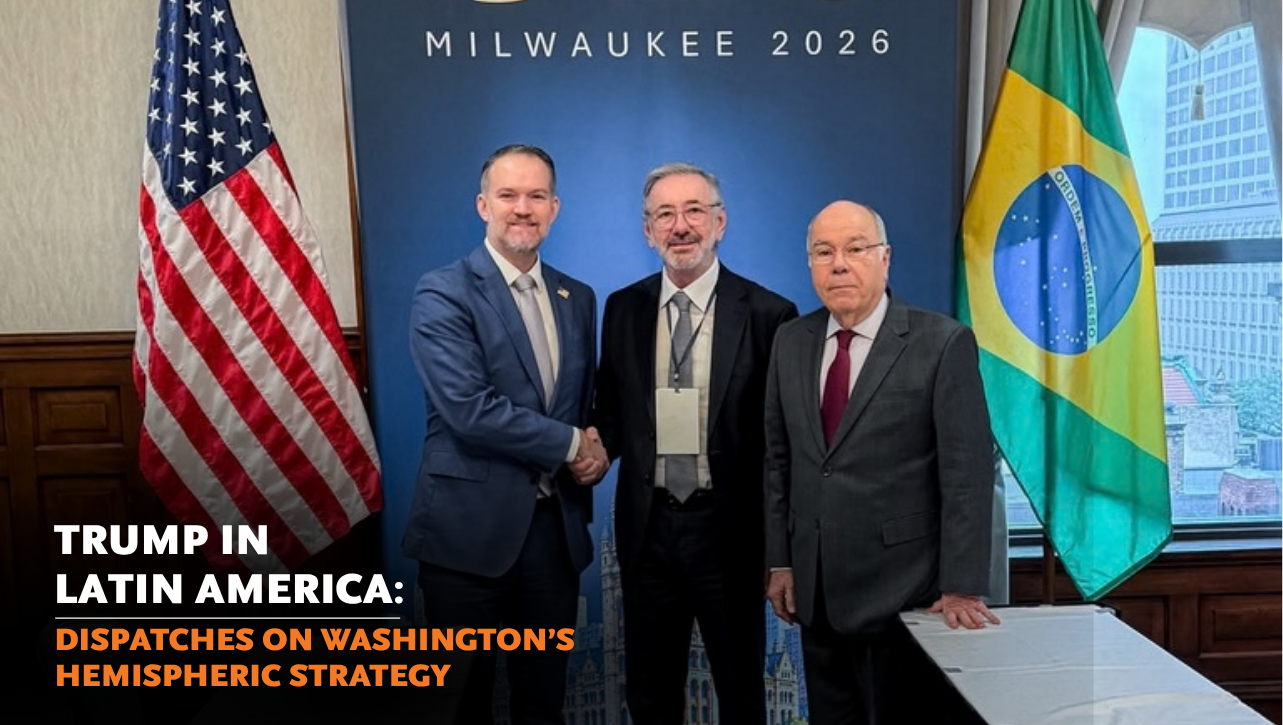
After an August 21 phone call between Trump and Brazilian President Luiz Inácio Lula da Silva, negotiations around Washington's July imposition of 37.5 percent tariffs on Brazilian goods resumed; U.S. Trade Representative Jamieson Greer, Brazil’s Industry and Trade Minister Márcio Elias Rosa, and Foreign Minister Mauro Vieira met virtually on August 31. "It was a meeting to resume dialogue. Obviously, we didn't make any progress on any of the negotiating points," said Elias Rosa. 

But there’s hope for the future; Greer and the minister will likely see each other in person on September 30, when the U.S. trade representative hosts a G20 ministerial meeting in Wisconsin.

Even as the talks proceed, Brazil’s government is considering options to retaliate through an economic reciprocity law mechanism triggered August 15, though that process may not produce action until the new year.

In other news

Trump teases Falklands/Malvinas shift: On August 31, Trump told a reporter he was reviewing U.S. neutrality over the United Kingdom and Argentina’s competing claims to the Falkland/Malvinas Islands after reports surfaced that Washington could shift its stance to pressure the UK to increase its defense and NATO spending. Argentine President Javier Milei celebrated Trump’s remarks and announced he would deliver a national address on the topic on September 3.

Cuban migration to Brazil swells: The population of Cubans seeking refuge in Brazil has surged since the Trump administration began its blockade on Cuba in December 2025 with 35,000 filing asylum applications in the first seven months of 2026. Brazil’s relative openness to Cubans could strain its relationship with Washington, posits Semafor. 

U.S military leader tours Colombia: Two weeks after Colombia joined the U.S.-led Shield of the Americas security alliance, the head of U.S. Southern Command Francis L. Donovan toured the country August 27 and 28, to talk joint efforts around surveillance in the Pacific, an augmentation Colombia’s aerial fleet, and joint operations on the border with Ecuador.

Landau spells out policy on podcast: “We can't be successful projecting power across the world if [...] we don't have the ability to project power in our own hemisphere,” said Deputy Secretary of State Christopher Landau when asked about the Donroe Doctrine on an August 31 podcast by conservative group American Moment. In the conversation, Landau also covered U.S. efforts to counter Chinese influence in the hemisphere and visas as “a genuine tool of statecraft.”

Related

Explore