Dinorah Figuera and Marco Rubio

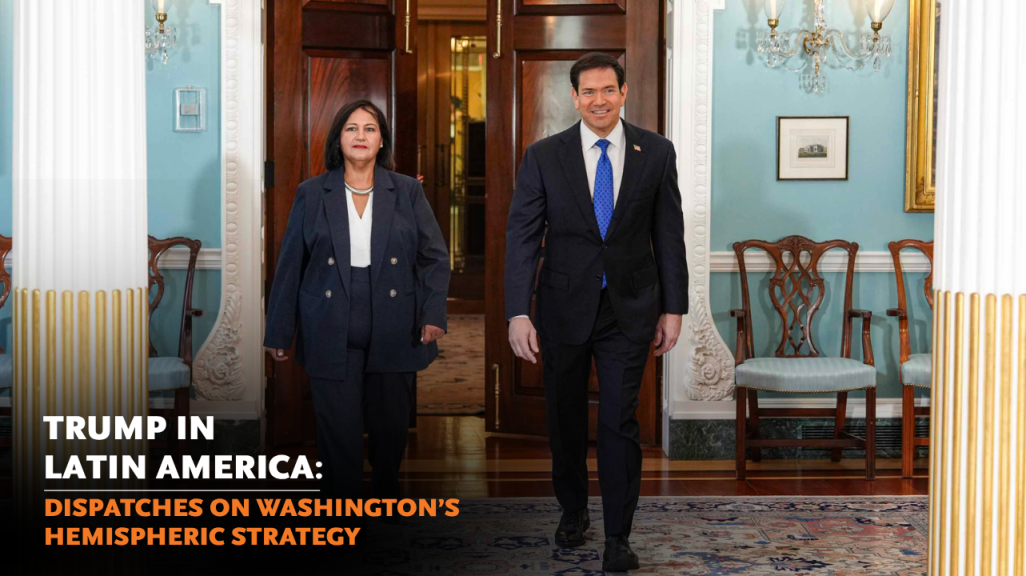
Venezuela's Dinorah Figuera and U.S. Secretary of State Marco Rubio. (Rubio's X account)

Trump in Latin America: U.S. Moves on Venezuelan Democracy and Mexican Energy

By Chase Harrison and Khalea Robertson

Oct 8–14: Plus, Nicaragua rejects U.S. ambassador, Chilean pensions hit by U.S. monetary policy, and Ecuadorian fishermen get acquitted.

Welcome back to our weekly dispatch of stories on the U.S. role in Latin America. Follow us each week and see previous roundups at as-coa.org/dispatches, or sign up to receive them via LinkedIn.

Here’s what to know this week: 

  • Treasury removes Venezuela’s national assembly head from sanctions list, Rubio gives update on transition talks.
  • Mexico faces Trump pressure over energy, deficit.
  • Rubio condemns Nicaragua’s rejection of U.S. ambassador and fields presidential phone calls.
  • Plus: Milei makes fifth U.S. visit in 2026, U.S. interest rate hike hits Chilean pension funds, judge acquits Ecuadorian fishermen affected by U.S. anti-narcotics campaign, and Treasury sanctions Mexico-based Cartel del Noreste.
Sanctions relief for top Venezuela official as democracy talks advance

The United States on Wednesday lifted sanctions on the president of Venezuela’s chavista-controlled National Assembly, Jorge Rodríguez. The first Trump administration sanctioned both him and his sister, interim President Delcy Rodríguez, in 2018 for their roles in the Maduro regime. Treasury had already lifted restrictions on Delcy in April as part of increasing bilateral collaboration.  

The brother is leading the interim administration’s delegation in ongoing U.S.-backed talks with the opposition towards a democratic transition. On October 9, the opposition leader, President of the 2015 National Assembly Dinorah Figuera, met with U.S. Secretary of State Marco Rubio in Washington to discuss progress. Speaking to press after the meeting, the two highlighted that two rounds of talks have so far yielded agreements to free some political prisoners, lift blocks on media websites, and restructure the Supreme Court of Justice.The third round begins in Caracas on October 14.  

“Our desire for Venezuela is that it not just simply have elections—elections of course are very important—but to have an enduring democracy,” said Rubio that day. No timeline has yet been set for a vote. In a recent interview, popular opposition figure María Corina Machado called for an election by July 2027. Machado, currently exiled in Panama and excluded from the talks, also argued that, if allowed to return home, her “presence will be a significant factor to facilitate” a transition. An August Meganalisis poll indicated she would win more than 60 percent of votes in a presidential election against seven other well-known politicians, including interim President Rodríguez.

Machado dipped her toe in another electoral competition on October 9, when she expressed support for Republican Congresswoman Maria Elvira Salazar (R-FL) in upcoming U.S. midterm elections. Three days later, Salazar also got the backing of Colombian President Abelardo de la Espriella. Salazar is running for reelection in a Southern Florida district with significant populations of Colombian and Venezuelan origin, in a race the Cook Political Report considers “competitive.”   

Meanwhile, U.S. authorities on October 11 arrested Álvaro Pulido Vargas, a Colombian-born businessman accused of bribing his way into Venezuelan state contracts during the Maduro regime. Pulido, who was previously imprisoned in Caracas, made his first court appearance on Tuesday in Southern Florida. He was an associate of Alex Saab, another Colombian national connected to Maduro and deported to the United States in May to face money laundering charges. 

Mexico faces Trump pressure over energy, deficit

Per the Financial Times, Trump used one of his regular calls with Mexican President Claudia Sheinbaum to suggest her country should sign deals with U.S. energy companies. Foreign investment in the sector is a politically touchy matter for Mexico, where Sheinbaum’s party has taken the country back down the path of state energy control.  A U.S. official familiar with the mid-September call said the conversation also explored the possibility of Mexico increasing its purchases of U.S. natural gas. Mexican imports of the product already account for three-quarters of demand and reached record-breaking rates this year.  

This summer, Sheinbaum reversed her anti-fracking position as part of an effort to weaken reliance on U.S. gas imports. But, during her daily press conference on Tuesday, Sheinbaum indicated that her government seeks to address the Trump administration’s concern over a widening U.S. trade deficit with Mexico in the hopes of moving forward on a trade deal. All told, U.S.-Mexico trade rose 27 percent year on year in August, but while U.S. exports to Mexico rose 15 percent, Mexico’s exports to its neighbor increased 34 percent. 

New and rejected ambassadors, plus presidential phone calls

On October 13, Nicaragua’s regime rejected Washington’s pick for the U.S. ambassador, Natasha Franceschi, a senior career diplomat. In response, Rubio recalled the U.S. chargé d’affaires to Nicaragua and admonished co-Presidents Daniel Ortega and Rosario Murillo for their “complete unwillingness to engage in productive diplomatic dialogue.”

Rubio also had phone calls this week with two regional presidents. On October 12, he spoke with Colombia's De la Espriella on bilateral relations and security issues. The next day, his conversation with Salvadoran President Nayib Bukele covered “keeping critical infrastructure, including ports, secure and free from malign foreign influence.”  

In DC, Rubio may soon meet with the newly appointed Peruvian Ambassador to the U.S. Álvaro Vargas Llosa. The son of the late, Nobel Prize-winning author Mario Vargas Llosa. 

In other news

Milei visits Washington...again. Argentina’s Javier Milei is in familiar territory this week: The United States. The president arrived October 14 for his fifth trip stateside this year and twentieth since his term began in 2023. This time it’s not an official visit; The Argentine leader will meet with the private sector and be honored by organizations. But reports indicate Vice President J.D. Vance could travel to Argentina in November. 

U.S. economic policy jolts Chilean pension fund. Seven major Chilean pension funds invested in derivatives betting on U.S. interest rate cuts stand to lose billions after Washington raised those rates, threatening retirement savings across the country. The funds now face the one-two punch of new regulations and a U.S. bond selloff.  

Fishermen’s case thrown overboard. In the first of three similar cases, an Ecuadorian judge on October 8 cleared of wrongdoing the crews of two fishing vessels that were intercepted and sunk last month by the U.S. military. The United States had accused the 32 fishermen of providing fuel to drug boats, a claim backed by Ecuadorian President Daniel Noboa.   

Plus, The Wall Street Journal reports that U.S. airstrikes on boats in the Caribbean and Pacific have done little to stop record cocaine flows to Europe and North America, as traffickers find new ways to transport their product.  

New cartel sanctions incoming. On Tuesday, the Treasury Department issued sanctions on four people and 11 entities tied to activities that finance the Mexico-based Cartel del Noreste. Secretary Scott Bessent described the move as Treasury’s "most significant action to date” against the group, which is a successor to Los Zetas and was designated as a Foreign Terrorist Organization last year.   

Carin Zissis contributed to this dispatch.

Related

Explore