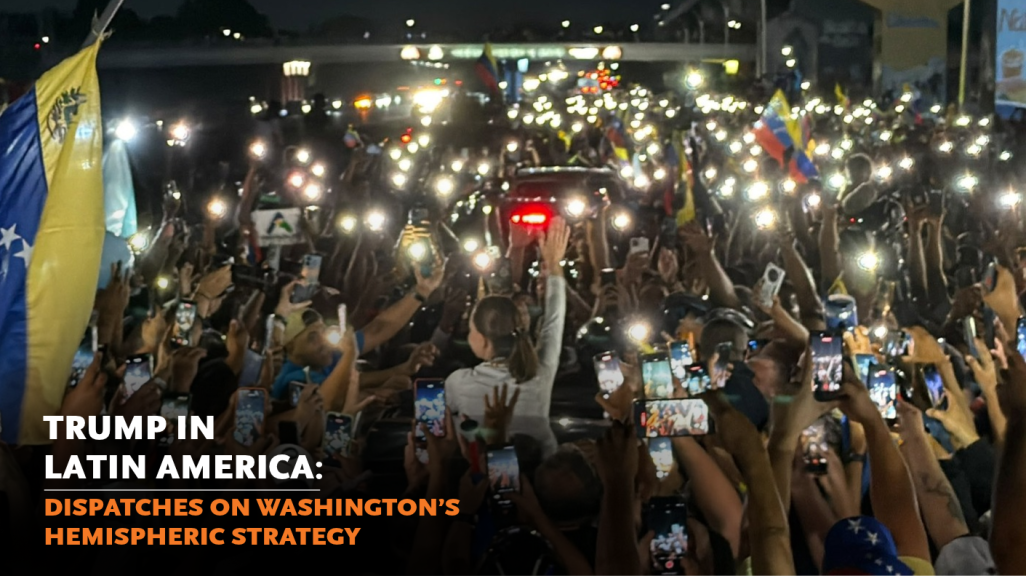
Maria Corina Machado, in white, rallies in Venezuela on October 25. (Machado's X)

María Corina Machado, in white, holds an October 25 rally in Venezuela. (Machado's X)

Trump in Latin America: Flávio Flees to Florida, Machado Flies Home

By Chase Harrison and Carin Zissis

Oct 22–28: Plus, the Dominican Republic hosts an A3C forum as U.S. regional security collaboration rises.

Welcome back to our weekly dispatch of stories on the U.S. role in Latin America. Follow us each week and see previous roundups at as-coa.org/dispatches, or sign up to receive them via LinkedIn.

Here’s what to know this week: 

  • Trump approves Flávio Bolsonaro fleeing to Miami after Brazilian election loss but doesn’t support annulment effort.
  • A3C forum in Santo Domingo builds on rising hemispheric security cooperation.
  • Washington celebrates María Corina Machado’s return while affirming its plan for Venezuela’s democratic transition.
  • Plus: Key Rubio advisor leaves post, Milei changes sanctions, and UN votes on Cuba embargo end.
Flávio flees to Florida

Less than two days after Flávio Bolsonaro lost the October 25 Brazilian presidential runoff, the right-wing senator bolted. Brazil’s Supreme Court had ordered him to surrender his passport due to a pending inquiry into money laundering and ties to disgraced banker Daniel Vorcaro. But he used his Italian passport to transit through Argentina before taking a private flight to Miami, arriving the morning of October 28 after making a stop in Ecuador. The U.S. State Department granted him and his family a humanitarian visa for one year. 

Bolsonaro, who lost to incumbent Luiz Inácio Lula da Silva by 4.5 million votes, had initially sought to contest the election results. The morning after the vote, U.S. President Donald Trump said the runoff “looked like another rigged election,” but avoided saying Washington would take some kind of action, adding, “I like Lula.” Still, a day later, as news broke of Bolsonaro’s flight, Trump voiced approval of his entry into the United States. Bolsonaro’s decision to flee to Florida marks a deja vu moment. His father, ex-President Jair Bolsonaro, did the same after suffering a narrower runoff defeat to Lula in 2022. The elder Bolsonaro is currently serving a prison sentence for his role in a 2023 coup attempt.

The younger Bolsonaro’s loss halts a string of right-wing electoral wins in Latin America that had expanded Washington’s ideological allies in the region, though Trump did not endorse Bolsonaro in this election. However, a Brazilian Supreme Court justice has launched a probe into illicit foreign financing of Bolsonaro’s campaign involving a group linked to U.S. Vice President JD Vance.

Machado returns to Venezuela as U.S. works on transition plan

Venezuelan opposition leader María Corina Machado returned to Venezuela on October 25 after 10 months abroad and several failed attempts. Secretary of State Marco Rubio called her arrival a “direct result of the U.S. supported reconciliation talks.” Prior to Machado’s return, Washington received assurances that the interim government, led by Delcy Rodríguez, would not intervene, though Rodríguez called for Machado to express “regret, remorse, and a change of course.”

The day after Machado’s return, the State Department released plans to shepherd Venezuela toward elections, developed in talks between the Rodríguez government and an opposition group led by Dinorah Figuera. Washington hopes a new Supreme Court will be installed by mid-December, followed by a National Electoral Council. The establishment of the two bodies would begin a six-month period during which elections should be held. The Supreme Court would have expanded powers focused on election administration, with members selected by a panel of experts without the approval of the National Assembly. 

Meanwhile, Trump highlighted the U.S.-Venezuela oil deal at a rally in Texas in advance of the November 3 midterm elections. “By unleashing energy dominance from Alaska, all the way down to Venezuela, I have made the Western Hemisphere the energy capital of the world,” he wrote in an October 27 Truth Social post.

DR, Southcom host A3C forum amid rising hemispheric security cooperation

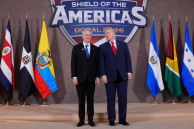
With Dominican President Luis Abinader and SOUTHCOM Commander General Francis Donovan at the helm, Santo Domingo played host to security and defense representatives from 19 countries on October 26 and 27 for an Americas Counter Cartel Coalition (A3C) forum. Launched in Florida in March by U.S. Secretary of Defense Pete Hegseth, the A3C is a hemispheric military-defense initiative that correlates to the Shield of the Americas, a broader political framework, with both initiatives prioritizing the battle against transnational organized crime.

Per SOUTHCOM, the event this week involved reviewing a military plan for an “operational strategy.” It coincides with rising U.S. security collaboration across much of the hemisphere. For example, this week, The Hill reported that the Pentagon is funding a naval training center in Guayaquil. On Tuesday, 300 U.S. troops landed in Colombia for a joint training exercise. El País notes that a similar exercise took place in Colombia in 2022, although it involved half as many troops.

Still, Latin America’s two largest countries, Brazil and Mexico, remain outside both the Shield and the A3C, while involvement has drawn pushback in some cases and countries. Prior to the Santo Domingo summit, Chilean President José Antonio Kast held an emergency cabinet meeting on his country’s A3C membership and opted to remain an observer state. Chile’s decision last month to join the Shield of the Americas sparked domestic divisions and is largely unpopular.

In other news

Personnel exit. Rubio advisor Jeremy Lewin, who first entered the government as part of DOGE and went on to lead talks with Cuba and Venezuela, is leaving the State Department. He served as director of policy planning.

Figuring out the Falklands. U.S. Deputy Secretary of State Christopher Landau met with President Javier Milei in the Casa Rosada on October 24, where the two spoke about the impact of potential Argentine sanctions on U.S. companies related to the Falklands/Malvinas dispute. (See October 21 dispatch) Milei’s government plans to change the proposed sanctions, which need legislative approval, to apply to companies directly working on illegal projects and not investment funds.

Hollers over Havana. The UN voted on its thirty-fourth annual resolution to condemn the U.S. embargo on Cuba and, while the measure passed, votes against it expanded from seven countries last year to 17 this year. Several countries in the region were among the dissenters: Colombia, Costa Rica, Ecuador, and Trinidad and Tobago joined Argentina and Paraguay. During the session, U.S. Ambassador to the UN Mike Waltz got into two verbal altercations with senior Cuban officials, including with Foreign Minister Bruno Rodríguez. 

Related

Explore