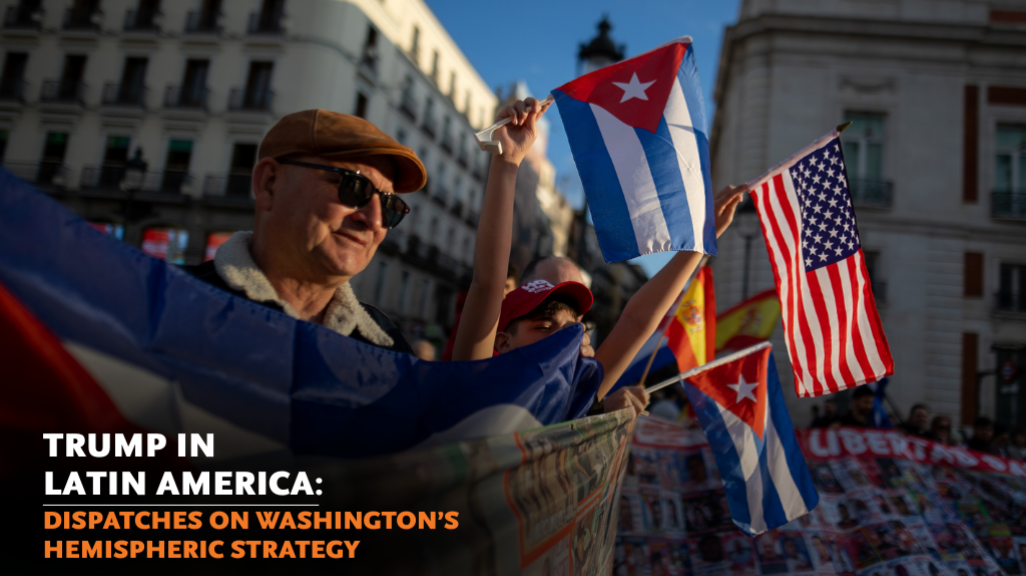
Cuba rally, Madrid

Cuban exiles at a March rally in Madrid, Spain. (AP)

Trump in Latin America: Negotiations with Cuba and Reviews with Mexico

By Chase Harrison and Khalea Robertson

March 13–19: Venezuelan oil gets sanctions relief and Washington launches trade investigations into dozens of hemispheric partners.

Welcome back to our weekly dispatch of stories on the U.S. role in Latin America. Follow us each week and see previous roundups at as-coa.org/dispatches, or sign up to receive them via LinkedIn

Here's what to know this week:

  • Trump threatens a change in Cuba as the island’s regime promotes diaspora investment amid an energy crisis.
  • Washington continues to loosen sanctions on Venezuela’s oil sector in a bid to boost global fuel supply.
  • The U.S. and Mexican officials complete their first bilateral meetings to launch the formal USMCA review, as Mexico’s security chief visits Washington.
  • In Brazil, the Lula administration banned a U.S. official from visiting jailed ex-President Jair Bolsonaro. 
Trump eyes Cuba

“I do believe I’ll be having the honor of taking Cuba,” U.S. President Donald Trump told reporters on March 16, “I mean, whether I free it, take it, [I] think I could do anything I want with it.” Three days earlier, Cuban President Miguel Díaz-Canel publicly stated his government has been in talks with Washington. Although The New York Times reported that Díaz-Canel’s removal from office is a key U.S. condition in the talks, Secretary of State Marco Rubio labelled that a “fake story” dependent on “charlatans and liars” as sources. 

But changes are afoot. In an interview released March 16, Cuba’s Deputy Prime Minister and Foreign Trade and Investment Minister Oscar Pérez-Oliva Fraga told NBC News his country “is open to having a fluid commercial relationship with U.S. companies.” Pérez-Oliva, the great-nephew of Fidel and Raúl Castro, also announced that Cubans abroad will be allowed to participate in the local private sector and partner with state companies. Rubio later dismissed these plans as “not dramatic enough” and said Cuba will “have to get new people in charge” to fix the economy. 

Meanwhile, a nationwide blackout early this week again laid bare the country’s energy crisis amid a U.S. fuel blockade on the island. The increasingly frequent power outages have triggered nightly protests of banging pots and pans, known as cacerolazos. Over the weekend, demonstrators set fire to a Communist Party office in central Cuba. 

Around 730,000 barrels of oil from Russia may arrive to the island next week and would be the first imports Cuba receives since a January shipment from Mexico. “May arrive” is the key phrase here. As international affairs expert Solange Márquez Espinoza recently noted, the Sea Horse, another tanker bound for Cuba in February and filled with Russian fuel, never made it. “The island, long sustained by external patrons, now faces a different reality. Cuba’s rulers are alone,” she writes. 

U.S. and Mexican officials launch USMCA negotiation

March 18 marked the formal kick-off of bilateral discussions ahead of the U.S.-Mexico-Canada Agreement (USMCA) review process, slated for July 1. Speaking about his country’s approach, Mexican Economy Minister Marcelo Ebrard said, “Mexico will propose the permanence of the USMCA and the elimination of tariffs” especially those on steel, which are currently at 50 percent. Ahead of the meeting, U.S. Trade Representative Jamieson Greer said, “If we are going to have a deal, it has to be a deal for Mexico and the United States and the goods should be made up of content from Mexico and the United States.” 

Technical teams will now convene for “a regular sequence of meetings” to tackle topics like increasing manufacturing production, adding employment, and curtailing unfair trade practices. 

Ebrard wasn't the only Mexican cabinet member in Washington. On March 16, Security Secretary Omar García Harfuch met with U.S. security officials, including the head of the Drug Enforcement Agency (DEA) and the director of the FBI, to speak about combating drug and firearms trafficking. The meetings were a sign of closer U.S.-Mexican security cooperation during the Sheinbaum administration, after tension between the governments under her predecessor. Another sign? Harfuch gave an exclusive interview to right-wing U.S. news source Newsmax on March 12, where he spoke about the capture of drug cartel leader El Mencho. Two days later, speaking to reporters on March 14, Trump praised Mexican President Claudia Sheinbaum but urged more joint cooperation on battling cartels.

Tapping into Venezuela’s oil and gas pipeline

On Wednesday, the U.S. Treasury further eased sanctions on the Venezuelan hydrocarbon sector, issuing a general license that permits U.S. companies to more freely invest in and trade with Venezuelan state oil and gas company PDVSA and its subsidiaries.  A day later, it extended a license that protects Houston-based, PDVSA-owned refinery CITGO from its creditors. This followed Treasury’s March 13 decision to waive other sanctions that prevented U.S. companies from conducting business involving Venezuelan oil, electricity, and petrochemical products such as fertilizer.

With the domestic costs of oil and fertilizer rising due to the Iran war, the Treasury Department said on X that the waiver announced on March 18 should “support the global energy market by increasing the supply of available oil.” However, energy expert Francisco Monaldi, a former guest on AS/COA Online’s Latin America in Focus podcast, commented to Bloomberg that Venezuela’s oil infrastructure is not prepared to significantly scale up production in the short term.  

In the meantime, acting President Delcy Rodríguez replaced Vladimir Padrino López with Major General Gustavo González López as Venezuela’s defense minister on March 18. González had been serving as the head of the presidential guard since the U.S. seizure of Nicolás Maduro on January 3. Said to be close to controversial Interior Minister Diosdado Cabello, González’s alleged involvement in human rights violations during his time heading military intelligence units drew sanctions from the United States, Canada, Panama, and Switzerland. 

In other news

Darren Beattie, a State Department official, was slated to head to Brazil this week to meet with jailed ex-President Jair Bolsonaro and his son, presidential candidate Flávio Bolsonaro. But Brazil’s Supreme Court on March 12 blocked Beattie from the prison visit. The next day, the Lula administration revoked the diplomat’s visa on charges of “intentionally misrepresenting a material fact or committing fraud” to obtain it. 

On March 12, the U.S. Trade Representative’s Office announced 301 investigations into countries believed to be using forced labor practices in the production of exports destined for the United States. Argentina, Brazil, Canada, Chile, Colombia, Costa Rica, the Dominican Republic, Ecuador, El Salvador, Guatemala, Honduras, Mexico, Nicaragua, Peru, Uruguay, and Venezuela are among the 60 countries subject to investigation.  

On March 13, U.S. and Ecuador officials signed a bilateral trade agreement, the fourth in the region so far. As part of the agreement, Ecuador will now require transit visas for Cubans and Haitians and reform their space agency to allow for more U.S. cooperation. 


Alleged Uruguayan drug trafficker Sebastián Marset, one of the DEA’s most wanted fugitives, made his first appearance in a U.S. court on Monday to face money laundering charges. Bolivian law enforcement worked with the DEA to capture Marset on March 13 in the Andean country and subsequently transfer him to the United States.

The United States and Venezuela faced off on a more fun frontier on March 17: the baseball diamond. Venezuela triumphed 3-2 over the United States in the finals of the World Baseball Classic, the country’s first victory in the championship. 

What's coming up?

From March 18 to 20, the annual conference of the Association of Mexican Banks (ABM) takes place in Cancún and both President Sheinbaum and U.S. Treasury officials will be in attendance. In an interview with El País, ABM’s president Emilio Romano spoke about the advances in the banking sector, Sheinbaum’s Plan Mexico, USMCA, and the need for binational cooperation against money laundering.

Related

Explore