Trump in Latin America: Iran Reactions, Ecuador Joint Action, Venezuelan Transactions
Trump in Latin America: Iran Reactions, Ecuador Joint Action, Venezuelan Transactions
Feb 27–Mar 5: The administration readies to welcome likeminded leaders in Florida as it eyes changes in crisis-hit Cuba.
Welcome back to our weekly dispatch of stories on the U.S. role in Latin America. Follow us each week and see previous roundups at as-coa.org/dispatches, or sign up to receive them via LinkedIn.
AS/COA Online's regular roundup covers U.S policy news on the Americas in the era of the Donroe Doctrine.
U.S. military strikes on Iran over the weekend quickly drew a range of reactions from Latin American leaders. Argentina’s President Javier Milei celebrated the joint U.S.–Israeli action that killed Iran’s Supreme Leader Ali Khamenei and recalled the 1994 bombing of a Jewish community center in Buenos Aires that an Argentine court determined in 2024 was directed by the Iranian regime. Eighty-five people were killed that day, marking the deadliest terrorist attack in Argentina’s history.
The foreign ministries of Ecuador, Panama, and Paraguay issued statements condemning Iran’s retaliatory attacks against U.S.-allied Gulf states without mentioning attacks carried out by the United States or Israel.
“I think President Trump made a mistake today,” wrote Colombian President Gustavo Petro on X as news of the U.S. offensive arrived on February 28. Chile’s statement criticized U.S. and Israeli attacks on Iran, as well as the Iranian response. The governments of Brazil and Mexico avoided assigning blame, instead appealing for an end to the hostilities and a return to diplomatic negotiations.
Among Iran’s longstanding ideological allies in the region, Cuba denounced what it called an “irresponsible and deliberate aggression” by Washington and Nicaragua sent condolences to Iran’s regime for Khameini's death but did not reference U.S. involvement. As for Venezuela, which hosts Iranian military installations and, up to very recently, depended on Iran’s support to help sustain its oil sector: Foreign Minister Yván Gil retracted a statement condemning military escalation against Iran within hours of publishing it.
On March 1, after the strikes on Iran, U.S. Senator Lindsey Graham’s (R-SC) told Fox News: “Cuba’s next [...] Their days are numbered.” Drawing on conversations with White House insiders and political analysts, The Atlantic backs up Graham’s thesis.
Amid critical shortages of U.S. dollars, food, and fuel, Cuban President Miguel Díaz-Canel urged his council of ministers on Monday to “focus on implementing the urgent, most necessary transformations to the economic and social model.” The plan? More public-private partnerships, investment outreach to the Cuban diaspora, and giving local government more control over economic policy. On Wednesday, two-thirds of the island went dark as the main power grid suffered its second partial collapse in a month.
In the meantime, the Cuban government on Tuesday filed terrorism charges against six survivors of last week’s exchange of gunfire in Cuban waters. Rubio has insisted that Washington was not involved in the February 25 incident that saw Cuban coast guard troops kill four U.S. residents of Cuban origin who had fired at them from a speedboat.
U.S. Secretary of the Interior Doug Burgum, along with more than two dozen mining companies, traveled to Venezuela on Wednesday. The secretary’s visit comes as Axios broke news that Venezuela’s state mining firm Minerven signed a major deal this week to sell as much as 1,000 kilograms of gold to U.S. markets.
Burgum met with interim President Delcy Rodríguez and other Venezuelan officials, including Venezuela’s Interior Minister Diosdado Cabello, who is under U.S. indictment for narcoterrorist links. After the meeting, Rodríguez indicated that a proposed reform to the country's mining law is in the works, which would open the door to more foreign investment.
On the same day, President Donald Trump and Rodríguez exchanged praise on social media.
In related news, opposition leader María Corina Machado announced on March 1 that she plans to return to her country in the coming weeks. A poll cited by the Miami Herald found that 71 percent of Venezuelans would support her if elections were held today.
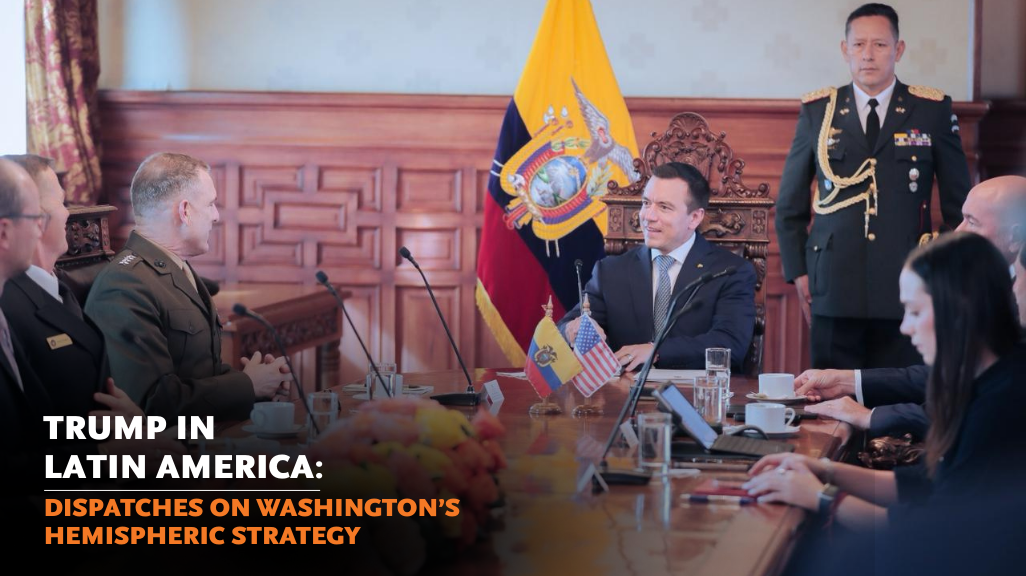
On Monday, U.S. Southern Command chief Francis Donovan was in Quito to meet with President Daniel Noboa who, that same day, announced that “in the month of March, we will be carrying out joint operations with our allies in the region, including the United States.” By Tuesday, the two countries had launched just such an operation against Los Choneros and Los Lobos, both of which Washington designated to be terrorist organizations last year. The New York Times indicated that the March 3 operation was carried out by Ecuadoran forces with U.S. intelligence and logistics support.
While Ecuador is not a cocaine source, the country has become a transit point for an estimated 70 percent of drug flows leaving Colombia and Peru—the world’s two biggest cocaine producers. Increased criminal activity has sparked a surge in violence in Ecuador; homicide rates exceeded 50 per 100,000 people last year, roughly double the rate in neighboring Colombia, per The Wall Street Journal.
Bilateral cooperation has grown since Noboa took office in 2023, even though Ecuadoran voters rejected the return of foreign military bases in a November 2025 referendum that essentially blocked U.S. operation of a base in Manta, on the Pacific Coast. Still, during a September 2025 visit, Secretary Rubio announced roughly $20 million in funding for drones and security.
On March 4, less than 24 hours after the joint operation commenced, the Noboa government announced intentions to sever diplomatic ties with Havana and eject the Cuban ambassador from Ecuador.
Noboa will be one of several hemispheric leaders heading to Doral, Florida to meet with Trump for the Shield of the Americas summit on March 7. White House Press Secretary Karoline Leavitt indicated guests would include leaders from “Argentina, Bolivia, Chile, Costa Rica, the Dominican Republic, Ecuador, El Salvador, Honduras, Panama, Paraguay, Trinidad and Tobago, and maybe some others as well.” The presidents of Latin America’s three most populous countries—Brazil, Mexico, and Colombia—will not be joining.
The March 7 summit is expected to focus on security concerns, including China’s influence in the hemisphere. El País covers how Salvadoran President Nayib Bukele, one of the invitees, is balancing his close Washington relations with economic ties to Beijing.
For more on how Latin America juggles U.S. and Chinese relations, listen to a recent Latin America in Focus podcast with Andrés Bello Foundation’s Parsifal D’Sola Alvarado.
Rather than heading back to Argentina after the Doral summit, President Milei will travel to New York City to lead an investment-focused delegation of governors, senior officials, and business leaders for what’s known as “Argentina Week.”
Meanwhile, Secretary Rubio is scheduled to attend the March 11 inauguration of Chile’s incoming President José Antonio Kast.