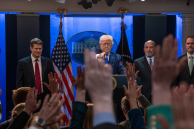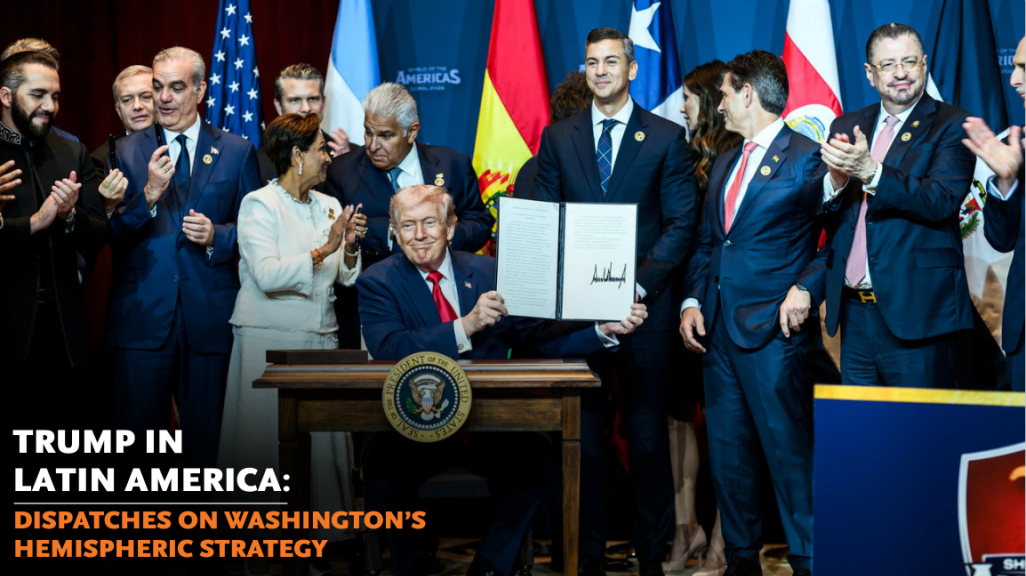
Center: U.S. President Donald Trump at his Shield of the Americas Summit. (White House)

Center: U.S. President Donald Trump at his Shield of the Americas Summit. (White House)

Trump in Latin America: The 411 on Doral, a 301 for Mexico, an A3C for the Region

By Carin Zissis and Khalea Robertson

Mar 6–12: Leaders gather for the Shield of the Americas summit before heading to Chile's inauguration. Plus: Washington restores Venezuelan ties.

Welcome back to our weekly dispatch of stories on the U.S. role in Latin America. Follow us each week and see previous roundups at as-coa.org/dispatches, or sign up to receive them via LinkedIn

The Doral Doctrine

“The only way to defeat these enemies is by unleashing the power of our militaries. So we have to use our military. You have to use your military,” U.S. President Donald Trump told ideologically aligned hemispheric leaders gathered at the March 7 Shield of the Americas summit in Florida. “Just as we formed a coalition to eradicate ISIS, we now need a coalition to eradicate the cartels.” The president also highlighted the U.S. capture of Nicolás Maduro and warned that the Cuban regime would soon face its own moment of change, saying: “As these situations in Venezuela and Cuba should make clear, under our new doctrine—and this is a doctrine—we will not allow hostile foreign influence to gain a foothold in this hemisphere.”

Heads of state from Argentina, Bolivia, Chile, Costa Rica, the Dominican Republic, Ecuador, El Salvador, Guyana, Honduras, Panama, Paraguay, and Trinidad and Tobago attended. But who wasn’t there drew as much attention, including the left-wing presidents of the region’s three most-populated countries: Brazil’s Luiz Inácio Lula da Silva, Mexico’s Claudia Sheinbaum, and Colombia’s Gustavo Petro.

At the Summit, Trump singled out Mexico as a source of cartel violence and noted Sheinbaum’s refusal to allow U.S. strikes on targets in her country.  Meanwhile, over the weekend, Brazil’s agriculture minister said that Lula’s planned visit to the White House later this month had been “suspended” due to the war in Iran. And, on March 10, White House Press Secretary Karoline Leavitt said, “I don’t think we’re seeing the level of cooperation we quite want to see yet from the Colombian government to invite them to the Shield of the Americas.” 

Still, on March 11, Trump waived away concerns about these leaders’ absence from the summit,telling journalists he thought they had been invited and that he “gets along very well” with all three.

Coincidentally, the three absentees have been chatting since the Doral event, with Lula disclosing that, in a March 9 call, he invited Sheinbaum to visit his country to explore opportunities for private-sector partnerships. Two days later, in a call with Petro, Sheinbaum confirmed Mexico’s presence at a March 21 Community of Latin American and Caribbean States (CELAC) summit with Africa to be held in Bogotá.

The three Cs of defense cooperation

The Shield of the Americas summit came on the heels of the launch of another hemispheric initiative: the Americas Counter-Cartel Coalition. On March 5, U.S. Defense Secretary Pete Hegseth, Homeland Security Adviser Stephen Miller, and U.S. Southern Command (SOUTHCOM) chief Francis Donovan met with regional defense ministers and military leaders at SOUTHCOM’s headquarters in Miami.

The aim of the new group—which Hegseth dubbed A3C—is to cut off financing to organized crime, train the militaries of partner countries, and counter “malign foreign influences from outside the Western Hemisphere.”

Seventeen countries have officially come aboard the A3C so far, with the Bahamas, Belize, Guatemala, Jamaica, and Peru joining the 12 countries represented at the Shield of the Americas Summit.

Kast’s guest list

In a left-to-right shift, Gabriel Boric handed over the presidential reins to José Antonio Kast in Chile on March 11. Several leaders who made the trip to Doral also traveled to Santiago for the inauguration, where they were joined by leaders such as Spanish King Felipe VI, Uruguayan President Yamandú Orsi, and Hungarian President Tamás Sulyok. While Trump was in attendance, U.S. Deputy Secretary of State Christopher Landau, whose father served as ambassador to the country in the 1970s, led a U.S. delegation to the event.

Who else was absent? Lula, who canceled his trip after hearing political rival Flávio Bolsonaro would be there. Foreign Minister Mauro Vieira attended instead

One notable attendee was María Corina Machado, who came to Santiago after an extended stint in the United States and before she says she plans to head back to her home country.

Venezuelan restoration

Kast may have invited her to the party in Chile, but, per The Wall Street Journal, “Machado appears to play no role in the Trump administration’s current calculations.” 

On March 5, Washington and Caracas reestablished diplomatic ties for the first time since 2019. In Doral, Trump described interim leader Delcy Rodríguez as the “President of Venezuela” and said she “is doing a great job, and working with U.S. representatives very well. The oil is beginning to flow.” In a further sign of Washington legitimizing Rodríguez, a March 10 letter by a top State Department official presented as evidence in ongoing litigation recognized her as the “sole” leader in Venezuela.

Mexico: Trade talks, trade tensions

On March 5, Mexico’s Economy Secretary Marcelo Ebrard and U.S. Trade Representative Jamieson Greer set the week of March 16 as the start of regular preparatory meetings for the mandatory July 1 joint review of the U.S.-Mexico-Canada Agreement (USMCA). The two sides indicated that boosting North American production, strengthening rules of origin, and securing supply chains will be central to the talks, as will be a focus on building obstacles to Chinese imports. Greer and Canadian Trade Minister Dominic LeBlanc also met on March 6 in what was the two countries’ first face-to-face talk on trade since October. 

But new trade tensions arose on March 11 when the Office of the U.S. Trade Representative announced a new investigation into what it says are unfair trade practices by 16 countries—Mexico included—allowing for “excess capacity” in factories that lead to U.S. trade deficits. Greer warned more trade-related investigations are coming, affecting dozens of countries and potentially paving the way for the administration to use Section 301 of the U.S. Trade Act to replace tariffs recently struck down by the Supreme Court.

Washington’s man in Guatemala?

On March 9, the White House nominated Cuban-American, Florida-based lawyer Juan Rodríguez, whom Guatemalan conservative outlet República described as a “hawk,” to serve as the next U.S. ambassador to the Central American country.

On the same day, Guatemalan Defense Minister Henry Sáenz announced a $50 million budget to purchase U.S. military equipment. El Faro reports that the news comes amid debate over whether President Bernardo Arévalo, who did not attend the Shield of the Americas summit, “is truly in Trump’s good graces,” especially given efforts by Florida-based lobbyists to get the Trump administration to demonstrate support for controversial Attorney General—and Arévalo foe—Consuelo Porras. Sáenz, however, attended Hegseth’s March 5 meeting of regional defense leaders.

In other news

The FBI is opening its first office in Ecuador, per the U.S. Embassy.

With Kast’s inauguration, all three countries in the Southern Cone’s so-called Lithium Triangle are now governed by right-wing leaders. A Financial Times article explores how Argentina, Bolivia, and Chile are balancing U.S.–China relations and what it means in the competition to extract critical minerals. 

On Wednesday, the Trump administration asked the Supreme Court to allow for it to revoke protected status for roughly 350,000 Haitians. 

Related

Explore