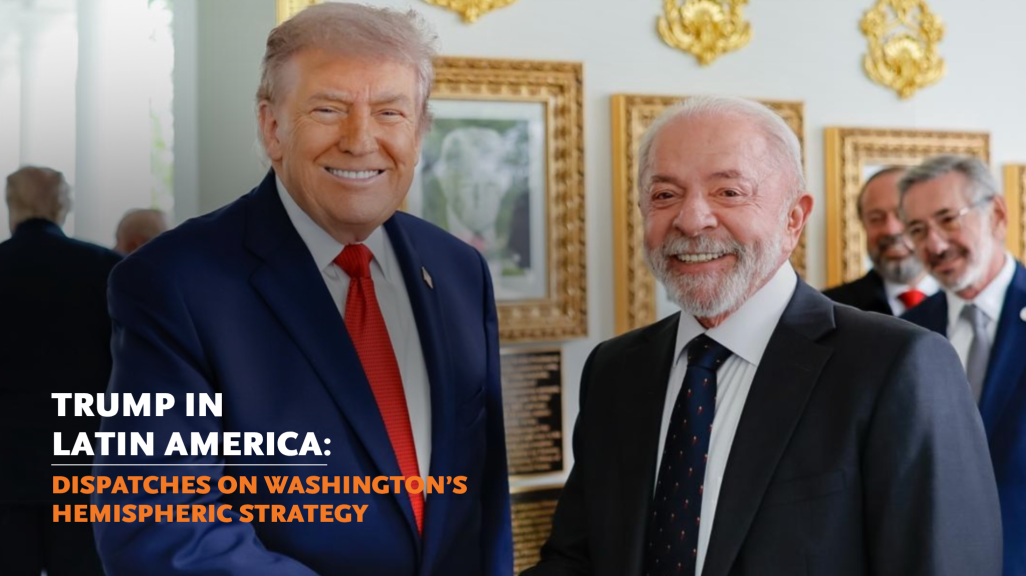
U.S. President Trump and Brazilian President Lula. (Photo: Planalto)

U.S. President Trump and Brazilian President Lula. (Photo: Planalto)

Trump in Latin America: Lula Visits White House, U.S. Drug Strategy Zeroes in on Mexico 

By Carin Zissis , Chase Harrison and Luisa Leme

May 1–7: Washington revokes Costa Rican media visas and green lights Venezuelan debt restructuring.

Welcome back to our weekly dispatch of stories on the U.S. role in Latin America. Follow us each week and see previous roundups at as-coa.org/dispatches, or sign up to receive them via LinkedIn

Here’s what to know this week: 

  • Brazil’s president visits the White House.
  • Trump administration releases counterterrorism and drug control policy strategies, prioritizing hemispheric cartel fight and pressuring Mexico for action.
  • Ahead of Costa Rica’s presidential inauguration, a local news outlet raises concerns over U.S. decision to revoke its board members’ visas.
  • Plus more on Venezuela, Cuba, and Panama.
Lula and Trump met at White House

Today, May 7, Brazilian President Luiz Inácio Lula da Silva joined President Donald Trump in the White House. It marked the two leaders’ first in-person meeting since October 2025, which had smoothed tensions after Trump placed a 50-percent tariff on Brazilian goods in July 2025, in part in response to the conviction of ex-President Jair Bolsonaro. Now, Lula's administration is working to dissuade Washington from imposing foreign terrorist designations on Brazilian criminal groups or ratcheting up tariffs related to to an ongoing Section 301 investigation. 

Before the meeting, a White House official said the talks would focus on economic and security matters. Media reports suggested binational agenda items could focus on issues such as Brazil’s online payment system Pix, transnational crime, and rare earth minerals, the last of which Brazil holds the second largest reserves in the world. 

U.S. counterterrorism and drug strategies put cartels, Mexico in focus

On Wednesday, May 6, the Trump administration released a 16-page Counterterrorism Strategy, listing “neutralization” of cartels in the Americas as its top priority.

That came two days after the release of the 2026 National Drug Control Strategy, which outlined the White House’s “relentless offense against the drug crisis." Among other matters, the document sets expectations for Colombia to reduce coca cultivation while Mexico, prominently featured throughout the strategy, is identified as a key source and transit country for synthetic drugs, notably fentanyl. It says various U.S. agencies “will lead diplomatic and justice sector efforts to secure robust, sustained, and measurable cooperation from the Government of Mexico to target and dismantle" criminal groups operating on Mexican soil, conditioning aid on tangible results. “If they’re not going to do the job, we’re going to do the job.”

The document also warns of investigations to pursue “the corrupt officials who enable [cartel] operation.” The strategy’s release comes days after the U.S. Department of Justice did just that by indicting the Sinaloa Governor Rubén Rocha Moya, as reported in last week’s roundup

On Saturday, Rocha stepped down from his role, thereby losing immunity, even as reports indicate divisions within President Claudia Sheinbaum’s governing party over the degree to which Mexico should cooperate with the U.S. extradition of the powerful political figure. In a May 6 interview, U.S. Attorney General Todd Blanche spoke positively of Washington’s ties with Mexico but suggested more indictments could be in the pipeline

Meanwhile, during separate remarks honoring mothers of U.S. military personnel on Wednesday, Trump said that the United States would augment its strikes on alleged drug trafficking vessels at sea, saying: “We’ve started the land force.” He suggested Washington would receive pushback “from Mexico and other places” but proceed anyway, emphasizing: “If they’re not going to do the job, we’re going to do the job.”

Costa Rican news outlet rings alarm over U.S. visa revocations

La Nación, a leading Costa Rican outlet, charged that the United States had revoked the visas of some members of its board in retaliation for the paper’s critical coverage of President Rodrigo Chaves, a Trump ally. Chaves has been in conflict with La Nación since the paper uncovered allegations of sexual harassment against him in 2022, reports the Associated Press.

Chaves will step down from office on Friday, when his successor and political mentee, Laura Fernández, takes the reins. Still, he won’t be straying far; Fernández named him minister of the presidency and finance minister in her incoming cabinet. Chaves, who last year faced illicit campaign financing charges, will maintain immunity from prosecution as a cabinet member.

Deputy Secretary of State Christopher Landau will lead the U.S. government delegation traveling to San José for Fernández’s inauguration. 

Venezuela permitted to hire debt restructuring advisors

Venezuela owes $170 billion to global investors and, on May 5, Washington took a step toward allowing Caracas to begin the repayment process. The U.S. Treasury department issued a license allowing the country to pay back about $60 billion in defaulted bonds, much of which is owed to oil companies. Now, the Venezuelan government and state-owned oil company can hire advisors to help them plan for a debt restructuring. 

In April, the IMF and the World Bank said they had engaged in talks with Caracas for the first time since 2019, which could open up financing options.

U.S. imposes sanctions on Cuba

On May 1, Trump signed an executive order imposing new sanctions on Cuba to block individuals from operating in the energy, defense, mining, security, or the financial services sector. The measures includes restrictions on Cuba’s major military-run enterprise and state mining company. 

During a May 5 press conference, Secretary of State Marco Rubio indicated the “status quo” on the island is unacceptable and that Washington would eventually address it. Cuba is expected to be an agenda item during Rubio’s meeting with Pope Leo XIV on Thursday, given the Vatican’s past role as a mediator between Washington and Havana. Before heading across the Atlantic, Rubio unveiled sanctions on specific actors, including a Cuban military-controlled enterprise. The State department press statement on the matter revealed: "Additional designations can be expected in the following days and weeks." 

U.S. troops train in Panama

Amid the largest U.S. military buildup in Latin America, Bloomberg covers U.S. forces training in the Panamanian jungle, after the three military bases were reactivated in the country last year. 

Related

Explore