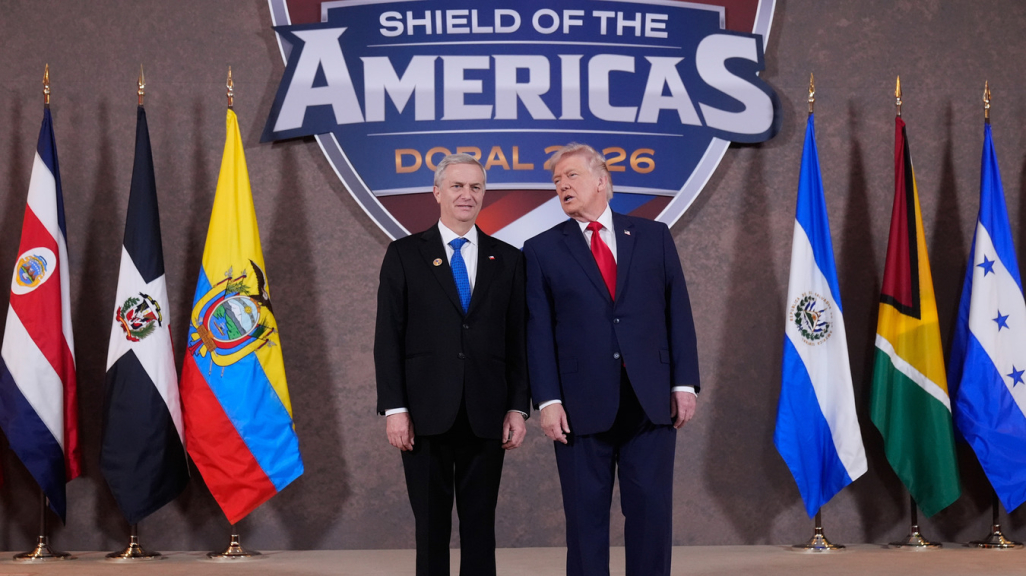
Presidents Kast and Trump

Presidents José Antonio Kast of Chile and Donald Trump of the United States. (AP)

Share

LatAm in Focus: The Shield of the Americas Cracks Open a Debate in Chile

By Carin Zissis

AthenaLab’s Diego Sazo explains the multilayered goals of the regional security coalition and why joining sparked a Chilean divide.

In September, the government of President José Antonio Kast of Chile set off a political firestorm at home when it opted to join the Shield of the Americas, an initiative launched by the Trump administration in March. Opposition legislators questioned the legal implications of membership while ex-presidents Gabriel Boric (2022–2026) and Michelle Bachelet (2006–2010, 2014–2018) issued a joint open letter asking the government to “reconsider” its participation in the security-focused hemispheric partnership. The Chilean general public is proving to have doubts as well; an October poll showed that just 31 percent approved of the decision to sign on to the Shield. But why would signing on to a security initiative stir such controversy? After all, voters concerned about crime helped propel Kast into office earlier this year, much as mano dura security pledges have given rise to a wave of right-wing wins across the Americas. That’s led to regional ideological alignment, leading 15 countries to join the initiative.

“Chile has a long tradition where foreign affairs are regularly treated as a national interest dynamic, so you normally seek consensus,” says Diego Sazo, head of international relations research at AthenaLab, a Santiago-based think tank focused on security and defense. The Shield’s ad and hoc nature, Sazo tells AS/COA’s Carin Zissis, means that member countries can skip the congressional ratification process that would accompany an international treaty. As such, the Kast administration was able to bypass winning over opposition support.  

With the Shield recently broadening its initial security focus to include economic and political cooperation in defense of “hemispheric sovereignty,” Sazo explores how Chile is trying to protect its commercial relationship with China, a top buyer of the country’s critical minerals and a U.S. trade rival.  

He also outlines what an initiative like the Shield offers the Americas and how it can outlast swings in the region’s electoral pendulum: “It's a kind of Sisyphus mythos where you keep pushing this big stone to create an outcome, but then after a while, you have to start from the beginning. So my main advice is to try to move from a government deal to a more state[-led] approach.” 


Our guest
Image
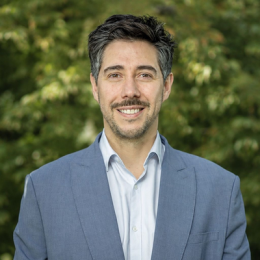
Diego Sazo, AthenaLab

Diego Sazo is the head of research in international relations at AthenaLab, a security and defense think tank based in Chile. He previously served as a policy advisor at Chile’s Interior and Public Security Ministry and at its National Defense Ministry.

Sazo, an author of two books and widely published in journals, holds a PhD in political science from the London School of Economics. His research focuses on political violence, conflict processes, international security, and comparative politics.   
Latin America in Focus Podcast

Subscribe to Latin America in Focus, AS/COA's podcast focusing on the latest trends in politics, economics, and culture throughout the Americas.
This episode was produced by Executive Producer Luisa Leme and Associate Producer Khalea Robertson. Carin Zissis is your host.

Mentioned in this episode:  

Share and subscribe at Apple, Spotify,YouTube, or wherever you get your podcasts. Access other episodes of Latin America in Focus and send us feedback at latamfocus@as-coa.org. 

The music in the podcast is Paulo Bellinati's "Laberintitis” performed by Lester Paredes for Americas Society. Find out about upcoming concerts at musicoftheamericas.org. Share your love for Latin America: Join Americas Society.  

Opinions expressed in this podcast do not necessarily reflect those of Americas Society/Council of the Americas or its members.   


Transcript

[MUSIC]  

Carin Zissis: More and more Latin American countries are signing on to the Shield of the Americas, an initiative the Trump administration kicked off in March this year to combat organized crime groups.

[MUSIC]  

Zissis: Since then, a right-wing electoral wave across the region has brought ideologically aligned countries like Peru…

[Clip of Peruvian President Keiko Fujimori speaking about joining the Shield.]

Zissis: ... and Colombia into the fold.  

[Clip of Colombian President Abelardo de la Espriella speaking about joining the Shield.]

Zissis: All told, 15 countries are now a part of it. And should frontrunner Flávio Bolsonaro win an upcoming presidential runoff in Brazil, he’s already pledged to join. 

[Clip of Brazilian presidential candidate Flávio Bolsonaro discussing wanting to join the Shield.]

Zissis: That means there’s a critical mass when it comes to governments wanting to be a part of the Shield. But on the ground, support is less clear. And in this episode we’re going to look at one case where there’s been a particularly visible domestic divide: Chile.  

Even before his inauguration, José Antonio Kast was at the Shield’s kickoff while president-elect. But it took the country months to join, and the decision was met with fierce political debate back home. A poll from earlier in October found that only 31 percent of Chileans back their country being a part of it.  

[Clip of news segment about ex-Presidents Gabriel Boric and Michelle Bachelet’s joint letter expressing concern about Chile joining the Shield.]

Zissis: That shows that two things can be true: Latin American voters’ concerns about crime might be elevating conservatives into power, even as they have doubts about how to solve the problem.  

[MUSIC]

Zissis: I’m Carin Zissis of AS/COA Online. Welcome back to Latin America in Focus, a podcast where we give you the context of the big issues affecting the Americas.  

In this episode we hear from Diego Sazo, head of research in international relations at Chile’s Athena Lab, a security and defense think tank.

Diego Sazo: The Shield of the Americas promised that more information should be shared among countries to tackle organized crime. And that is a practical, let's say, incentive. But we can talk that that has some limits.”

Zissis: We’ll learn about the Shield of the Americas, what it is, why it’s been so contentious in Chile, and its prospects for actually helping the region get a grip on organized crime.  

Stick around for the full conversation, subscribe to the show on all major podcast platforms, and follow ASCOA on social media.

[Show intro: You're listening to Latin America in Focus. Latinoamérica en foco. América Latina em Foco. A podcast by Americas Society/Council of the Americas on politics, economics, and culture in the region.]

Zissis: Diego, thank you so much for being with me today for Latin America in Focus.

So we're talking today about the Shield of the Americas and Chile's relationship, to the Shield of the Americas because, days before his inauguration in March, José Antonio Kast was in Florida for the launch of the Shield of the Americas. But Chile waited a while to join, and its decision to join finally in September has sparked a domestic divide in the country.

Before we get into that division, I just want to start with understanding the larger picture. What exactly has Chile joined, and what commitments come with being a member of the Shield of the Americas?

Sazo: First of all, thanks for the invitation. Let's start by defining what is the Shield of the Americas. And one good way to understand what is something is trying to understand what it is not.  

So the Shield of the Americas, first of all, is not an international treaty. It is not a military alliance because it doesn't involve obligations, and it doesn't have a legal body that supports it. And that's why the Shield of the Americas can be unfolded by countries without congressional ratification. So that is a very important clarification. We are not talking about a legal institution so far.  

So what is the Shield of the Americas? And we can say that it is an ad hoc political coalition to strengthen coordination against organized crime in the hemisphere. The Shield of the Americas, as a political coalition, also has an operational branch. It’s the so-called Coalition of the Americas against Cartels, which is based within the U.S. Southern Command. That is the military part. But it doesn't involve necessarily those countries that have signed the declaration.  

And what is interesting is that the Shield of the Americas took shape over time. So military operations came first. So we had the operations against vessels in the Caribbean Sea, but we also had the capture of President Nicolás Maduro in Venezuela last January. So after that, we saw this collective effort to create a political framework that can support this operation.

Uh, what is interesting is that this dynamic that the Shield of the Americas has shown helps explain why the initiative, which started just focused on security, now is moving to more or to broader areas, which involve—and I think we are going to talk about that—economic pillars, but also multilateral coordination.

Zissis: Great. Yes, you're right. We're going to keep talking about it. I want to get a little bit into the Chilean case right now. As you pointed out, joining the Shield of the Americas doesn't require some kind of formal commitment or approval from Congress, yet it took a while for Chile to join. If we compare it, for example, to Colombia and Peru, which both had elections and inaugurated their presidents this summer, they joined even faster and before Chile did in September.

At the same time, back in Chile, the decision to formally join and become more than an observer, has drawn criticism from opposition lawmakers and even from two former presidents: Gabriel Boric and Michelle Bachelet. So, tell me, what's at the heart of Chile's divide over joining the Shield, and why did it take Chile so long to join?

Sazo: Here you have two main reasons. So the first one is the association of the Shield of the Americas and basically the operational branch, which is…

Zissis: SOUTHCOM, right?

Sazo: Yes, I'm talking about the SOUTHCOM. Yeah. Particularly related to the attacks on vessels in the Caribbean Sea.

Just in September, a recent United Nations report has suggested that maybe we're facing potential crimes in relation to the attacks against vessels in the Caribbean Sea. And because Chile has been completely aligned with international law and international human rights, that is a potential situation that creates division within the society. So it's an issue of association.  

And the second one is related to the way that the government informed the accession to this group. It is true that this is not an international treaty, so you don't need to pass through the Congress. But even so, Chile has a long tradition where foreign affairs are regularly treated as a national interest dynamic. So basically, you normally seek consensus. Whereas in this case, we knew through the U.S. State Department that Chile had signed this declaration, and that also created much controversy, specifically because then we knew all the details. It was not just about security, but it was also about economic and multilateral coordination.

Zissis: We understand why there are some voices opposing it or against it. But I want to understand the argument on the other side. Why did Chile join? What does Chile get out of becoming a part of the Shield of the Americas?

Sazo: I will say that the government had, the President Kast government had reasons to join.

So the first one was the general context of the hemisphere. After the pandemic, we have seen an increase in criminal violence across many countries. And Chile, which used to be one of the safest and more peaceful countries, has been also involved in this criminal dynamic. Just to say, in a few years, um, the homicide rate was doubled, and also some repertoires of criminals have changed. So now in the country, you can see extortion, kidnappings, and more assassinations of police forces.

And that created a general context that President Kast used during his presidential campaign, uh, in terms of being elected. So the first thing is that there was a general context.  

But also there is a political affinity with the government of President Trump. There is no surprise that this right-wing government shares some diagnoses on what the solutions to the problem. We are talking about an iron fist. We are talking about, uh, the use of force against criminal organizations.  

And the government also had the incentive to improve the relationship with the Trump administration. During the Boric administration, the relationship between Chile and President Trump, and the U.S. more broadly, was quite, um, complicated. And for the Kast administration to be part of the Shield of the Americas will be a kind of good sign to show that now the relationship can be closer.  

And the third one was for practical issues. The Shield of the Americas promised that more information should be shared among countries to tackle, uh, organized crime. But we can talk that that has some limits.

Zissis: There are a few different things that you touched on that I'd like to follow up on.  

So one thing that I'm curious about is that, in May, Chile also initiated a new security framework with six other countries in South America that's called the Santiago Commitment. So that was in May. And it includes six countries that are part of the Shield, as well as one country that actually isn't: Uruguay. And what I'm curious about is, how does the Santiago Commitment work with the Shield?

Sazo: Yeah, I have the same question. When, the foreign affairs minister of Chile announced this accession of Chile to the Shield of the Americas, he said that those initiatives will be complementary, but he didn't explain how they're going to work.

So in a way, we are facing, um, a typical problem in the Americas, which is the creation of some international organizations that then overlap with other ones, and basically they don't work as they're designed to.

Initially, the Compromiso de Santiago had the purpose to create a more, um, focused initiative targeted against transnational organized crime, more particularly in the southern axis of the Andes. Uh, that's why it involves Chile, Peru, Bolivia, Argentina, and Ecuador, and then also Paraguay and Uruguay. Uh, but now we are seeing a broader effort. So the most likely thing is that this more, uh, humble initiative can be absorbed by the Shield of the Americas.

Zissis: You also mentioned that the Shield of the Americas has, as a result of its September declaration, clarified that there's an economic aspect to it.  

When President Trump brought together the different Shield of the Americas members in New York on the sidelines of the UN General Assembly, a declaration came out, and it pointed out that there were three pillars behind the Shield of the Americas: an economic one—and that was highlighted first—security, and a multilateral approach to tackling issues.

And one of the things that was part of and within that economic framework was critical minerals. And I'm curious, for Chile, a country that exports a majority of its copper [and] its lithium to China, how does it navigate that aspect that the U.S.'s main trade rival, China, is its main export market, and it's joined the Shield of the Americas?

Sazo: Hmm. To answer that question, I think it's useful to know the declaration of Undersecretary of War Elbridge Colby, uh, even much more important than the joint declaration of the Shield of the Americas. I'm talking particularly about the statement that Undersecretary of War Elbridge Colby made at the Conference of Defense Ministers that took place in July in Cusco, in Peru. And he, let's say, developed the idea of this Donroe Doctrine, which basically explains what the purpose of the U.S. is now in terms of its relationship with the Americas.

So basically, what Undersecretary of War Colby said is that the U.S. no longer considers Latin America a peripheral area, but rather now it's a more... It's a security perimeter that is crucial for the national interest of the U.S. So that's why all the influence from foreign superpowers is going to be completely restricted, or at least that is going to be the will that the U.S. is trying to spread across Latin American countries.

So when Undersecretary of War Colby talks about threats, he doesn't mention China, but he talks about external, uh, interests in the region. And we know that not only Chile, but also most countries depend on exports to China.  

So the thing is that, now, when in the joint declaration of the Shield of the Americas, we see the second pillar, which says explicitly, and I'm going to read because it's important, "Security-based investment screening; critical mineral supply chains involving trusted and diversified partners," and the third, “The trusted-provider standard for digital infrastructure,” what the U.S. basically is stressing is the idea that we are going to put the focus on the Chinese role in the region. Chile, in particular, promoted in the declaration a clause that speaks about the non-discriminatory application, which is a kind of way to navigate, uh, with the Chinese, uh, elephant in the room, you know?

Zissis: Mm, mm-hmm.

Sazo: So the thing is that the government of President Kast said that this is not a constraint on the autonomy of the decision[-making] of Chile. But from the opposition, you see strong criticism against this particular point because it, for the opposition, shows the way that the Donroe Doctrine, uh, unfolds in Chilean affairs. So it's one of the highly… or one of the most controversial points of the declaration.

Zissis: So, you know, one of the things that we've been talking about is who's in the Shield of the Americas, who's not in the Shield of the Americas, when Chile joined, um, what attracts a country to join. But there's an important aspect of it, and you touch on this in your report. (We'll make sure that that's linked for our listeners in the podcast notes.) You touch on the fact that another important part of that declaration from September lists 24 criminal organizations designated as foreign terrorist organizations by Washington, and that the members of the Shield of the Americas will unite in targeting those groups.  

Now, as you point out in your paper, a third of those groups are in Mexico, and then others of those groups are in Brazil. You, in fact, have a number of these groups that are not based in countries that are part of the Shield of the Americas. In fact, none of those FTOs are based in Chile.  

So what does it mean that you have some of these countries that are not part of it that are essentially home to these FTOs?

Sazo: I think that is one of the weaknesses of the Shield of the Americas as an idea to tackle organized crime in the hemisphere. So when you exclude two of the main countries that are part of the ecosystem where organized crime, uh, develops its illicit activities, you have a big hole in the instrument that you can employ to struggle against them.

So one of the main premises of the Shield of the Americas is to share financial and tax intelligence information. And it also promises, um, training for police institutions. But the thing is that Mexico and Brazil are completely excluded. So how are you going to create valuable information that can be employed to prosecute and to punish these groups?  

Now, in Brazil, in the upcoming weeks, we will see if Bolsonaro or Lula, uh, is going to be the next president, and that could change this problem.

At least with Mexico, we know that for a while it's not going to be part. But in the case of Brazil, maybe that can be an opportunity for this to improve [on] one of the main weaknesses that, uh, so far it involves.

Zissis: Mm-hmm. You know, that brings me to a question. To some degree, it seems as though one strength of the Shield is that so many countries in the region are a part of it. And that Brazil, you know, as you pointed out, after its runoff, it could become a part of the Shield of the Americas if Bolsonaro wins, as he's promised to join.

But the fact that it ends up having this ideological aspect to it raises the question of, you know, right now we're seeing this wave of right-wing leaders coming into power in Latin America, but a few years ago, we saw left-wing parties coming into power. And we could see in the next election cycle that the pendulum swings back the other way.

So as someone who has focused on things like security coalitions and alliances over time, when we think about the struggle against organized crime, what would you advise the members of the Shield of the Americas to take as steps in order to make this an enduring, durable, effective coalition?

Sazo: Hmm. According to the evidence, one of the most effective ways to struggle against organ- transnational organized crime is international cooperation. And that is one of the main problems in the region.  

As you mentioned, political cycles normally condition the outcome of this effort. So we have good news when we know that countries are coordinating to, to face a common challenge, but it's not good news when we know that that is a government agreement, and it's not a state agreement. When it's a government agreement, the most likely thing is that it's going to last as long as the government lasts in power.

Zissis: Mm-hmm.

Sazo: We saw that on the other side of the political spectrum. Around 15 years ago, we had UNASUR, which was a multilateral effort in South America, led by most of the left-wing governments at that time. But basically today, it doesn't work. And actually it had a proper infrastructure, it had more ambitious purposes in terms of what it involved.

But now we have another wave of conservative or, let's say, right-wing governments, which, as soon as they take power, they rule out this effort, and they start a new effort. It's a kind of Sisyphus mythos, where you normally keep pushing this big stone to create an outcome, but then after a while, you have to start from the beginning. So my main advice for the government would be: try to move from a government deal to a more state approach. That, that should be essential.  

I'm very skeptical about that possibility, especially because we need to see what is going to happen in the U.S., in the elections in November. What happens if most of the region is aligned with the Trump administration, but the Trump administration is losing electoral traction? That should be a real problem for the Shield of the Americas.

Zissis: Diego, thank you so much for being with us today. Um, just a note for our listeners: Diego referred to a speech by Elbridge Colby and our magazine, Americas Quarterly, actually published a version of that exact speech. So we'll make sure that there's a link to that, too, as well as to Diego's work in the podcast description for everyone to access.

Thank you again, Diego, for being with us.

Sazo: Thank you for having me.

[MUSIC]

Zissis: Thank you for listening. I’m your host, Carin Zissis. This episode was produced by Associate Producer Khalea Robertson and our Executive Producer Luisa Leme.  

Check the episode notes for Diego Sazo’s article for AthenaLab covering the Shield of the Americas and other resources mentioned in our chat.  

If you haven’t subscribed yet, now's the time. Latin America in Focus has over 200 episodes on key issues that help you better understand the region. We’re on Apple, Spotify, YouTube, or wherever you get your podcasts.  

Send us an email at latamfocus@as-coa.org to share feedback or let us know what you think on social media.    

The music in the podcast was performed for Americas Society. Find out about upcoming concerts at musicoftheamericas.org. And consider becoming an Americas Society member for preferential access to all performances at 680 Park Avenue in New York, as well as art exhibitions, book talks, and more.  

Opinions expressed in this podcast do not necessarily reflect those of Americas Society/Council of the Americas or its members. Thank you.

[MUSIC]

Related

Explore