


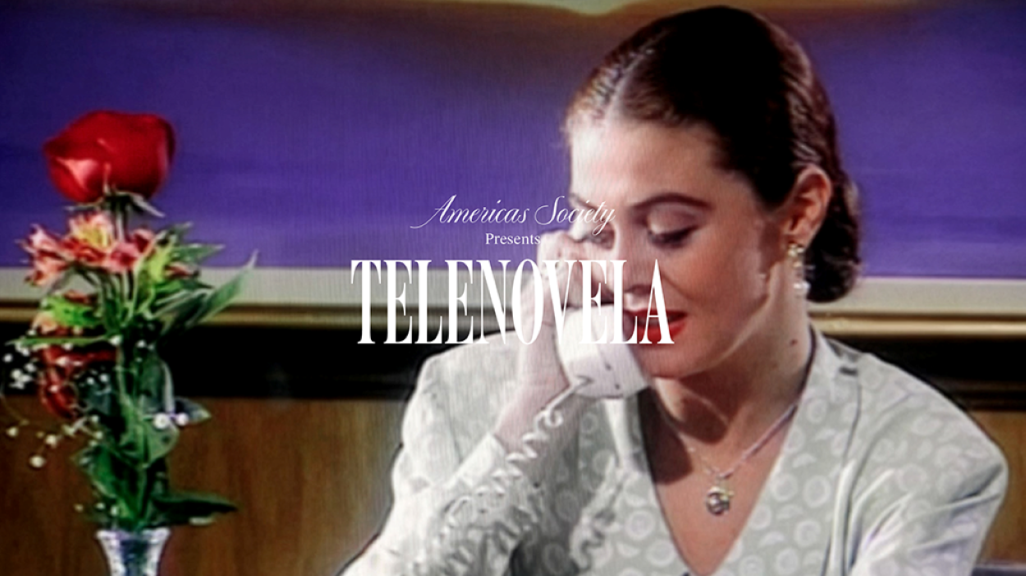
New Exhibition: AS Highlights the Power of Telenovelas in the Americas
New Exhibition: AS Highlights the Power of Telenovelas in the Americas
Telenovela features over 50 artworks from the 1970s to the present, including an installation commissioned by Mexican artist Pablo Helguera.
Telenovela mostrará más de 50 obras desde la década de 1970 hasta el presente, incluyendo una instalación comisionada por el artista Pablo Helguera.
New York, August 31, 2026—Opening at Americas Society on September 9, 2026, the exhibition Telenovela explores how contemporary Latinx and Latin American artists have engaged with the visual and conceptual richness of telenovelas, the most circulated Latino cultural product of the postwar period.
The exhibition aims to demonstrate that telenovelas are an enduring Pan-American phenomenon that transcends geography, social stratification, or cultural categories. Curated by Aimé Iglesias Lukin, director and chief curator of Art at Americas Society, the show explores the profound cultural, social, and political significance of the telenovela across the Western Hemisphere, positioning it as a serious subject of art-historical inquiry.
Telenovelas are a key part of an inter-American dialogue, specifically with shows from Argentina, Brazil, Colombia, Mexico, and Venezuela becoming international hits over the years. The exhibition analyzes how, even though they have long been associated with lowbrow cultural consumption, telenovelas have been immensely popular, shaping cultural identity and fostering connection by creating a vital platform for discussing personal and collective experiences.
“As someone who grew up watching telenovelas, I understand their appeal to all audiences, including artists,” says Iglesias Lukin. “Since moving to New York, I have experienced how they can usher a memory and cultural reference, not only for migrants, but also for Latinx and international audiences, who find in telenovelas a space for social catharsis. The research for this exhibition grew exponentially thanks to the advice of many artists, curators, and art aficionados who confessed a passion for the subject, one that is typically hidden due to class and cultural prejudice.”
On view until March 2027, the exhibition features a collaboration with Mexican artist Pablo Helguera, whose ongoing work Instituto de la telenovela (Institute of the telenovela) (2002–present) pioneered the exploration of the topic. A new iteration of the Instituto entitled Entre la gloria y el olvido (Between glory and oblivion), which examines telenovelas from a Pan-American perspective, has been commissioned for this show. Each monitor displays a video of a melodramatic scene written and directed by Helguera, filmed with local actors in different Latin American cities—including Bogotá, Buenos Aires, Mexico City, and Rio de Janeiro—each representing a parallel reality shaped by its unique context. The Rio de Janeiro segment was produced with generous in-kind support from TV Globo, one of the world's leading telenovela production companies, which provided access to its studios and talent. By composing a telenovela scene in each location, Helguera demonstrates both the universality and the nuances of the television genre across geographies.
Located at the entry point to the exhibition, the audiovisual installation—comprising of multiple screens amid elements of a telenovela set—serves as a prologue to over 50 artworks using all sorts of media, from video art and photography to installation, painting, drawing, sculpture, and collage.
The artists featured in the exhibition are: Alexander Apóstol, Amelia Bande, Miguel Calderón, Sol Calero and Dafna Maimon, Stephen Callis, Leslie Ernst, Rubén Ortiz-Torres and Sandra Ramírez, Déborah Castillo, Leda Catunda, Alex Cerveny, Phil Collins, Miriam Inez da Silva, Wilson Díaz, Andrés Duque, Enrique Flores, Coco Fusco and Nao Bustamante, Julio Galán, Dalton Gata, Camilo Godoy, Felix Gonzalez-Torres, Martine Gutierrez, Pablo Helguera, Katalina Iturralde, Christian Jankowski, Maripaz Jaramillo, Silvan Kälin, Leandro Katz, Juan David Laserna, José Leonilson, Lolo y Lauti, Daniela Lovera and Juan Nascimento, Arnulfo Luna, Antonio Manuel, Lucas Michael, Jessica Mitrani, Luis Molina-Pantin, Rachelle Mozman Solano, Vik Muniz, Hélio Oiticica, Yoshua Okón, Bernardo Oyarzún, Wanda Pimentel, Luciana Pinchiero, Wanda Raimundi-Ortiz, Abigail Reyes, Reynaldo Rivera, Fátima Rodrigo, Daniela Rossell, Marco Rountree, Stefan Ruiz, Teresa Serrano, Rodrigo Valenzuela, Yvonne Venegas, Erika Verzutti, Francesco Vezzoli, Márcia X and Aimberê César, Bruce and Norman Yonemoto.
The show invites U.S and international audiences to recognize the historical significance of telenovelas and to understand that the Americas are a plural yet connected cultural identity. The intellectual framework of the project is informed by a series of four closed convenings that took place virtually between April and October 2025. These meetings brought together a group of scholars, artists, and scriptwriters from across the humanities and social sciences. Moderated by Iglesias Lukin and Mariano López Seoane, director of the Graduate Program and ISLAA Fellow in Latin American Art at the Center for Curatorial Studies at Bard College, these sessions advanced the research and intellectual content that form the foundation of both the exhibition and its accompanying publications.
Telenovela is accompanied by two printed publications: an exhibition catalogue featuring essays and an illustrated checklist, and Telenovela: A Reader. The scholarly reader, coedited by Iglesias Lukin and López Seoane, compiles artworks, archival documents, and multidisciplinary essays exploring telenovelas from the perspectives of art history, sociology, anthropology, comparative literature, performance studies, and visual studies.
To accompany the show, Americas Society will present a series of public programs:
- Wednesday, September 16, 2026, 6-8 pm: Telenovela: A Reader Book Launch
- Wednesday, October 14, 2026, 6-8 pm: Panel: Instituto de la Telenovela: Entre la gloria y el olvido by Pablo Helguera in conversation with Julieta González and Ana Janevski
- Friday, January 22, 2027, 6-8 pm: Telenovela Karaoke hosted by artist Wanda Raimundi-Ortiz in partnership with Music of the Americas
- Wednesday, February 24 and Thursday, February 25, 2027: Telenovela: A Symposium
- Wednesday, March 10, 2027, 6-8 pm: La pasión de Andrea del Boca. Ópera para un barítono y dos televisores (Andrea del Boca's passion: Opera for a baritone and two televisions). Performance by Lolo y Lauti in partnership with Music of the Americas (Art at Americas Society Performance Series)
- Early 2027: Ensayo abismal (Abysmal rehearsal). Performance by Amelia Bande in partnership with Music of the Americas (Americas Society Performance Series)
After its presentation in New York, the exhibition is confirmed for travel to institutions in Mexico and Brazil.
Press contact: mediarelations@as-coa.org
Funders:
The presentation of Telenovela has been made possible by generous support from the Andy Warhol Foundation for the Visual Arts, Henry Luce Foundation, New York City Department of Cultural Affairs, New York State Council on the Arts with the support of the Office of the Governor of the State of New York and the New York State Legislature, Cowles Charitable Trust, and Colección Patricia Phelps de Cisneros.
Significant in-kind support has been provided by Globo. Americas Society acknowledges the generous support from the Arts of the Americas Circle members: Amalia Amoedo, Ileana Anselin, Estrellita B. Brodsky, Virginia Cowles Schroth, Emily Engel, Blanca and Sunil Hirani, Isabella Hutchinson, Carolina Jannicelli, Diana López and Herman Sifontes, Elena Matsuura, Maggie Miqueo, Maria Mostajo, Antonio Murzi, Marco Pappalardo and Cintya Poletti Pappalardo, Gabriela Pérez Rocchietti, Carolina Pinciroli, Erica Roberts, Sharon Schultz, and Edward J. Sullivan.
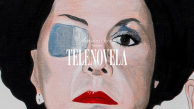
The exhibition, on view through March 2027, explores the psychological and philosophical principle of the melodrama genre.