


Guide: Fall 2013 Latin American Elections
Guide: Fall 2013 Latin American Elections
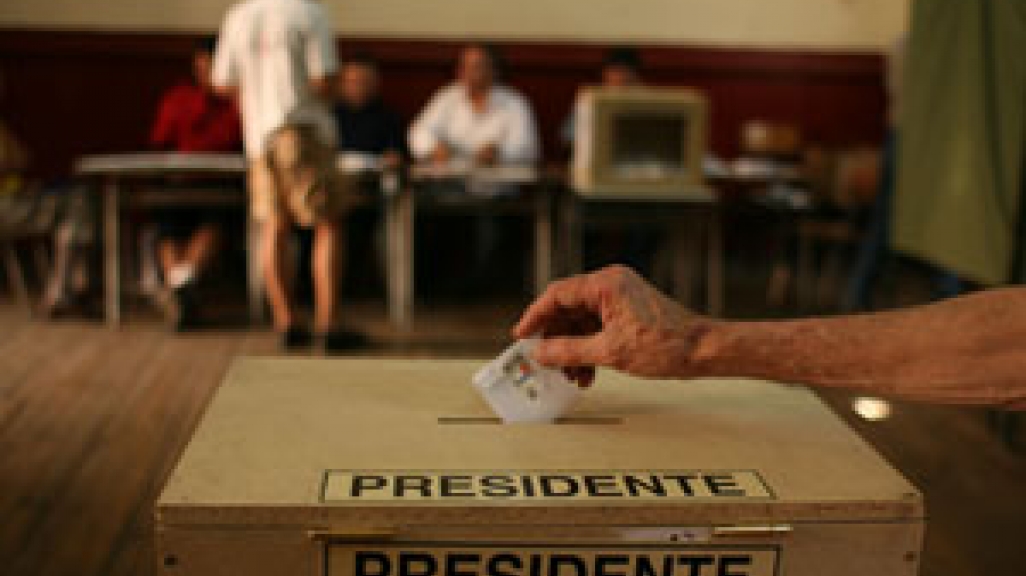
Four Latin American countries held elections in the last quarter of the year. At the end of November, Honduras chose a new president, Juan Orlando Hernández. And in December, former Chilean President Michelle Bachelet won the presidency again in a runoff election. In October, Argentina held legislative and provincial elections, and in December, Venezuelans picked mayors and city councilmen.
AS/COA Online looks at these four elections, giving a brief overview of what each will entail.
Updated December 17, 2013.
Related
En Casa welcomes back Mar María and introduces Cande Marzinotto with original songs.
The 2024 election saw high levels of Hispanic support for Trump. Can Republicans replicate that success in the November congressional vote?
Argentina
Dates: October 27
The province of Corrientes held an election for provincial legislators and governor on September 15. Salta held elections on three dates: October 6 for provincial primaries, October 27 for national legislators, and November 10 for provincial legislators.
Election Type: Legislative and Provincial
Number of Seats up for Vote: In the Chamber of Deputies, 124 seats of 257 were filled for four-year terms. In the Senate, voters chose 24 of 72 seats for six-year terms. On the local level, 10 provinces elected provincial deputies, and four provinces elected provincial senators. Santiago del Estero elected its governor.
Results and key Candidates: One of the notable candidates who won was Tigre Mayor Sergio Massa, running on the Renewal Front ticket as a deputy from Buenos Aires province. Massa, a former member of President Cristina Fernández de Kirchner’s cabinet, left the ruling party in June and could be a potential presidential candidate in 2015. Massa’s main contender was Martín Insaurralde, mayor of the Lomas de Zamora municipality in Buenos Aires province. Insaurralde, of the Victory Front coalition, was hand-picked by Fernández de Kirchner to run. Kirchner’s ruling Victory Front coalition won 47 new seats in the Chamber of Deputies, and 14 new seats in the Senate. However, the coalition fell short of winning a two-thirds majority of both houses in order to pass constitutional reforms. The Ruling Front now encompasses about 50 percent of House seats and 55 percent of the Senate. Meanwhile, the Renewal Front won 19 seats in the Chamber of Deputies.
In Buenos Aires province, Massa and his party took nearly 44 percent of the vote, while Insaurralde and the Victory Front earned 32 percent.
Who Voted? Voting is mandatory in Argentina, and around 30.6 million people were eligible to vote. Voter turnout stood at over 75 percent.
This was the first election in which citizens aged 16 and 17 had voluntary suffrage; around 600,000 were registered to vote. Argentines can vote abroad in presidential and legislative elections; around 37,000 expat voters were eligible to vote in this election.
Chile
Dates: The first round election was held on November 17. A runoff election was held on December 15.
Election Type: Presidential and Legislative
Number of Seats up for Vote: Voters chose the next president for a 4-year term. Presidents can serve multiple terms, but not consecutive ones.
On November 17, all 120 members of the Chamber of Deputies were elected for four-year terms, and 20 of 38 senators were elected for eight-year terms. There was also a vote for regional councilors, a type of representative of the country’s regions. This election marked the first time regional councilors were elected by direct, universal vote.
Results and Key Candidates: Former President Michelle Bachelet of the New Majority coalition won 62 percent of the vote during the runoff, facing Labor Minister Evelyn Matthei, who won nearly 38 percent. Matthei stepped in to represent the conservative Independent Democratic Union Party after candidate Pablo Longueira dropped out of the running in July. Camila Vallejo, the former leader of the Confederation of Chilean Students who rose to fame during the country’s student protests, won a deputy seat on the Communist Party ticket.
The New Majority coalition won the largest number of Chamber and Senate seats, but did not achieve a supermajority in order to push through constitutional reforms.
Who Votes? This was Chile’s first presidential election in which voting was not mandatory and in which eligible voters were be automatically registered. Chilean expats cannot vote from abroad, but Congress is considering a bill to allow them to do so.
Election Issues: Because this was the country’s first presidential election with optional voting, there were concerns about low voter turnout. The December 15 runoff saw a 58 percent abstention rate, while the November 17 vote saw a 44 percent abstention rate.
*Editor's note: The original post erroneously said there were 20 of 37 senatorial seats that will be voted on. However, the correct number is 20 of 38.
Honduras
Date: November 24
Election Type: Presidential and Legislative
Number of Seats up for Vote: The president is elected for a single four-year term. Presidents are elected by a majority; there is no runoff election. In addition, 128 members of the unicameral Congress were elected through a proportional system for four-year terms. Voters elected mayors and vice-mayors to the country’s 298 municipalities.
Results & Key Candidates: As of December 12, with all votes counted, Juan Orlando Hernández of the ruling National Party held 36.89 percent of the vote against the Freedom and Reestablishment Party (LIBRE)'s Xiomara Castro de Zelaya's 28.78 percent. Castro, the former first lady of Honduras and wife of deposed former President Manuel Zelaya, had polled neck and neck with Hernández, the former head of Congress. She also claimed victory on election day and decried the results as a fraud. Electoral authorities announced on December 2 that they would conduct a recount. However, LIBRE officials didn’t appear at court for the recount; the AFP reported that the court would allow the party to compare election results. On December 6, Zelaya asked the court to nullify the election results. Hernández traveled to the United States that day, continuing a tour to meet with leaders and investors after traveling to Central America and Mexico. On December 11, the country’s electoral court confirmed Hernández as the winner.
Organization of American States electoral monitors expressed confidence in the electoral proceedings. Colombia, Costa Rica, Guatemala, Nicaragua, and Panama recognized the electoral outcome by November 26. On that date, Hernández met with President Porfirio López regarding transition and began to reveal the details of his transition team.
As electoral authorities tallied votes for legislators, no party had won enough seats for majority control of Congress.
Who Voted? In Honduras, voting is mandatory. Expatriates can vote for president from abroad; over 46,000 Hondurans living in the United States are eligible to cast their ballots. This voter group accounts for less than 1 percent of all eligible Honduran voters.
Roughly 3.2 million out of 5.4 million registered Honduran voters cast ballots, meaning a turnout of approximately 60 percent. This exceeds turnout for the 2009 election, which saw just over 50 percent of the electorate participating.
Election Issues: Security and the economy counted as some of the top issues; around 64 percent of Hondurans think crime has gotten worse and 59 percent believe poverty has increased, according to an August 2013 poll. Moreover, with close results, no candidate winning a majority, and a divided Congress, the next president faces the challenges of polarization and a weak mandate.
Venezuela
Date: December 8
Election Type: Municipal
Number of Seats up for Vote: Venezuelans elected 337 mayors and 2,455 city councilmen for four-year terms.
Key Candidates: One of the most important positions up for a vote was that of mayor of metropolitan Caracas. Mayor Antonio Ledezma—a member of the opposition Democratic Unity (MUD) coalition—won reelection with nearly 51 percent of the vote. Ernesto Villegas ran on the ruling United Socialist Party of Venezuela (PSUV) ticket; he stepped down as information minister in order to run.
Two other key mayoralties include Sucre, in eastern Caracas, and Maracaibo, the capital of oil-producing Zulia state. In Sucre, opposition Mayor Carlos Ocariz won reelection with almost 53 percent against PSUV candidate Antonio "El Potro" Álvarez, a famous baseball player. In Maracaibo, MUD Mayor Eveling Trejo de Rosales defeated PSUV candidate Miguel Ángel Pérez Pirela at the polls.
The PSUV put up numerous celebrities as candidates, such as Álvarez, actor Winston Vallenilla for mayor of Baruta, and baseball player Magglio Ordoñez for mayor of Sotillo. The opposition saw this as a lack of leadership on the part of the PSUV.
Campaigns officially ran from November 16 through December 4, in accordance with electoral law.
Who Votes? There are no runoff elections; victors achieve a majority of votes. In Venezuela, voting is not mandatory. Over 19 million people were eligible to vote in this election, and participation stood at around 59 percent. Venezuelans living abroad can vote in presidential elections; around 100,000 expat voters are registered and most tend to vote for the opposition. However, voters cannot vote abroad in municipal elections.
Election Issues: This Andean country’s local elections were postponed three times, most recently following the late President Hugo Chávez’s death in March.
This election proved another test of Chávez’s party. According to the National Electoral Council’s final bulletin, the PSUV won 54 percent of the vote overall, while the opposition garnered 44 percent. The PSUV gained control of 242 mayoralties, or 72 percent of the country, while the opposition won 22 percent of mayoralties. During the last municipal election in 2008, the PSUV won over 80 percent of the country’s mayor seats.
Venezuela’s commune system is another issue. The country now counts over 1,400 comunas—local bodies that carry out social programs, infrastructure projects, and other services—according to a September census. The opposition had concerns that if the PSUV lost important seats during the election, the government would continue to expand the commune system to increase its power on the local level.