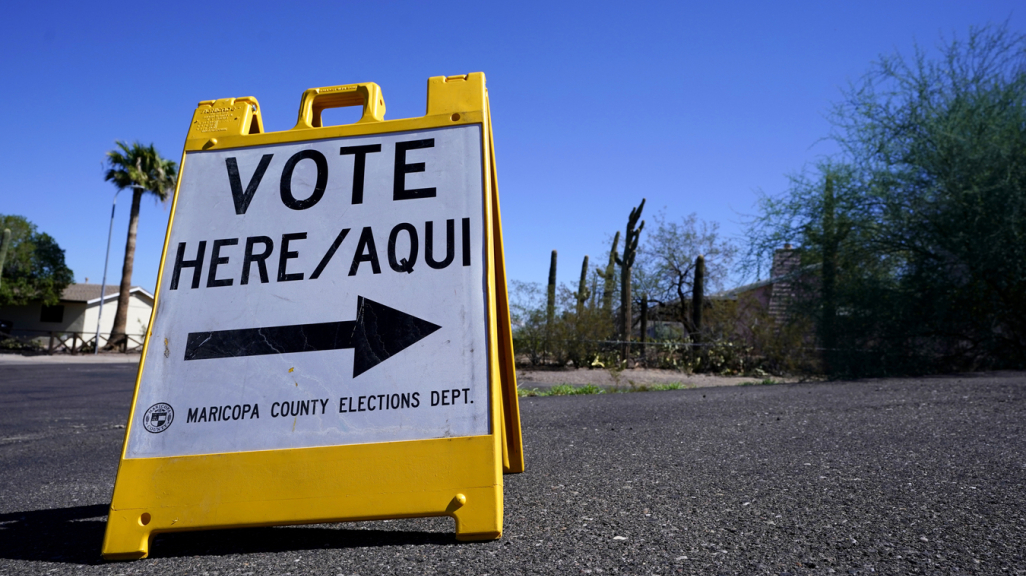
A voting site in Arizona. (AP)

A voting site in Arizona. (AP)

What Will Trump's Latin American Policy Mean for the U.S. Midterms?

By Chase Harrison

Learn how the president's trade, immigration, and Venezuela policy are playing out in congressional races.

On November 3, U.S. voters will cast ballots in midterm elections viewed as a referendum on the first half of Trump 2.0. And, as Election Day nears, President Donald Trump’s declining approval is raising questions about prospects for his political movement’s congressional control. Roughly two-thirds of voters say their ballot will be a direct reflection of their feelings toward Trump and his policies. 

What does that mean for Latin America, the region Trump has placed front and center in U.S. foreign policy? In under two years, the White House has taken actions with deep impacts across the region, such as applying tariffs, reopening the U.S.-Mexico-Canada Agreement (USMCA), taking a hardline approach on immigration, and capturing Venezuelan leader Nicólas Maduro. But, whether it’s trade, border security, or foreign policy, rejection outpaces support for his government’s management of major electoral concerns, per an October Financial Times poll.

AS/COA Online looks at three major policy actions of the president connected with Latin America and their on-the-ground impacts in the upcoming elections.

Tariffs and trade tensions spark affordability concerns

No country in Latin America has escaped Washington’s global tariff regime. In fact, Washington’s top two trade partners—Mexico and Canada, respectively—were early targets of tariff threats, and the White House opted in July not to renew the USMCA deal with the countries, leaving it in the limbo of annual reviews for the next decade.

However, a June poll by the Chicago Council on Global Affairs found that 78 percent of U.S. respondents think the USMCA is good for the economy while 8 percent of respondents said the United States should leave the agreement.


On the ground. Democrats have tied Trump’s trade and tariff policy to higher prices and affordability concerns. Some candidates are spotlighting Trump’s trade war with Canada, the top export market for 26 states, especially those in battleground states targeted by Canada’s retaliatory tariffs that went into effect in September.

Maine, where polling indicates a deadlocked Senate race, is seeing depressed exports, canceled foreign investment projects, and decreased tourism amid the U.S. trade war with Canada. The Republican Senate candidate in that race, Susan Collins, has criticized the president’s levies on the bordering country and spoke of her work in Congress to exempt key Canadian products like road salt and cement. Voters rate her Democratic opponent, Troy Jackson, 11 percentage points higher on his ability to tackle the cost of living, per a Washington Post-Schar School poll. 

Trump, meanwhile, said he is close to a trade deal with Mexico in an October 19 rally in Kansas, a traditionally Republican state with an atypically close Senate race that counts Mexico as its top trade partner. 

Questions arise about extent of immigration actions

Trump has made immigration enforcement and border security centerpieces of his presidency. In his second term, daily immigrant encounters at the southern border have dropped 95 percent compared with during the Biden administration. A March survey by the Civic Health Institutions Project recorded support for Trump’s immigration policy at 37 percent, but just 11 percent of Democrats support it, compared with 78 percent of Republicans. Democrats’ disapproval is driven by their objection to Trump's aggressive tactics, such as pausing visa and asylum applications, increasing immigrant detentions, and expanding ICE actions.


As part of his immigration strategy, Trump has struck bilateral deportation deals with countries in Latin America while also ending migrant protections known as TPS for Haitians, Hondurans, Nicaraguans, and Venezuelans. Some 86 percent of Democrats disapprove of ending TPS while only 31 percent of Republicans do. 

On the ground. Immigration is animating campaigns on both sides of the aisle. In the first half of the year, Republicans ran nearly 300 advertisements on the issue, almost five times more than the Democrats, who are often portrayed as using government resources to support undocumented immigrants.

In their campaigns, Democrats highlight high-profile ICE killings and the chilling effect of the policies on the business climate and immigrant communities. Some Republicans locked in tight races, such as U.S. Senator Roger Marshall (R-KS) and Rep. María Elvira Salazar (R-FL), also argue that Trump has gone too far on immigration. Salazar represents a majority Hispanic district and polling shows that Latinos disapprove of Trump’s immigration policy at higher rates than other groups. Some 30 percent of Latinos who voted for Trump in 2024 are against the scale of his deportation efforts, per Pew. In South Texas, a heavily Latino region that saw a swing toward Trump in 2024, personal connections to immigrant communities are pushing undecided voters toward the Democrats. 

Will Trump be rewarded for Cuba and Venezuela action?

Two of Trump’s most decisive foreign policy in Latin America actions have been his January removal of Venezuelan leader Nicolás Maduro, leaving interim President Delcy Rodríguez to govern in his stead, and his ongoing oil embargo on Cuba. Though there is no recent polling, surveys from the first half of the year shows around a third of U.S. voters support each action. 

On the ground. The question over Trump’s conduct in Cuba and Venezuela may have an outsized impact in Florida, where a majority of voters with heritage from the two countries live.

Democrats have gone on the offensive. Cuban American Elliott Rodríguez, who is running against Rep. Salazar and has a slight edge in polls, has criticized the Trump administration’s maximum pressure stance. Elsewhere in the state, Democratic Rep. Jared Moskowitz, who polls indicate could lose his seat, has endorsed the oil embargo. 

In the Senate race, Democratic nominee Angie Nixon, who is down in polling, is attacking her Republican opponent for Trump’s support for Delcy Rodríguez and the oil deal. Meanwhile, Salazar, who has questioned the Trump administration's direction in Venezuela in the last few months, won the endorsement of Venezuelan opposition leader María Corina Machado. 

Related

Explore