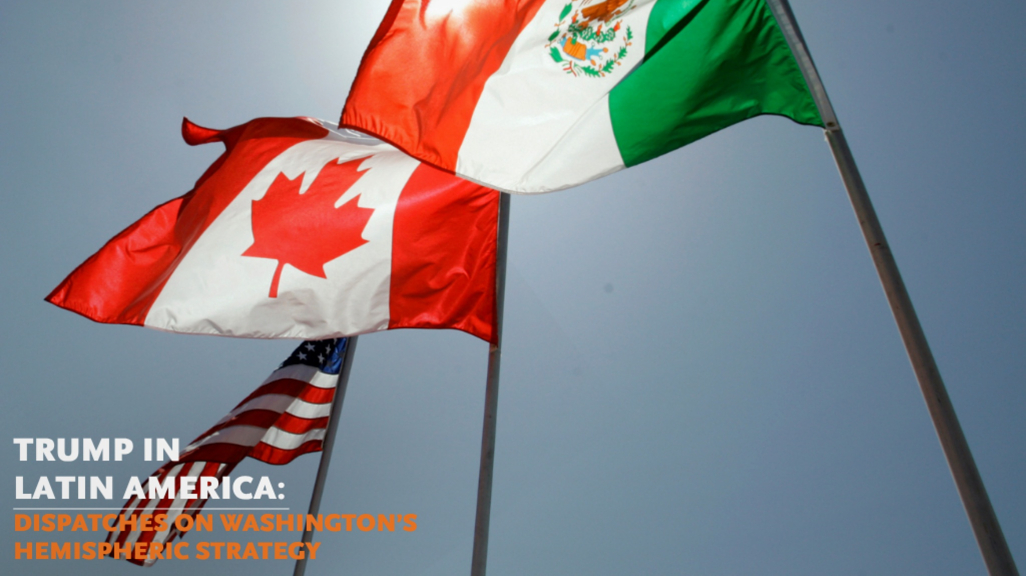
canada mexico US flags

Flags of North American countries. (AP)

Trump in Latin America: USMCA Views Shift, Delcy Deadline Lapses, Cuba Releases Prisoners

By Carin Zissis and Khalea Robertson

Apr 3–9: Also, Ecuador’s president opens door to U.S. troop presence and Mexico’s new foreign secretary builds on North American experience.

Welcome back to our weekly dispatch of stories on the U.S. role in Latin America. Follow us each week and see previous roundups at as-coa.org/dispatches, or sign up to receive them via LinkedIn

Here’s what to know this week: 

  • U.S. voters shift views on Trump trade policy and USMCA partners.
  • A 90-day deadline comes and goes for Venezuela’s acting president.
  • Cuba announced prisoner release, but questions remain.
  • In other news: Noboa’s U.S. troop invite, Mexico's new foreign secretary, and Panama’s port pressures. 
How U.S. voters view Trump, trade, and USMCA partners

Washington has witnessed a bipartisan shift against free trade in recent years, but it appears that U.S. voters are skeptical of the Trump administration’s approach to trade. Per Pew Research, 58 percent say they lack confidence in his trade policy. When it comes to tariffs, that figure rises to 63 percent.  

There are differences across party lines, with Republicans (74 percent) far more likely to bank on Trump’s trade policy compared with Democrats (12 percent). Still, regardless of party affiliation, U.S. adults have become less likely to say trade relations with USMCA partners  benefit Mexico and Canada more than the United States, as the chart below shows. 


On Tuesday, U.S. Trade Representative Jamieson Greer said the USMCA review process will likely run past the July 1 deadline, suggesting Washington would pursue bilateral negotiations while keeping the trilateral nature of the pact. The three countries could, by the deadline, agree to renew the USMCA for 16 years or begin a 10-year process of annual reviews. Greer suggested the latter option is likely, reportsThe Globe and Mail. The Trump administration’s talks with Mexico are underway and have yet to start with Canada. 

A 90-day deadline in Venezuela comes and goes

Venezuela’s Constitution sets a 90-day period for a vice president to temporarily assume leadership. That period came to an end on April 3, with Delcy Rodríguez remaining in the role of acting president although Venezuela’s National Assembly has not called a vote to extend the interim period for another 90 days. In a televised April 8 speech, Rodríguez pledged wage increases come May 1 and asked Venezuelans for patience as her government seeks to improve the economy, signaling her intention to remain in power beyond the interim period.  

At a recent event hosted by the Heritage Foundation, a conservative think-tank, Assistant Secretary of Defense Joseph Humire said, “You have stabilization, you have recovery, and then you have transition,” suggesting the Trump administration’s view is that a democratic transition would need to wait out the current stabilization period. He also said Washington and Caracas have “persistent engagement at multiple levels” to promote investment in the South American country and “make Venezuela what it used to be: one of the richest countries in all of Latin America.” Washington is weighing whether to lift sanctions on Venezuela’s central bank in a move that would allow oil revenues to flow more freely through the country’s financial system, reports Bloomberg.  

Meanwhile, the Miami Herald reports that U.S. companies eyeing investments in Venezuelan gold will face the challenge that the country's mining sector is run by illicit networks.

Cuba releases prisoners, welcomes Dem legislators

Amid U.S. pressure, Cuba on April 3 began releasing what the island’s authorities say will be more than 2,000 pardoned prisoners. The Cuban government referred to the Good Friday action as a "humanitarian and sovereign gesture … in the context of Holy Week celebrations.” But human rights groups signaled that political prisoners were not among those freed.  

At the same time, two Democratic congressmembers, Pramila Jayapal of Washington and Jonathan Jackson of Illinois were on the island to meet with President Miguel Díaz-Canel and Foreign Minister Bruno Rodríguez. At the conclusion of their five-day visit on Sunday, they released a statement condemning the U.S. fuel blockade on the island.  

The additional strain on Cuba’s ailing power grid has seen the island increasingly turn to solar technology from China to keep the lights on, reports the Financial Times. Beijing helped the Caribbean country to more than quadruple its solar capacity in 2025, and Havana plans to power 15 percent of its grid with the renewable energy source by the end of 2026, up from an estimated 9 percent currently. 

In other news: Ecuador, Mexico, Panama

Ecuador’s President Daniel Noboa told Bloomberg in an interview that he is open to U.S. troop deployment in his country in an effort to contain violence, suggesting it could happen this year. Read coverage of U.S.-Ecuadorian joint operations in a prior dispatch.

El País covers Roberto Velasco, Mexico’s incoming foreign secretary. The 38-year old will be the youngest person to hold the role in nearly a century but, the profile explains, his prior service as subsecretary for North America and other key positions relevant to U.S.-Mexico affairs make him well-positioned to work with the White House. His first call in his role was to his Brazilian counterpart, Mauro Vieira, in anticipation of an upcoming summit of the two countries’ presidents, expected to take place in June.  

The Wall Street Journal reports that Hong Kong firm CK Hutchison has kicked off arbitration proceedings against Danish firm Maersk, alleging it had a role in Panama’s decision to take over its port operations at either end of the Canal. The Panamanian decision to seize control of the two ports was viewed as a win for the Trump administration in the Sino-U.S. battle for influence, but has drawn backlash from Beijing. Panama’s Foreign Minister Javier Martínez Acha said Wednesday that his country’s commercial shipping fleet has seen rising inspections and detentions in Chinese ports.

2026 COA Mexico Conference

Council of the Americas' annual conference on May 5 will discuss investment opportunities and North America's path forward amid evolving regional dynamics.
Related

Explore