Trump in Latin America: Rubio at CARICOM, SCOTUS on Tariffs, and Trump's SOTU
Trump in Latin America: Rubio at CARICOM, SCOTUS on Tariffs, and Trump's SOTU
Feb 20-26: U.S. intelligence helps take out a kingpin and Washington cancels Chilean officials’ visas over an underwater cable.
Welcome back to our weekly dispatch of stories on the U.S. role in Latin America. Follow us each week and see previous roundups at as-coa.org/dispatches, or sign up to receive them via LinkedIn.
AS/COA Online's regular roundup covers U.S policy news on the Americas in the era of the Donroe Doctrine.
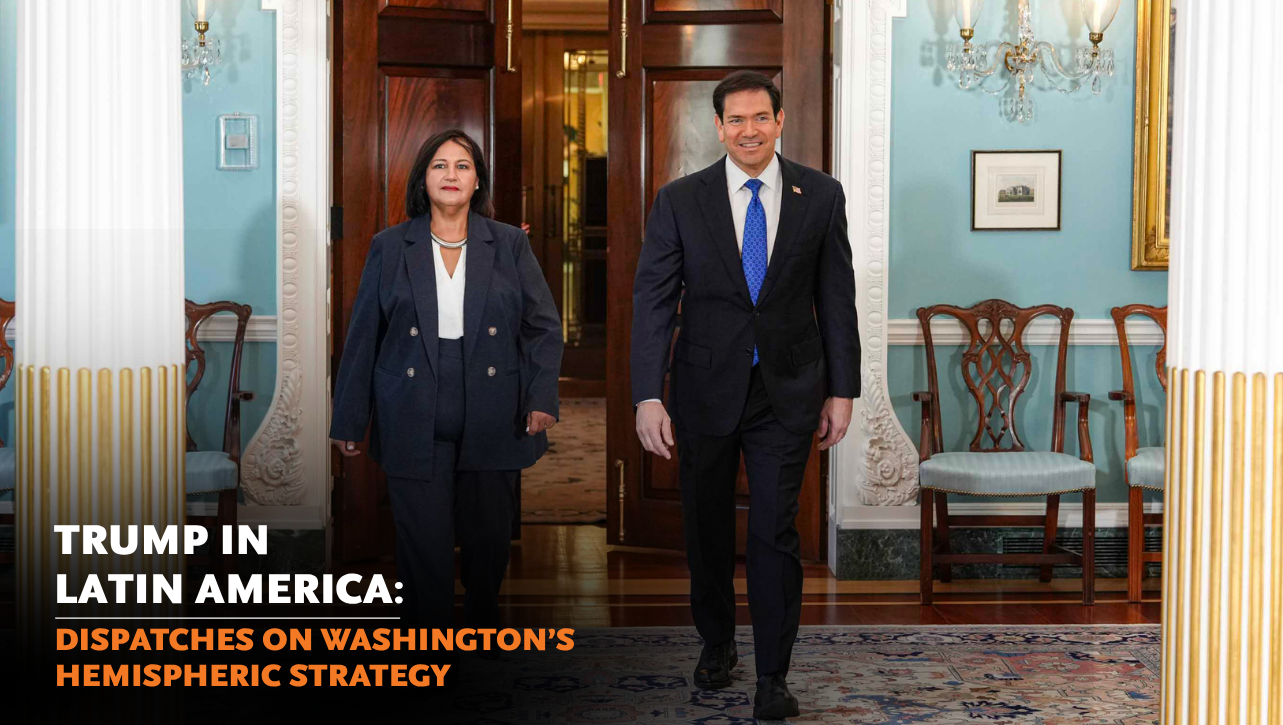
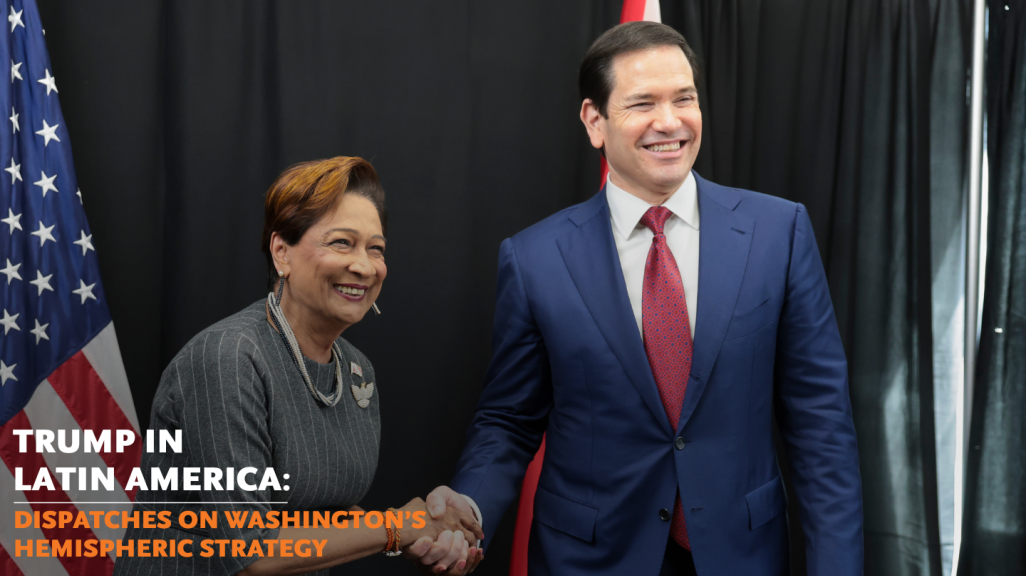
U.S. Secretary of State Marco Rubio hopped a flight to the island country of St. Kitts and Nevis on Wednesday to attend the fiftieth meeting of CARICOM leaders. " I am very happy to be in an administration that’s giving priority to the Western Hemisphere after largely being ignored for a very long time,” said Rubio, addressing representatives from the Caribbean bloc’s 15 member states and five associate members.
Rubio’s speech made the prominence of the region for the Trump administration clear, as he spoke about its policy on Venezuela, counternarcotics, and energy development. He asked leaders of the bloc, some of whom had voiced concerns about U.S. strikes on alleged drug boats or the U.S. operation to oust Venezuela’s Nicolás Maduro, for cooperation. Rubio did not speak publicly, however, about Cuba at the summit, which, though not a CARICOM member, has strong ties across the bloc. Prior to the meeting, Jamaican Prime Minister Andrew Holness called for "constructive dialogue between Cuba and the United States aimed at de-escalation, reform and stability."
Still, at a post-summit press conference, Rubio was asked about an incident that occurred that day in which the Cuban coast guard attacked a boat it claims was registered in Florida, killing four and injuring six people. The secretary said the U.S. government is investigating the incident and commented on the U.S. Treasury’s decision to allow the resale of Venezuelan oil to Cuba’s private sector for humanitarian purposes even as Washington enforces an oil embargo on the island nation.
Rubio’s trip comes as Washington tries to caution countries about China ties. "The red line that the Trump administration is trying to draw is Chinese investment in strategic assets, such as ports, that the Trump administration believes could be damaging to the national security of the United States," Brian Winter, editor-in-chief of Americas Quarterly told CNN in an interview covering Rubio’s CARICOM visit and U.S. policy toward Cuba.
On February 20, the U.S. Supreme Court ruled 6-3 against Trump’s use of the 1977 International Emergency Economic Powers Act (IEEPA) to impose tariffs on trade partners. As readers may recall, Trump used the IEEPA a year ago to slap tariffs on Canada, China, and Mexico, before using it more broadly as part of his April 2025 “Liberation Day” tariffs. The president called the Supreme Court decision “disappointing,” before reaching for other ways to carry out his tariff policy; he turned to Section 122 of the 1974 Trade Act to apply new duties. The new global tariff rate came in at 10 percent, though the Trump administration could seek to raise it to 15 percent. U.S. Trade Representative Jamieson Greer said that Washington would also begin new investigations into unfair trade practices using Section 301, which could also lead to tariffs. Brazil is already facing an investigation under this rule.
Having a hard time understanding the distinction between IEEPA, 122, 301, and other trade rules? In the latest episode of Latin America in Focus, Diego Marroquín Bitar of the CSIS Americas Program broke it all down, explaining, “President Trump has a huge trade arsenal at his disposal, and what we're going to be seeing in the next few weeks is the Trump administration using other measures [that are] more procedural but are less legally exposed.”
So how did Latin America make out from the IEEPA trade ruling? Not too shabbily, experts told Americas Quarterly.
On Sunday, Mexican forces captured and killed Nemesio Oseguera Cervantes, the leader of the Jalisco New Generation Cartel who was more commonly known as “El Mencho.” The operation marked one of the biggest blows to organized crime leadership in the country’s history, and sparked an initial wave of violence carried out by the well-armed criminal group. While Mexico carried out the attack, U.S. intelligence played a key role in raid, reportedly with the support of the relatively new Joint Interagency Task Force-Counter Cartel.
Bloomberg Línea argues that killing of El Mencho gives Mexican President Claudia Sheinbaum “breathing room” with the Trump administration, which has demanded to see more counternarcotic progress from her administration and has repeatedly suggested the possibility of drone strikes on cartels inside Mexico. The New York Times contends she’s caught between a rock and a hard place—Trump and the cartels. In either case, Sheinbaum revealed on February 25 that Trump called her after the raid to see “how things are in Mexico.”
On February 24, Washington’s “drug czar,” Sarah A. Carter, traveled to Mexico City to hold high-level bilateral security talks in the wake of the attack “to advance the historic cooperation” of the two presidents.
“We are also restoring American security and dominance in the Western Hemisphere, acting to secure our national interest and defend our country from violence, drugs, terrorism and foreign interference,” Trump said during his February 24 State of the Union address to Congress.
The president directly mentioned two countries: Mexico and Venezuela. In the case of the former, he highlighted increased U.S. counternarcotic actions. On the latter, he heralded “our new partner, Venezuela,” saying the United States has received 80 million barrels of oil from the country. He celebrated the capture of Nicolás Maduro, calling it a “colossal victory for the security of the United States.” In conjunction, Trump invited two guests to the address: A soldier injured in the January 3 operation and a 2024 presidential candidate who was imprisoned after questioning Maduro’s victory at the time.
What prior presidential candidate wasn’t present for the SOTU? Venezuela opposition leader María Corina Machado, although Senator Rick Scott (R-FL) indicated he extended an unanswered invitation.
On February 20, the State Department announced it would be imposing visa restrictions on three Chilean government officials, including the minister for transport and telecommunications, for actions taken to support a submarine cable that will connect Chile with Hong Kong.
“In its twilight, the Boric government’s legacy shall be further tarnished by actions that undermine regional security at the ultimate expense of the Chilean people. We look forward to advancing shared priorities, including those that strengthen security in our hemisphere, with the incoming Kast administration,” said Rubio. The Chilean government expressed its surprise with the decision and called it inconsistent with the history of the bilateral relationship.
On February 20, Paraguay’s President Santiago Peña posted a copy of Trump’s invitation to what’s known as the Shield of the Americas summit, to be held March 7 at the president’s Doral resort in Florida. Invited leaders from the region will, per reports, address hemispheric security matters and ways to expel “foreign interference in the hemisphere,” most likely referring to China. Heads of state from Argentina, Bolivia, the Dominican Republic, Ecuador, El Salvador, Guyana, Honduras, and Trinidad & Tobago are expected to join. Costa Rica’s outgoing President Rodrigo Chaves and his successor Laura Fernández will head there together. Chile’s President-elect José Antonio Kast will also make it, even though it takes place just four days before his inauguration.
But there’s a chance that, aside from the Florida summit, another Latin American leader may be stopping in for a White House visit. Brazilian President Luiz Inácio Lula da Silva is expected to visit Washington imminently, following up on a promise made in a January 26 phone call.