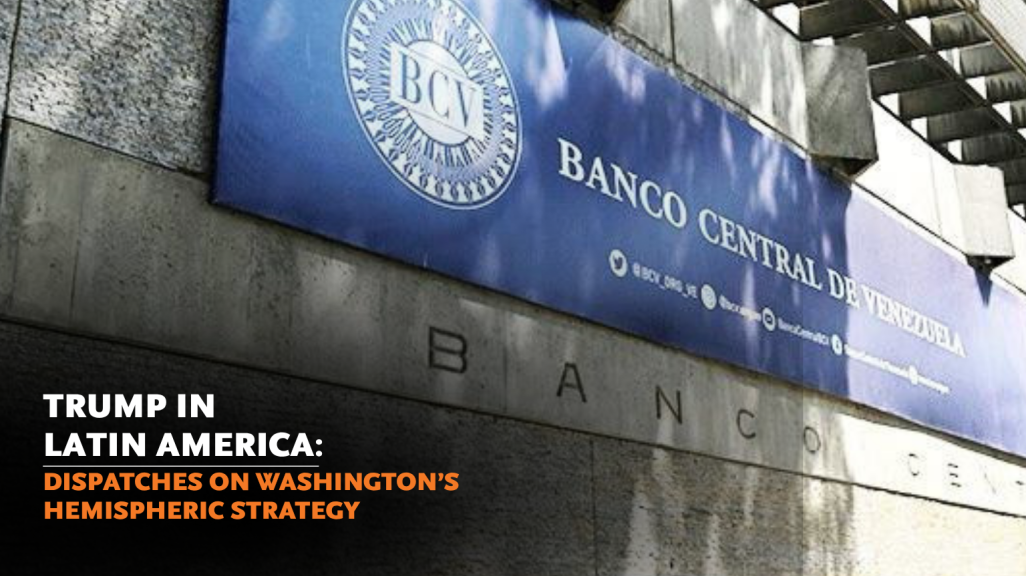
Central Bank of Venezuela. (BCV on Instagram)

Central Bank of Venezuela. (BCV on Instagram)

Trump in Latin America: A Brazil-ICE Row, Sanctions Lifted on Venezuelan Banks

By Chase Harrison , Luisa Leme and Khalea Robertson

April 10–16: Plus, Sheinbaum decries Mexican detainee deaths and Cuba's Díaz-Canel goes on U.S. television.

Welcome back to our weekly dispatch of stories on the U.S. role in Latin America. Follow us each week and see previous roundups at as-coa.org/dispatches, or sign up to receive them via LinkedIn

Here’s what to know this week: 

  • ICE arrests and then releases a Bolsonaro ally convicted for the 2023 coup attempt.
  • The U.S. Treasury lifts sanctions on Venezuelan financial institutions, including the Central Bank.
  • In other news: Mexico denounces migrant deaths, Costa Rica accepts third-country deportees, and Cuba’s president goes on NBC.
ICE Arrest and Release of Bolsonaro Ally, U.S.-Brazil Cooperation on Organized Crime

U.S. Immigration and Customs Enforcement (ICE) arrested fugitive Alexandre Ramagem, a former Brazilian intelligence officer and ex-congressman on April 13. Then, two days later, while Brazil’s government was seeking extradition, Ramagem was released.  

Ramagem, a close ally of former President Jair Bolsonaro, was sentenced to 16 years in prison in Brazil for participating in the 2023 coup attempt. Ahead of his sentencing last September, he fled to the United States on a diplomatic passport and has since been living in Florida. 

Allies of Ramagem say he was detained by ICE after a traffic infraction that led to immigration inquiries. Brazil’s Federal Police, however, said Ramagem’s arrest was a result of international cooperation between law enforcement, as his name was on Interpol’s wanted fugitives list. Brazilian law enforcement is meeting with U.S. authorities to understand the conditions of Ramagem’s release as Brazilian authorities were not informed of the decision. 

The Brazilian government submitted a request for Ramagem’s extradition back in December and President Luiz Inácio Lula da Silva said Ramagem should be brought back to Brazil “to serve his sentence.” Presidential candidate Flávio Bolsonaro said Washington should grant asylum to the former congressman.  

Days before, Brazil’s government announced a new partnership program with the United States to fight transnational organized crime. Project MIT—which stands for Mutual Interdiction Team—focuses on sharing intelligence to seize illegal weapons and drugs coming from the United States to Brazil. The program is a result of bilateral talks that started during tariff negotiations last year. Brazilian authorities say they have seized over 1,100 weapons in the last twelve months and 1.5 tons of drugs from United States in the first quarter of 2026.  

More Temporary Sanctions Relief for Venezuela

Washington continued to loosen sanctions on Venezuela this week when the U.S. Treasury issued temporary licenses that allow for U.S. citizens to do business with the country’s banking sector, including the Central Bank, removing restrictions that had been in place since 2019. With these sanctions lifted, these Venezuelan financial institutions will now be able to use U.S. dollars and partake in the global financial market. This will enable Venezuela to receive revenues from the sale of its oil by the United States, giving interim President Delcy Rodríguez a lifeline to try to stabilize the economy and attract more investment. One day before, Chevron increased its footprint in the country with an asset swap, growing its stake at one of its joint ventures with Venezuela’s state-owned oil company, PDVSA.  

Shortly after the decision, Rodríguez called for all sanctions on Venezuela to be lifted, and in a meeting with U.S. Chargé d’Affaires in Venezuela Laura Dogu and U.S Assistant Secretary of Energy Kyle Haustveit, she emphasized the temporary nature of the licenses. These licenses build on actions taken by the Treasury earlier this year to lift sanctions on PDVSA, as well as Rodríguez herself.  

Meanwhile Dogu, the top U.S. diplomat in Venezuela, stepped down from her post on April 15. She will be replaced by John Barrett, a foreign service officer who mostly recently was posted in Guatemala.

In other news: Mexico, Costa Rica, Cuba

Mexican President Claudia Sheinbaum on Tuesday decried the recent death of a Mexican immigrant in ICE custody, the fifteenth casualty since January 2025, and called for investigations. Still, the Sheinbaum government continues to work with its U.S. counterpart on issues including border security, migration, and trade, and, as AS/COA’s Carin Zissis points out to AP, global economic uncertainties “gives the U.S. and Mexico more reason to work together.”  

In support of the Trump administration’s deportation agenda, Costa Rica received 25 third-country deportees from the United States on April 11, the first of the weekly deportations agreed in a memorandum of understanding signed on March 23 (see March 26 dispatch).   

“If we’re in talks, it’s because we hope we can get a deal,” said Cuban President Miguel Díaz-Canel on April 12 in his first U.S. television appearance. In a 50-minute interview with NBC’s “Meet the Press,” Díaz-Canel said his government was willing to consider U.S. private-sector participation in the island’s ailing energy industry and also affirmed that Cuba was prepared to defend against a possible U.S. military attack. A day after, President Trump told reporters his administration “may stop by Cuba” once the war with Iran was “finished.” 

Related

Explore