Colombia center-right

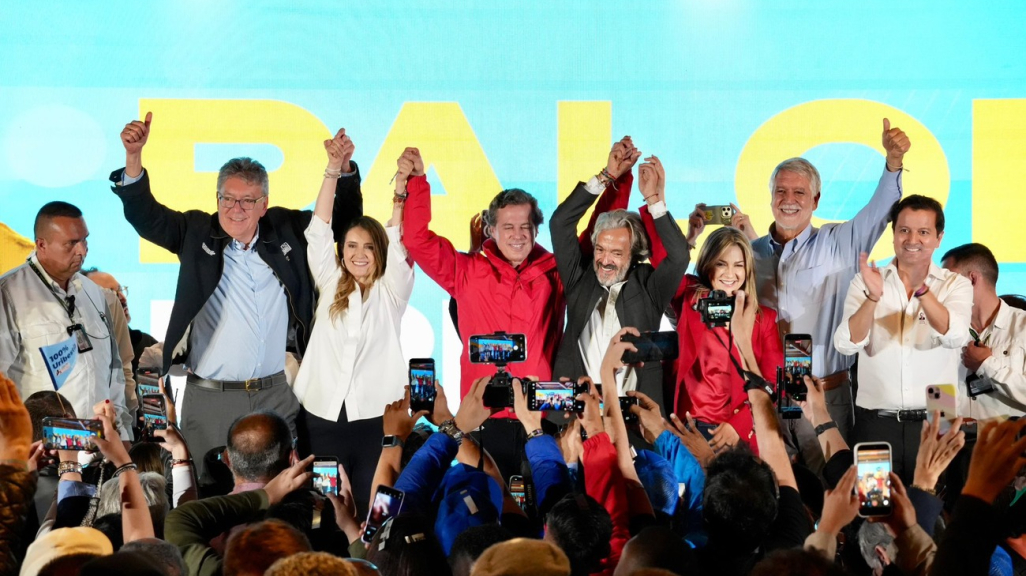
Center-right presidential pre-candidates celebrate primary election results in Colombia. (@PalomaValenciaL on X)

Four Takeaways from Colombia’s Legislative and Presidential Primary Vote

By Carin Zissis and Chase Harrison

Paloma Valencia’s win in the center-right coalition may reset the race, but the next government will need to build alliances in a fragmented Congress. 

There’s one thing we know for certain about Colombia’s 2026 electoral process: President Gustavo Petro can’t run again. But, as the March 8 presidential primaries showed, polls thus far may not be a safe indicator of who will take his place.  

In the Sunday vote, Colombians cast ballots in an inter-party competition to select the presidential candidates representing three coalitions: one each for the left, center, and center-right. Not only did conservative Senator Paloma Valencia exceed polling expectations, but her center-right coalition’s results proved voters may be looking for less polarizing options. Given that two of the top contenders, Iván Cepeda on the left and Abelardo de la Espriella on the far-right, skipped the primaries to go right to the May 31 first-round competition, will Valencia’s resounding victory end up resetting the race? 

On the same day as the primaries, voters also selected their next Congress, and the fragmented result means the next president will need to build alliances. While Petro’s party won the most seats in the Senate, the lower house's makeup was unclear and the time of this report, and no party was close to having a legislative majority.  
1. Paloma Valencia’s win changes the electoral balance

Based on numbers, the center-right coalition’s primary drew the most Colombians to electoral centers. No candidate did so more than the Democratic Center’s Paloma Valencia, 48, a close ally of former President Álvaro Uribe (2002–2010) and granddaughter of ex-President Guillermo León Valencia (1962–1966). Valencia, a senator since 2014, won 3.23 million votes, close to 46 percent of ballots cast across all three primaries. Overall, the center-right coalition won four of each five votes cast. 

In celebrating her win, which coincided with International Women’s Day, Valencia championed common ground in her coalition, saying: “United we made history and united we will have the first woman president of Colombia.” She coasted to victory on a platform focused on battling organized crime and proposing “a new Plan Colombia” with the United States.   

2. Juan Daniel Oviedo, the surprise of the primaries

Valencia wasn’t the only one who had a good March 8. Juan Daniel Oviedo, 48, defied polls to not only take second place in the conservative coalition competition, but also become the second-most voted contender of the day. Overall, he captured close to 18 percent of votes cast. His appearance at Valencia’s victory event drew shouts of “Vice! Vice!” for him to become her running mate.  

The cries were an echo of a 2022 presidential primary surprise, when Francia Márquez, an Afro-Colombian environmental activist, exceeded expectations to place second in the left’s competition, leading to her selection as Petro’s running mate. Oviedo, an economist, also has a compelling life story. Born into a middle-class family in Bogotá and openly gay, he suffered an accident as a youth that affected his speech and a later one that impacted his hearing. After heading Colombia’s statistic’s agency during the presidency of Iván Duque (2018–2022), he finished second as an independent in the capital’s 2023 mayoral race, earning a seat on the city council.

As of the time of publishing, it was not clear whether Oviedo would become Valencia’s choice of running mate. The technocrat centrist indicated to Semana in an interview that such a move would require coming to agreements on issues such as security policy. 

But winning over his backers could be a path to presidential victory. Oviedo captured well over double the vote count earned by Claudia López, 56, winner of the centrist primary. López, a former Bogotá mayor (2020–2023) and senator (2014–2018), won just 575,000 votes. A candidate who can win over Oviedo’s support could also deal a blow to Sergio Fajardo, 69, the former Medellín mayor who didn’t participate in a primary but is still pitching himself as the centrist option in the first round.   

3. The primaries complicate two frontrunners’ paths

Neither of the two top polling candidates competed in Sunday’s primaries, though the results could affect both their standings. 

Poll leader Iván Cepeda of Petro’s Historic Pact coalition was originally slated to compete in the leftist Front for Life primary, but the National Electoral Council disqualified him from doing so last month. Instead, Roy Barreras—a former senator, ambassador, and peace deal negotiator—won on Sunday, though his coalition’s primary had the lowest participation of any of the three contests. Barreras blamed the low turnout on Petro, saying he discouraged Colombians from casting primary ballots. Still, the overall turnout rate of 48 percent was relatively in line with past legislative elections. Barreras, whose candidacy has Márquez’s support, has given no indication he will drop out to support Cepeda. 

Meanwhile, Valencia’s strong showing in the right-wing primary creates hurdles for Abelardo de la Espriella, a far-right lawyer who models himself after presidents like Argentina’s Javier Milei and El Salvador’s Nayib Bukele.   Valencia now presents a viable option to the voters on the right and those in opposition to Petro.   

In the Senate vote, de la Espriella’s National Salvation Movement netted 3.6 percent of the vote, or five seats, barely reaching the threshold for representation, and underperforming its stated goal of ten Senate seats.  

4. No matter the president, Congress will be fragmented

Voters selected all 183 members of the House of Representatives and 103 seats in the Senate. That’s fewer seats than in the last session of Congress with the expiration of five seats in both houses guaranteed to former FARC guerillas by the 2016 peace agreement. Comunes, the party of the ex-FARC members, competed in this election, but failed to win seats and fell below the minimum threshold to maintain its party registration.

In the Senate, Petro’s Historic Pact netted 25 seats, five more than their current allocation. Valencia’s Democratic Center will be the second-biggest force with 17 seats, up from 13, followed by the Liberal Party (13 seats), Conservative Party (11 seats), the Party of the U (9 seats), and the Green Alliance (11). While Valencia performed well in the presidential primaries, Uribe, one of her key political mentors, failed to win a Senate seat, marking his first loss in a national election. 

At the time of this report, it was unclear who would control the House of the Representatives. The Democratic Center was the most-voted party in that chamber, winning about 13.5 percent of ballots cast. It was followed by the Liberal Party with 11.1 percent, the Conservative Party with 10.4 percent, and the Party of the U with 5.5 percent. The Historic Pact, which won the most Senate seats, won 4.82 percent of House votes. While these are national vote totals, 161 House seats are distributed by contests in each department and final seat counts were not available at the time of publication. The other 22 seats are distributed among special groups, including victims of conflict, indigenous Colombians, Afro-Colombians, and Colombians abroad. 

Legislators serve four-year terms and will be inaugurated on July 20, three weeks before the new president assumes office.   

Related

Explore