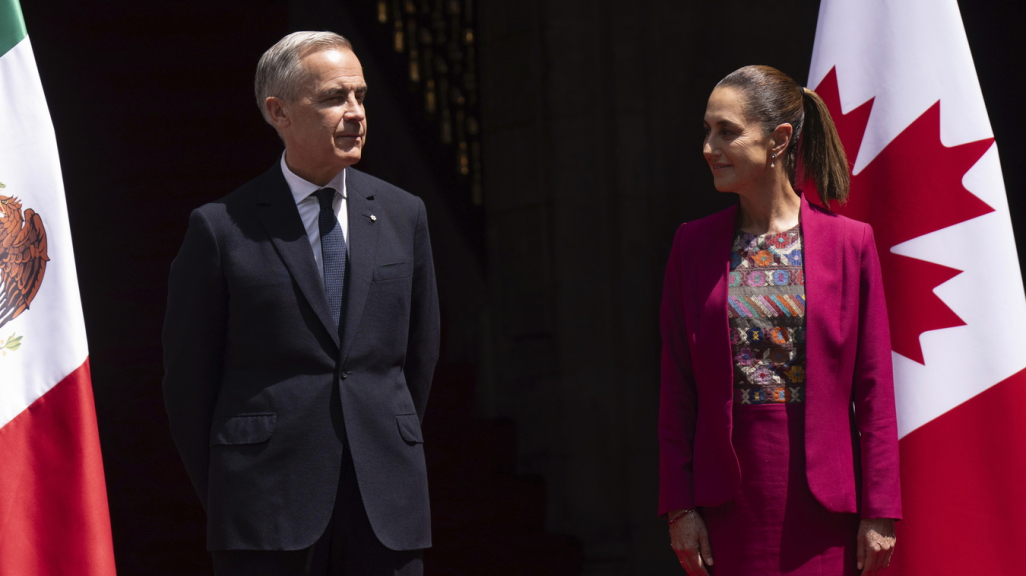
Canadian Prime Minister Mark Carney and Mexican President Claudia Sheinbaum. (AP)

Canadian Prime Minister Mark Carney and Mexican President Claudia Sheinbaum. (AP)

Share

Q&A: UNAM's Solange Márquez on What the U.S.–Canada Trade War Means for Mexico

By Carin Zissis

The Toronto-based analyst covers Ottawa and Mexico City’s distinct approaches to negotiating with the Trump administration.

Ottawa and Washington reached a trade impasse on August 21, leading Canada to slap tariffs on $20 billion worth of U.S. goods Tuesday in retaliation for U.S. tariffs announced in July. The standoff also leaves bilateral progress on the USMCA review with the United States’ second-biggest trade partner in limbo.

Image
Solange Marquez

“The actions undertaken by Washington in the last 18 months have taught Canada that the United States is not an ally that they can trust anymore. And that’s changing Ottawa’s strategy,” says Solange Márquez, a law professor at the National Autonomous University of Mexico and a fellow at the Canadian Global Affairs Institute, adding that, Prime Minister Mark Carney has taken a hard line against concessions. “Whenever the White House attacks Canada and Carney responds in a tough way, his approval ratings go up.”

In this Q&A with AS/COA’s Carin Zissis, the Toronto-based analyst explores the distinct ways Ottawa and Mexico City have handled trade talks with Washington, explaining that, despite the fact that Mexico has trade deals with more than 50 countries, “the Mexican government has been less interested in diversifying its economy.”

Could the U.S.–Canada divisions change Ottawa’s Mexico ties? Márquez identifies opportunities, but cautions: “Mexicans and Canadians see each other through the lens of Washington.”

Carin Zissis: Canada has just announced retaliatory measures against the United States, leading to a tit-for-tat series of tariffs taking effect in the next couple of weeks. Trump has also threatened 50 percent tariffs on Canadian autos and steel for January.

Considering that longer-term threat, do you think that Trump is looking to bring Canada back to the negotiating table? And do you think Ottawa would be willing to show up?

Solange Márquez: Well, from the side of Ottawa, I think the Canadians will be willing to go back to the table, but only with some conditions. The first condition is the respect and the reliability of the United States. The actions undertaken by Washington in the last 18 months have taught Canada that the United States is not an ally that they can trust anymore. And that’s changing Ottawa’s strategy.

Once they knew about the new tariffs, they immediately followed up. As I have been reading and talking with people here, the Canadian government tried to reach their counterparts in Washington and that's how finally the negotiations started because in the last months, Mexico has sat for three negotiation rounds with Washington while Canada has been completely left out of the table. This was the first time they have sat down for negotiations and it was because Canada pushed for it. It shows the willingness of Canada to be at the table with good faith for negotiations.

How are U.S. actions being viewed from Canada? Some Canadian politicians, specifically in the opposition Conservative Party, hold the view that maybe the United States is not interested in pursuing a free trade agreement anymore—emphasis on free. Canada and Mexico have been negotiating on an agreement that includes tariffs, so in that sense, it’s not free anymore.

Zissis: It’s interesting you point that out. Before we even had NAFTA in 1994, the United States and Canada had a trade agreement that that was signed in 1988. So we're almost 40 years later looking at this big shift in that bilateral relationship.

Let's get to Mexico. In the wake of the collapse of U.S.–Canada talks, Mexican President Claudia Sheinbaum has sounded optimistic about reaching a deal with Washington. What's your view? How does this trade war affect Mexico's negotiating position with Washington?

Márquez: Canada and Mexico have been following different strategies. Canadians have been much more confrontational, trying to stand up for their own issues. And the strategy from Ottawa has also been to diversify their economy, to shift from their dependency on the United States.

On the other hand, the Mexican government has been less interested in diversifying its economy despite the fact that it already has trade agreements signed with different 52 countries or regions of the world.

There are also differences with each country’s approach to appeasement. Canada has been firm about not bringing internal or domestic decisions to the negotiation table. That’s different from Mexico, which has negotiations dependent on migration issues and security issues. The “good relationship” between Sheinbaum and Trump is not just because they have good chemistry and a good friendship; it is because Mexico has been saying yes to everything. The government has been saying everything is good, everything is going fine, but they are not saying what Mexico is going to have to offer to have an agreement, which could include concessions in the automotive sector or other sectors that are crucial for Mexican economy.

What we as Mexicans may need to learn from what is happening with Canada is that even if you sign an agreement... We have an agreement already and it has been violated many times. You can have an agreement and the next day, the U.S. president can impose a new tariff and you have to sit again at the table.

Zissis: You spoke about how there is this different approach with Canada and Mexico and how Carney and Sheinbaum have each had distinct approaches. With Carney, it's been a situation of drawing a line. With Sheinbaum, we are seeing the government offer concessions. But both Carney and Sheinbaum have been framing their relationship with Washington in terms of their national sovereignty.

Why have we seen confrontation in the case of Canada's approach and restraint in the case of Mexico's approach?

Márquez: In Canada, when ex-Prime Minister Justin Trudeau left government and people voted for Carney, part of the reason why they voted for him was because they were expecting someone to be tougher on Donald Trump. And something that you can see in the polls is that whenever the White House attacks Canada and Carney responds in a tough way, his ratings go up.

The issue of sovereignty also factors into Mexico’s approach but in a different way. The United States has accused Mexican politicians, including a governor and senator from Sheinbaum’s party, of having links to the cartels and Sheinbaum does not want them to go to the United States for trial. So in order to keep them on Mexican soil, her government is going to be much more in agreement with the Trump administration. This situation could be weakening the ability of the Mexican government to negotiate on equal terms with the U.S. government.

Zissis: What about Canadian–Mexican relations? Given in particular what just happened between Ottawa and Washington, where does Mexico fit in terms of Canada's foreign economic policy? Will there be an impact on bilateral relations between Canada and Mexico?

Márquez: Both Sheinbaum and Carney have been working on trying to deepen the relationship. We saw the biggest Canadian commercial mission to Mexico recently, for example, and another huge commercial mission coming from the Mexico to Ottawa. I think there is interest in stronger commercial ties. For example, Mexico has the opportunity to export some agricultural products to Canada that it used to get from the United States, especially in winter.

The problem is that they are competitors for some of the crucial sectors for both economies, especially in autos. And there are some opportunities, but unfortunately, the relationship between Canada and Mexico is very related to what is happening in Washington and with USMCA.

The other issue that I see complicating the bilateral relationship is that we don't really know each other. Mexicans and Canadians see each other through the lens of Washington. Canadians do not really understand Mexican culture. Mexicans do not really understand Canadians. They see Canadians as cooler Americans.

I’ve had the opportunity to be here in Canada for almost eight years and the biggest problem I see is that neither Canadians nor Mexicans are interested in knowing each other deeper. I had the opportunity to coordinate a book two years ago with people who had been working on the bilateral relationship between Canada and Mexico for more than two decades. And the more time these people I talked to have been working on the Canada-Mexico relationship, the more they say there is just not interest.

Things might change, but that's a big impediment to the bilateral relationship.

Zissis: We've got talks coming up between Mexico and the United States in Washington that are expected in September. I'm sure we'll see shifts happening in relations between the United States and Canada. What are you going to be looking for in the coming weeks when it comes to North American ties and relations?

Márquez: In the automotive sector and steel and aluminum, I expect to see the private sector in the United States show up more because they are the most affected. They will have a lot of troubles if these 50 percent tariffs start in January, given many auto parts enter the United States, go to Mexico, and then go to Canada. So the logistics of these auto parts is so complex that these tariffs will cost them a lot.

This interview has been edited for length and clarity.

Related

Explore