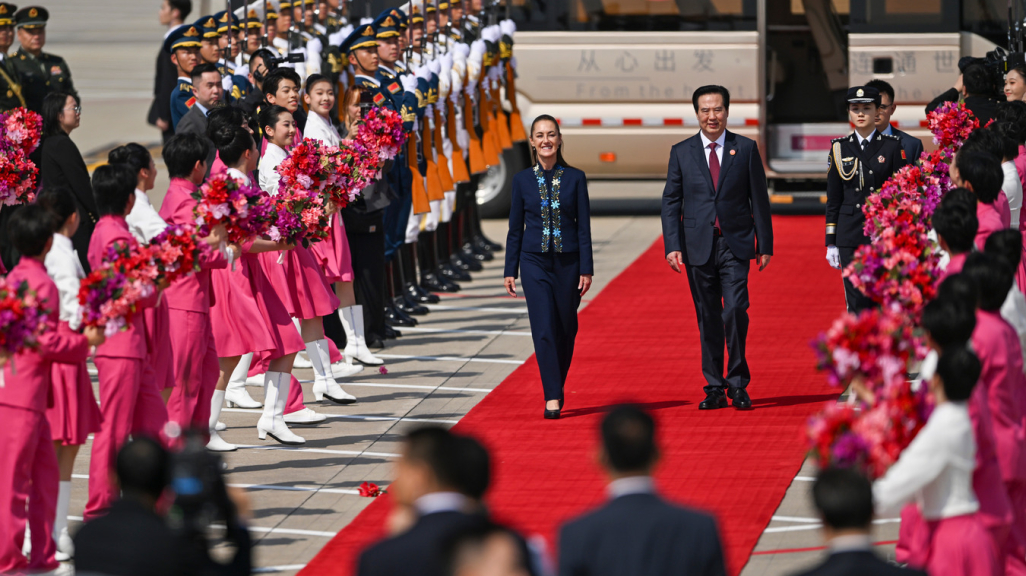
Mexican President Claudia Sheinbaum arrives in China. (AP)

Mexican President Claudia Sheinbaum arrives in China. (AP)

Latin America at APEC: Mexico, Peru, and Chile Take Trade Talks to China

By Khalea Robertson and Carin Zissis

Under the shadow of a U.S.–China rivalry, three of the region's largest economies are in Shenzhen to tighten commercial relations with Pacific partners.

From a spy scandal hitting the U.S. tech sector to energy shakeups sparked by the Iran conflict, the 21 countries convening in Shenzhen, China this week face a turbulent global scenario. As such, all eyes will be on a trilateral Wednesday meeting that brings together host, President Xi Jinping, and his U.S. and Russian counterparts, Donald Trump and Vladimir Putin.

But, in the meantime, attending leaders assembled from Asia-Pacific Economic Cooperation (APEC) countries, who together account for more than 60 percent of global GDP, are hammering out deals and working through ways to collaborate on the sidelines of the November 18 and 19 summit. APEC counts three Latin American countries among its membership and their presidents, Claudia Sheinbaum of Mexico, Keiko Fujimori of Peru, and José Antonio Kast of Chile, are taking part at a time when the region finds itself in the middle of a Sino-U.S. tug-of-war for influence. Mexico, the next Latin American country to host APEC in 2028, is working through that triangular tension as it seeks to make headway on USMCA trade negotiations with Washington, its top trade partner.
Mexico navigates being in the crosshairs of U.S.-China tensions

President Sheinbaum doesn’t stray too far from home. Up until this week, she had taken just seven trips abroad in the two years since she took office. Of those, two involved World Cup events. Except for a transatlantic trip to Spain in April, the remainder have all been in the Americas. Her predecessor, Andrés Manuel López Obrador (2018–2024), has had a mantra her party follows: “The best foreign policy is domestic policy.” 

Still, Mexico is party to trade agreements with 52 countries. Geopolitics intrude, as they have for the Sheinbaum government, which finds itself navigating the great power rivalry between Washington and Beijing. Amid pressure from Washington over the possibility that China is taking advantage of USMCA to funnel goods through Mexico into the United States, the Mexican government earlier this year implemented tariffs of up to 50 percent on close to 1,500 products from mostly Asian countries with which Mexico does not have trade pacts—China included. Beijing responded by warning Mexico to “correct its wrong practices of unilateralism and protectionism.” 

But fast forward to November 17 for Sheinbaum and Xi’s handshake in Shenzhen, and those tensions seemed bygone. López Obrador never traveled to China, meaning Sheinbaum’s visit is the first trip by a Mexican president there since 2017. She celebrated the meeting with her counterpart with a post on X that went out at 3 a.m. Mexico City time with a declaration of “a new era of cooperation in the development of Mexico-China relations.” But tariffs haven’t had much of a dent in trade anyway; the value of Mexican imports of Chinese goods rose 13 percent year-on-year in the first nine months of 2026. 

Of course, even if China is Mexico’s second-biggest trade partner, Washington dominates Mexico’s trade relations. On Friday, a day before Sheinbaum headed to the airport for her commercial flight to APEC, U.S. Ambassador Ronald Johnson took to X to note that 83 percent of Mexican exports are U.S. bound compared with only 2 percent headed for China, adding that the Asian giant “floods the Mexican market with cheap imports.” 

Sheinbaum told reporters her meeting with Xi was “very frank, very cordial” and involved talk of boosting Mexican exports, “from avocados to tequila.” She also used her trip to present a $432 billion infrastructure plan to Asia-Pacific business leaders at the APEC CEO Summit,  as well as meeting with leaders such as her other USMCA counterpart, Prime Minister of Canada Mark Carney to talk trade, security, and investment. Meanwhile, Sheinbaum, who will have a brief sideline meeting with Trump on Wednesday, still finds her government in trade-talk limbo with Washington, given that USMCA has fallen into an annual review process and bilateral talks drag on.

Trade and El Niño aid lead Peru's APEC agenda

Fujimori’s APEC attendance marks her third international trip since her July 28 inauguration and takes her to Peru’s most important trade partner of the last 15 years. More than a third of the Andean country’s international trade is with China and Peru is the second-largest recipient of Chinese investment in Latin America, after Brazil.

Ahead of the leaders’ summit, Fujimori met with Xi on November 17 to discuss strengthening these close commercial ties, which were bolstered by a November 1 update to a 2010 bilateral free-trade agreement that updated guidelines on e-commerce, global supply chains, rules of origin, and trade in services. Xi also made a $22.5 million commitment in money and machinery to aid in Peru’s El Niño preparations.

While in Shenzhen, Fujimori has sideline talks planned with attendees, including Kast and Sheinbaum. In the latter case, it will be the first time the two female presidents meet and comes after the August restoration following a nine-month freeze. That breakdown was sparked by Mexico granting political asylum to former Peruvian Prime Minister Betssy Chávez (2022), who faced a prison time for her role in a 2022 failed coup. 

After the summit, Fujimori jets off to Tokyo to sign bilateral cooperation agreements on disaster response, agriculture, and critical minerals with Japanese Prime Minister Sanae Takaichi, a fellow APEC leader. 

Chile plugs its critical minerals to Asian partners

“They are our main trade partner, and we value ... [this relationship],” said Kast after his November 17 bilateral meeting with Xi, which Kast described as “frank, pleasant, and relaxed.” For his part, Xi pushed for expanding cooperation in deep-sea exploration and AI, while building on existing collaboration in infrastructure and mining. 

Chile is home to the world’s largest reserves of both copper and lithium, two resources key to sustaining global tech manufacturing and powering the energy transition. About half of Chile’s copper exports and more than 70 percent of its lithium go to China. Speaking at the APEC CEO Summit, also on November 17, Kast promoted Chile’s role in the global AI industry, not only as a critical minerals source, but also its processing and tech manufacturing capabilities. 

This year, Chile and China celebrated 20 years of having a free trade agreement, which was Beijing’s first in Latin America, and ten years of a Comprehensive Strategic Association involving tech, education, and cultural cooperation. The two countries committed to deepen ties with a “roadmap for economic cooperation” and a memorandum of understanding on free trade and multilateralism, both signed by Chilean Foreign Minister Francis Mackenna, who accompanied the president to Shenzhen. 

Kast’s trip to Asia will also take him to Vietnam and Japan, which, like all of Latin America’s APEC members, are also party to the Comprehensive and Progressive Agreement for Trans-Pacific Partnership. 

Related

Explore