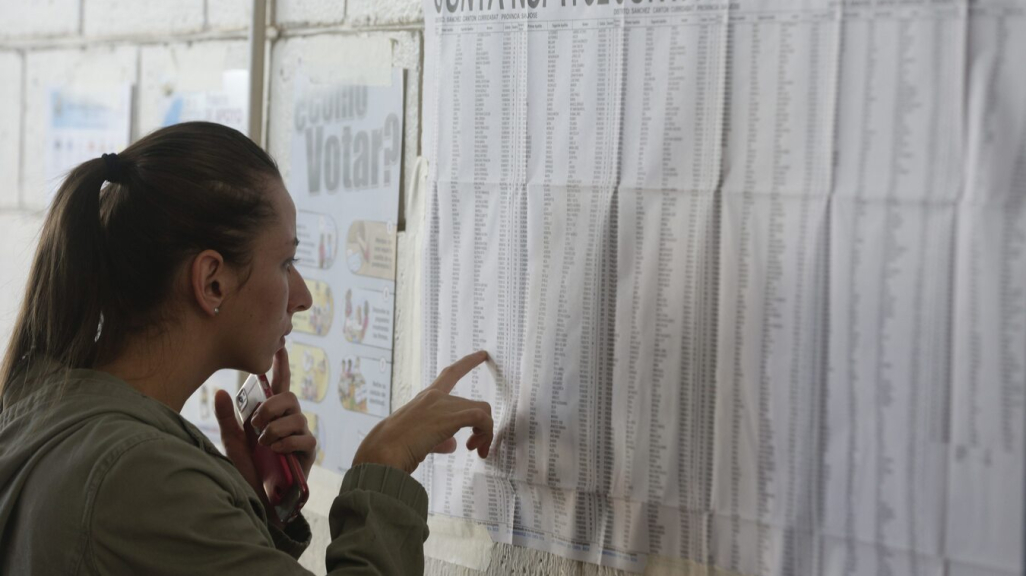
A Costa Rican looks up her voting table. (AP)

A Costa Rican looks up her voting table. (AP)

Four Questions Driving Costa Rica's Presidential Race

By Chase Harrison

Laura Fernández, running to continue President Rodrigo Chaves’ agenda, may win in the first round of a February 1 election marked by insecurity woes.

On January 13, just weeks before the country’s February 1 presidential and legislative elections, authorities in Costa Rica announced they had uncovered a plot to assassinate President Rodrigo Chaves. It was a shocking moment that only heightened political tensions in a country experiencing an uncharacteristic rise in violence in recent years.

How to address that violence—and issues like economic inequality—are central to this year’s election, as is Chaves’ high approval. His candidate in the race, Laura Fernández, is polling ahead in a field of 20 candidates with her pitch to continue his agenda.

AS/COA Online explores four questions shaping the race for the country’s 3.7 million voters.

What’s driving Laura Fernández's poll lead?

Polling shows one clear leader: Laura Fernández of the Sovereign People's Party (PPSO). She hovers around the 40 percent threshold needed to avoid a second round, slated for April 5.


Fernández, Chaves’s former chief of staff, calls herself the “heir” to his movement. A recent poll from CIEP places his approval at 58 percent, which is the highest of any president in Costa Rican history just before an election. Not only has Chaves presided over economic growth above regional averages, but he also advanced a personalistic style of politics.

That was present in his populist 2022 campaign for the presidency, when he ran as an outsider in opposition to Costa Rica’s traditional political parties In office, the battle between Chaves on one side and the opposition and institutions on the other has defined his presidency. With his party holding eight of the 57 seats in the country’s unicameral Congress, Chaves has struggled to push through his agenda, which he has blamed on “the enormous obstruction” of opposition legislators, judges, and bureaucrats.In fact, he’s faced two unsuccessful congressional attempts to strip his presidential immunity. Chaves has tried to pursue reforms in other ways, though a national referendum on many of his proposals was blocked by the courts.

Fernández hopes to pick up the baton from Chaves and plans to appoint him to her cabinet. Her platform, titled “Continuity Plan: More Opportunities, the Same Direction,” echoes his proposals and, on the campaign trail, she replicates his populist style.

With the goal of avoiding the institutional clashes Chaves has faced, Fernández is calling on voters to deliver at least 40 congressional seats to her party, which would allow for constitutional amendments and Supreme Court selections.

Can another candidate break through?

Ahead of the election, no other candidate has broken into double digits in polls, although 30 percent of voters said they were still undecided in a January CIEP survey. When the same pollster pressed undecided voters to choose, Fernández remained the top choice.

Aside from battling the headwinds of Chaves’ popularity, candidates representing traditional parties, like Álvaro Ramos of the National Liberation Party, or associated with political elites, like former First Lady Claudia Dobles, face anti-establishment frustration. So far, there’s been little effort among opposition parties to consolidate support around a single candidate, though that could change in a runoff.

Fernández is only participating in four of the 10 debates, minimizing opponents’ opportunities to directly confront her. Some candidates have even accused Fernández and her party of intimidating opposition supporters

Still, Costa Rica has had its fair share of electoral surprises. In 2018, Fabrizio Alvarado, an Evangelical pastor, defied expectations to win the first-round vote, only to lose the runoff. In 2014, Luis Guillermo Solis polled far from the front of the pack only to win the second round with the largest margin in Costa Rican history.

What will this election mean for the future of security policy in Costa Rica?

As in other parts of Latin America, security is a major election issue, with just over 40 percent of Ticos in a November poll naming it their top voter concern. Over the past five years, organized crime groups have driven up homicide and crime rates in the country. Chaves has taken action, instituting police reform, increasing port monitoring, and leaning into cooperation with the United States.

Then, on January 14, at a ceremony to open a maximum-security prison, Chaves hosted El Salvador’s president, Nayib Bukele, known for his hard-line approach to crime. Since 2022, Bukele has maintained a state of exception, which suspends civil rights to advance anti-crime measures, a move echoed the same year by President Xiomara Castro in Honduras and, as of January 19 this year, by President Bernardo Arévalo in Guatemala

Will Costa Rica follow in its neighbors’ footstep? Many candidates are proposing approaches that would heighten security measures. One candidate, Advance's José Aguilar, married to Bukele’s cousin, proposes a plan similar to that of the Salvadoran leader. Fernández, meanwhile, plans to complete the maximum-security prison and declare a state of emergency in high-crime areas

How will the election impact Costa Rica’s relationship with Washington?

U.S. Secretary of State Marco Rubio’s first trip abroad included Costa Rica, where he and Chaves covered bilateral cooperation in areas such as cybersecurity and migration. Costa Rica is among countries that have third-country removal agreements with Washington, and, in February 2025, the country accepted deportation flights with 200 people from a range of countries. 

The United States is also Costa Rica’s top foreign market and the destination for nearly half of its exports. To that end, it’s feeling the weight of Trump’s tariff policy, facing a 15 percent baseline tariff rate, higher than the 10 percent applied to much of Latin America, though Costa Rica did see some agricultural products exempted through a White House executive order in November.

Trump has also threatened to repeal the CHIPS Act, the Biden-era legislation that subsidizes Costa Rica’s semiconductor manufacturing. There’s also concern that tariffs could hit Costa Rica’s exports of medical supplies to the United States, valued at around $4 billion annually.

Then there’s the question of whether Trump will intervene in the election. While he made endorsements in 2025 Argentine and Honduran elections, he has yet to comment on Costa Rica’s vote. Fernández, for her part, worked on the bilateral relationship while in Chaves’ cabinet and Rubio called her a "very strong" ally in February. Analysts suggest a Trump endorsement may be more likely in a runoff scenario.

Related

Explore